Marketing teams spend significant time producing content without a structured plan to guide their efforts. Blog posts get published without clear audience alignment, social media updates go out without campaign context, and budgets get allocated to channels without data to support the decision. A content marketing plan closes these gaps by turning broad marketing objectives into a documented, actionable workflow the whole team can follow.
This guide walks through the essential components of a content marketing plan and shows how to build each one using PowerPoint templates. According to the Content Marketing Institute’s B2B Content and Marketing Trends: Insights for 2026, 97% of B2B marketers now have a content strategy, yet only 13% say its effectiveness improved significantly over the past year. Having a strategy is no longer what separates successful teams from the rest. Turning that strategy into a plan the team actually executes, measures, and revises is the key. For teams that need a structured starting point, content marketing plan templates for PowerPoint provide a pre-built framework that covers every section described in this guide.
What Is a Content Marketing Plan?
A content marketing plan is a documented framework that defines what content an organization will create, for whom, through which distribution channels, on what schedule, and against what performance benchmarks. It is the working document between a broad marketing strategy and the day-to-day work of a content team. Without this layer, content production tends to be reactive: shaped by what feels timely or easy to produce rather than by what an audience actually needs at a given stage of their relationship with a brand.
A practical content marketing plan does not need to be lengthy. Its value comes from being specific, actionable, and regularly reviewed, not from its page count. Teams that build their plans in PowerPoint benefit from a format that is easy to share in planning meetings, simple to update between cycles, and accessible to stakeholders who may not engage regularly with spreadsheets or project management tools.
Content Marketing Plan vs. Content Marketing Strategy
These two terms appear together often enough that the distinction between them gets blurred in practice, but they describe different levels of planning. A content marketing strategy defines the overarching goals, target audience, brand positioning, and competitive rationale for investing in content. A content marketing plan translates that strategy into a specific schedule of content items, channel assignments, resource requirements, and measurement criteria.
The strategy asks why an organization creates content and for whom. The plan asks what will be created, when it will be published, on which channels, by whom, and how success will be measured. Both are necessary. A strategy without a plan tends to remain abstract and unexecuted. A plan without a strategy tends to produce well-organized content that serves no meaningful business purpose.
For teams building their first content marketing plan, the most useful starting point is confirming that clear strategic goals and a defined target audience exist before diving into planning details. If those foundations are not yet documented, the first version of the plan will need to establish them alongside the operational components.
Key Components of a Content Marketing Plan
A content marketing plan typically spans several interrelated components, each feeding into the next. Understanding what these components are and how they connect makes it easier to build a plan that functions as a coherent whole rather than a collection of disconnected sections.
The plan begins with a situational analysis that reviews past performance, the competitive content landscape, and the organization’s current standing relative to its content marketing goals. From there, it moves into audience definition, which establishes specific profiles of the people the content is intended to reach. Next, goals and KPIs translate business objectives into measurable performance targets. With those foundations in place, planning shifts to the content itself: which topics to cover, which formats to use, and how to sequence content to support a buyer’s journey. Distribution planning determines which channels each piece of content will reach and at what cadence. The editorial calendar translates all of these decisions into a publishable schedule. Finally, a resource section addresses team capacity, budget allocation, and tool requirements. When these components are laid out visually in a presentation format, they become significantly easier to review and communicate. Our marketing plan presentation templates provide a pre-designed structure covering each of these components.
How to Build a Content Marketing Plan Step by Step
The process below runs in nine steps. The first four build the analytical base: a SWOT review of your current content, a definition of the audience the plan serves, measurable objectives, and a gap analysis of your existing assets. The remaining five turn that analysis into an operating plan covering content pillars, distribution, the editorial calendar, the roadmap and budget, and measurement. Each step produces at least one slide, so by the end, you have both the plan and the deck you will use to get it approved.
What Is Inbound Marketing?
Inbound marketing is the combined effort of promoting a company, brand, product, or service through internet channels such as ebooks, blogs, podcasts, videos, newsletters, SEO, social media, and other content channels to attract customers. Instead of the marketer searching for potential customers, inbound marketing brings customers to the website. Its guiding principle is to earn the customer rather than buy the customer.
Each of those channels depends on a steady supply of content that answers real questions, and that dependency is why inbound programs stall without a plan. Publishing volume keeps rising across every channel, so content produced without a defined audience, goal, and distribution route rarely gets noticed. A content marketing plan gives inbound efforts the structure they need to be measured, which lets the team calculate return on investment and defend the budget. If you are building an inbound program from scratch, the Inbound Marketing PowerPoint Template gives you a ready structure to present it.
Content SWOT Analysis
What Is SWOT?
SWOT is a popular management tool for analysis and decision-making. The word is an acronym for Strengths, Weaknesses, Opportunities, and Threats. SWOT analysis helps you understand the current situation and develop a positive strategy. The framework is simple: a 2×2 matrix (4 quadrants), where each cell represents one component of the SWOT acronym. Analyze this matrix jointly to identify the major components and visualize the relationships. You can learn more about this tool in our SWOT analysis guide.
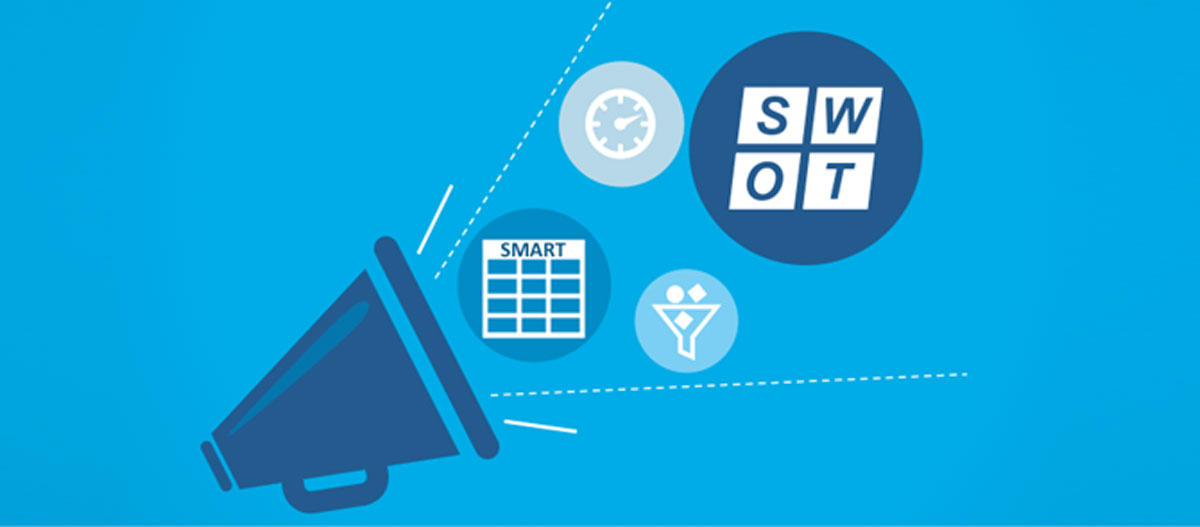
For a deeper understanding of the SWOT Analysis and a practical guide to creating it with professional SWOT PowerPoint Templates, you can review our previous post, “Best SWOT Analysis Templates for PowerPoint.”
Start with a Content Audit
A SWOT analysis built only on brainstorming reflects what the team believes about its content, which doesn’t always match what the numbers show. A short content audit before the SWOT session grounds the discussion in evidence. Export every published asset into a spreadsheet and record its URL, format, funnel stage, publication date, last update, organic traffic over the past twelve months, and any conversions it generated. Most teams find that a small group of assets drives most results, while a long tail of older pieces drives almost nothing.
Give each asset one of four verdicts. Keep the pieces that perform and remain accurate. Update the ones with good rankings but outdated information. Consolidate articles that cover the same topic and compete with each other in search. Retire content that no longer serves any audience or product. These verdicts feed directly into the SWOT matrix: strong performers become documented strengths, and clusters of outdated or overlapping content become weaknesses with a concrete fix attached.
Spend an hour on the competition, too. List the topics your top three competitors cover that you do not, the formats they use that you avoid, and the questions in your space that nobody answers well. Put those findings in the Opportunities and Threats quadrants. A competitive landscape slide is a practical way to summarize this comparison for the team before the SWOT workshop begins.
Current Content SWOT
The Content Analysis starts with a simple exercise: present the 5 major strategic strengths and weaknesses of your current content marketing efforts. It could be difficult on the first try, but the iterative approach, trying to reach the five points, is vital to analyze your knowledge about the marketplace and environmental situation. In essence, you need to set a title for what is working well and what is not working. This deep thinking will prompt the analyst, or group of analysts, to identify several levers that will allow fresh ideas in future steps of the process.
Teams that work remotely can run the SWOT session directly in a shared PowerPoint file, which works well as a common canvas. Our guide on how to collaborate in PowerPoint explains how to co-author slides and leave comments during the session.
Using “virtual” sticky notes in the PowerPoint Slide makes it easy to keep the previous ideas and track the evolution of the SWOT analysis. Also, printing the template in a poster and generating an Agile meeting, working with tangible paper, triggers interactions and creativity; take the suggestion and try it; it has a proven track.
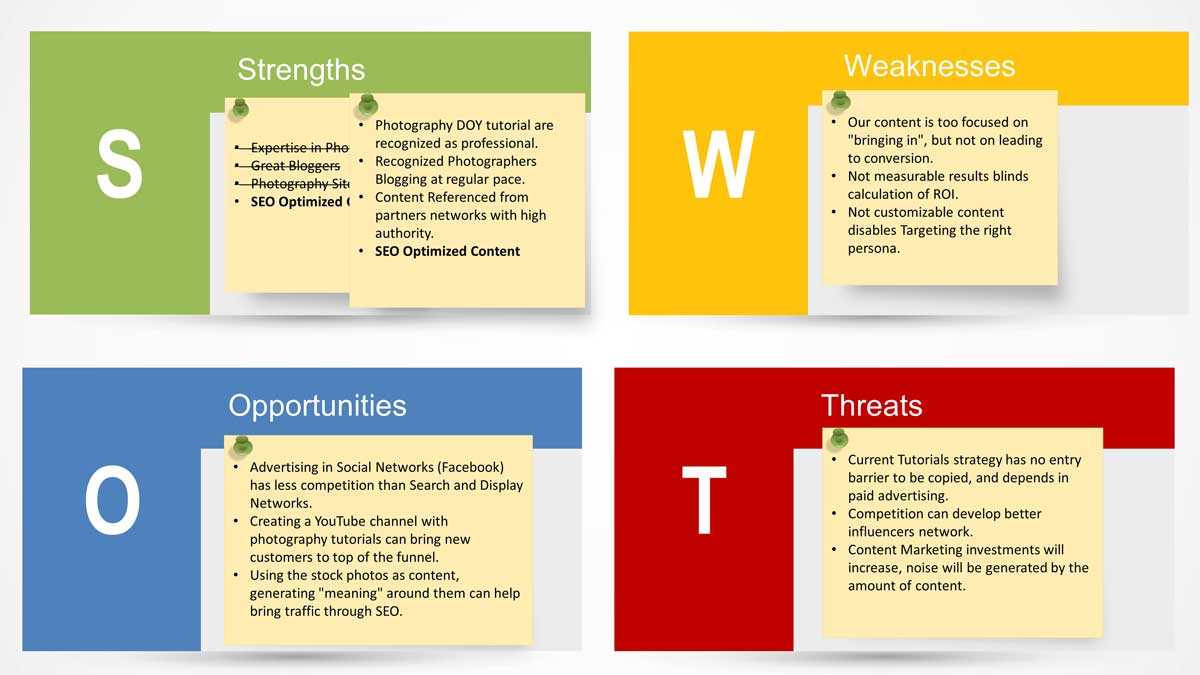
Let’s describe an example. Consider the “Stock Photo Business,” where a company sells pictures to its users. The content marketing SWOT could look like this after a couple of iterations. Look at the ideas and their evolution. The team starts to realize the effect of their content strategy. The PowerPoint Template shows, in one snapshot, the full team ideation and will be extremely easy to showcase later.
Strengths
- Expertise in photography -> Photography DOY tutorials are recognized as professional.
- Great Bloggers -> Recognized Photographers Blogging at a regular pace.
- Photography sites linked -> Content referenced from partners’ networks with high authority.
- SEO Optimized Content drives traffic.
Weaknesses
- Our content is too focused on “bringing in” rather than driving conversion.
- Results are not measured consistently, so ROI cannot be calculated.
- Content is generic, which makes it hard to target a specific persona.
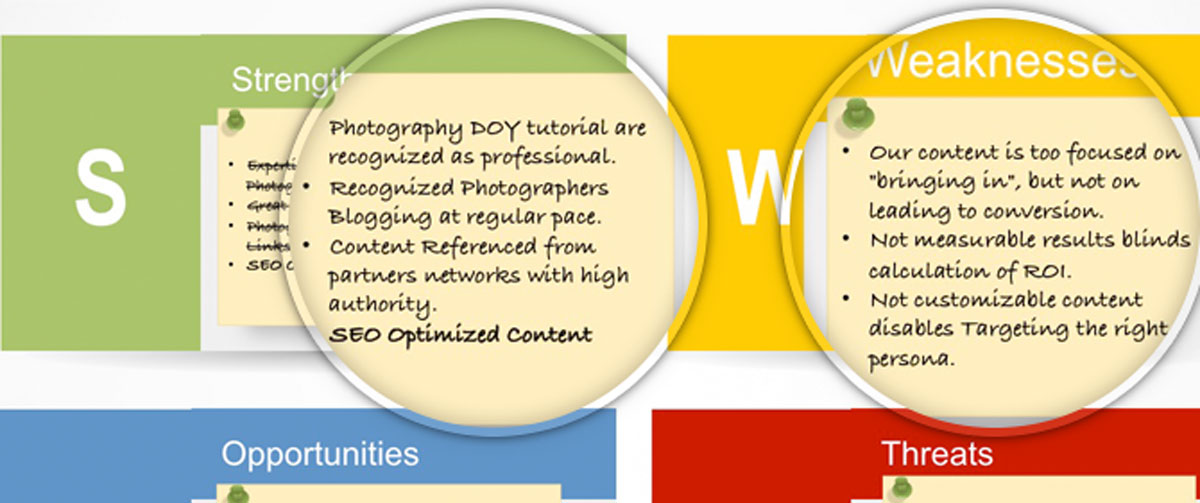
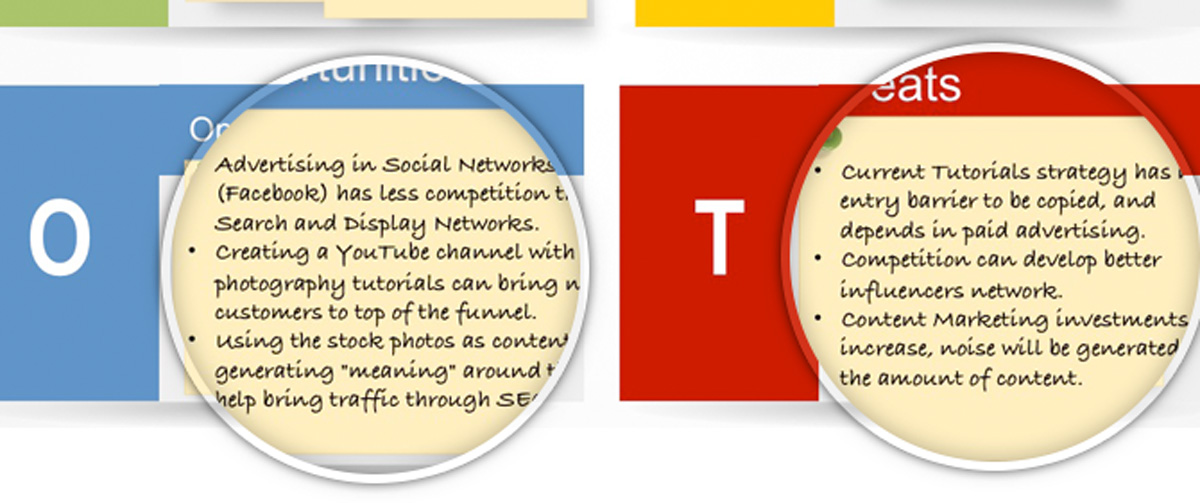
The second step moves to the Opportunities and Threats. At this point, the analysis has moved past the initial iteration that breaks the ice on ideas. Now, strategic thinking flows, opportunities are clearer, and potential threats are no longer hidden.
Opportunities
- Advertising on social networks (Facebook) has less competition than Search and Display Networks.
- Creating a YouTube channel with photography tutorials can bring new customers to the top of the funnel.
- Use stock photos as content and use a photo editing platform to improve them. Generating “meaning” around them can be used as one of the techniques to bring traffic through SEO, or alternatively, hiring Search Engine Optimization (SEO) services through an agency or SEO professional.
Threats
- The current tutorial strategy has no barrier to entry and relies on paid advertising.
- Competitors can build a stronger influencer network.
- Content Marketing investments will increase, and noise will increase as content volume grows.
Defining Tactics and Actions over the SWOT
Once the SWOT analysis is complete, summarize the exercise and create an actionable plan that uses it. Leveraging strengths, acting on opportunities, and addressing weaknesses protects your Content Marketing efforts against threats.
The following example applies to the SWOT Analysis described:
- Shift your photography tutorial approach toward photo editing to drive conversions.
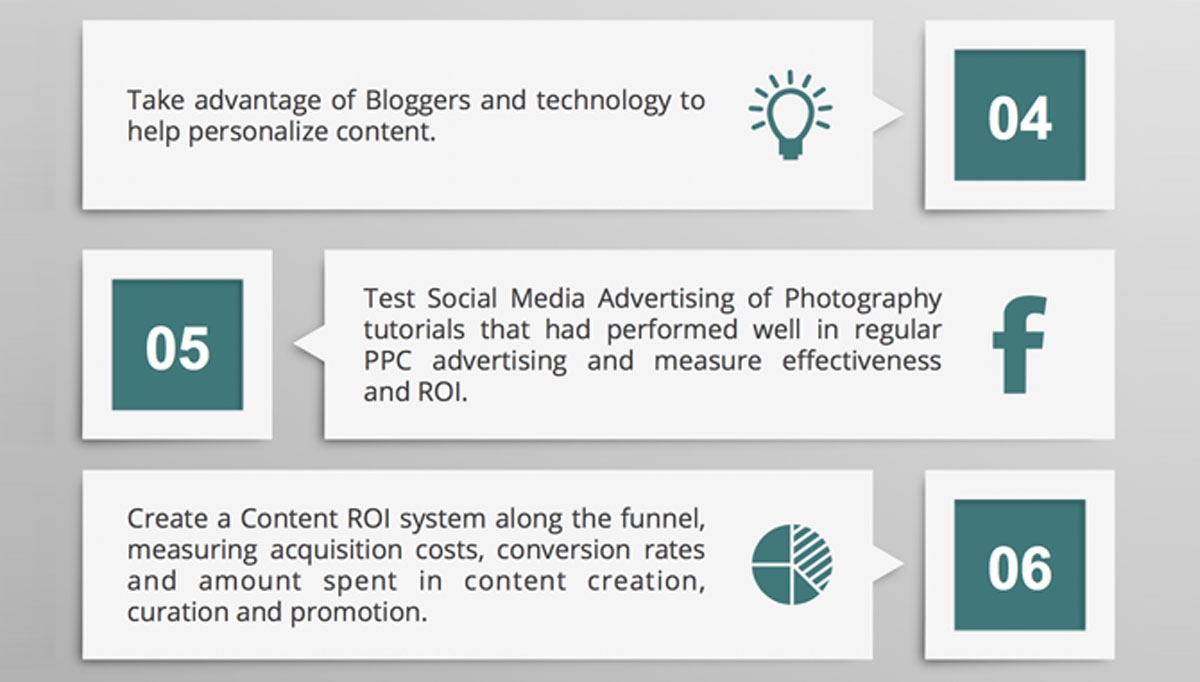
- Create a Content ROI system across the funnel that measures acquisition costs, conversion rates, and spend on content creation, curation, and promotion.
- Test social media ads for photography tutorials that have performed well in regular PPC, and measure effectiveness and ROI.
- Create a YouTube channel of free photography tutorials powered by the partner’s network.
- Develop an Affiliate program for influencers to build loyalty.
- Leverage bloggers and technology to help personalize content.
- Consider offloading some of your content marketing responsibilities by outsourcing them to an external SEO agency.
Use one of our Text & Tables PowerPoint Templates in order to present the plan clearly and visually and add it to your deck.
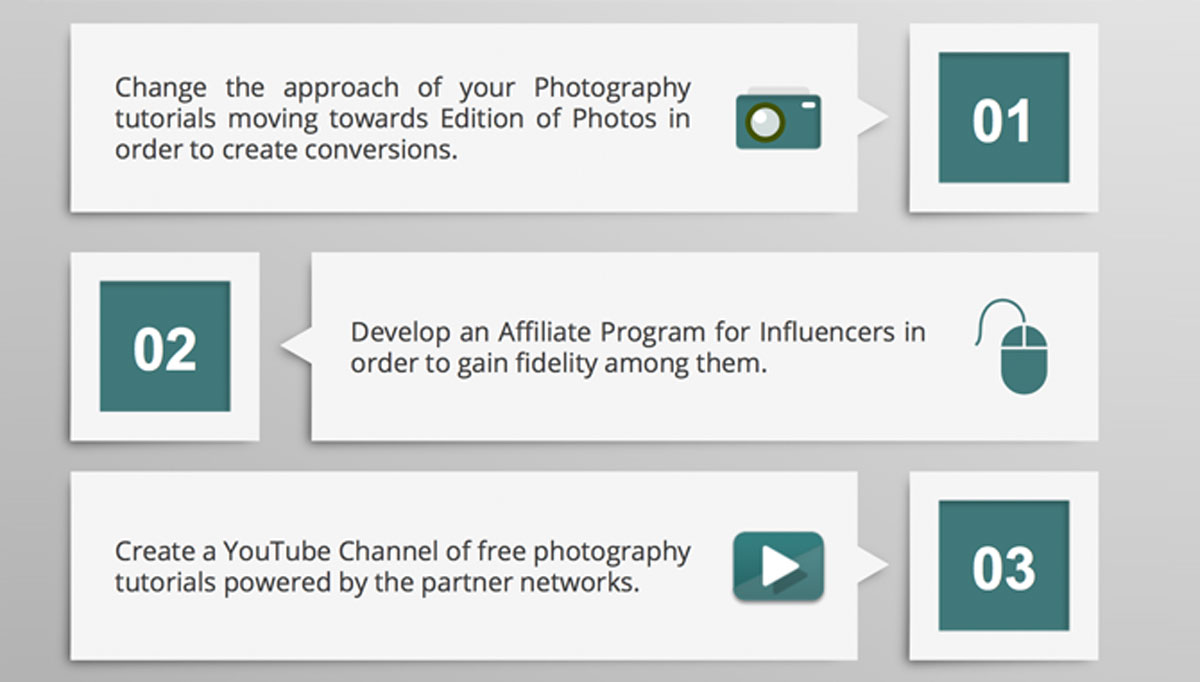
Each of the sections describes the Actions that the plan will execute. This template clearly presents the ideas, catalogs them with an ID number, and visually engages the audience with top-of-the-line PowerPoint Icons.
Define Your Target Audience and Buyer Personas
Audience definition is one of the most consequential decisions in a content marketing plan, and it is also one of the areas where plans most commonly remain too vague to be actionable. Statements like ‘our audience is marketing professionals’ or ‘we target mid-market companies’ describe a segment but not an audience. Effective content planning requires more specificity than a segment description can provide. A buyer persona is a semi-fictional profile, built from research, that represents a key decision-maker or influencer in your target audience. It captures not just demographics and job title but the professional challenges that person is trying to solve, the questions they ask at each stage of the buying process, the content formats they prefer, and the channels where they are most likely to engage.
For B2B marketing teams, a single buying decision typically involves multiple personas: an end user who evaluates fit, a manager who approves the investment, and a finance or procurement contact who reviews terms. Each profile requires different content at different stages. An end user may engage primarily with how-to guides and product comparisons. A manager may prioritize ROI data and case studies. A finance contact may respond to pricing breakdowns and vendor comparison frameworks. Building persona profiles for each role creates a content plan that serves the full buying committee, not a single, generalized audience.
Building useful personas requires primary research wherever possible. Short interviews with current customers, sales team debrief sessions, and analysis of support ticket themes all produce audience data that reflects real behavior rather than assumptions. Even three or four solid customer interviews can surface recurring language and concerns that fundamentally shift how a content team frames its topics and headlines. Our buyer persona analysis framework provides a structured format for presenting these profiles in a way that is accessible to both marketing and sales teams. Linking to the target audience guide gives teams an additional resource for segmenting their audience before finalizing personas. Once personas are documented, every subsequent planning decision, from topic selection to format choice to channel prioritization, can be tested against whether it serves the documented audience.
Define Content Marketing Objectives and Key Performance Indicators (KPIs)
After the analysis stage, the next step is to define the objectives that map to the actions described previously. For each objective, define a key performance indicator (KPI) to measure progress toward achieving it. This methodology is the basic foundation of the strategic approach to Content Marketing. It provides visibility to understand whether the content marketing plan is on track.
RACE Framework
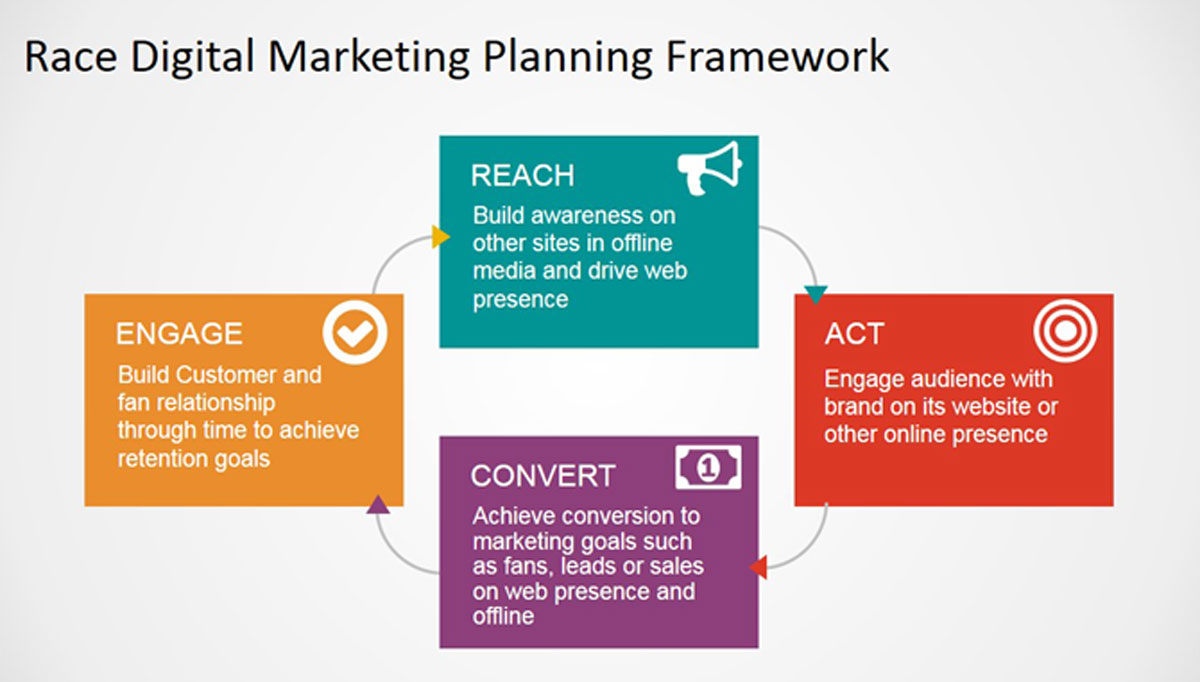
To define clear objectives for your content marketing, map them through the marketing funnel. To follow this approach strategically, we will use the RACE Digital Marketing Planning Framework. The RACE framework covers the four main stages of the customer lifecycle along the marketing funnel. The RACE Acronym states:
- Reach: Build awareness and drive visits.
- Act: Engage the audience with the brand. Interaction and Visits.
- Convert: Achievement of marketing goals.
- Engage: Build Customer Loyalty.
In each RACE Stage, define the objectives and KPIs. For this purpose, we will use the second management tool: the SMART objectives goal-setting framework.
SMART Objectives
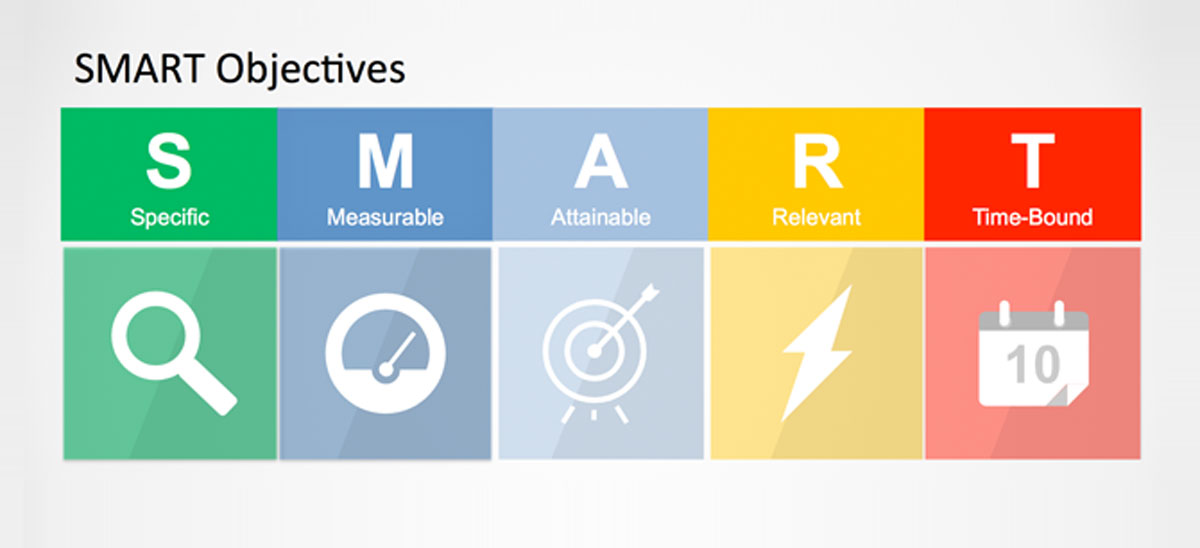
SMART is a management acronym generally used to guide goal-setting across different management areas (projects, business, strategies, etc.). Following the SMART principles increases the chances of success. The meaning of the SMART Goals acronym is as follows:
- Specific: The goal needs to be as specific as possible. It must be clear and unambiguous. A specific goal is short, crisp, and concise. Specific Goals always answer the 5 “W” questions (What, Why, Who, Where, Which)
- Measurable: If You Can’t Measure It, You Can’t Manage It. Goals need to be quantifiable. Progress towards achievement must be measurable.
- Attainable: Goals need to be possible in a realistic scenario.
- Relevant: Goals need to matter. Managers can choose infinite goals, but only a few will matter.
- Time-bound: The goal needs to be achievable within a planned time frame.
Teams that already set goals with OKRs can use the same process, writing each key result to meet the SMART criteria. Our OKR framework guide explains how objectives and key results fit together.
How To Work With the RACE and SMART PowerPoint Templates?
As with the SWOT template, we will explain how to use PowerPoint templates to guide users’ strategic thinking in an ordered, structured way. The process continues from where it left off: the action plan, and the RACE framework PowerPoint template is placed on the board. The Template provides a matrix with 4 rows, each row representing a stage of the customer lifecycle. The analysis team will start placing the different actions in the correct stage of the lifecycle. It will happen in three different scenarios:
- Action will match a specific stage: Great, this is the best scenario.
- Action will match more than one stage: Great too. This is the most common scenario. As a rule of thumb, the team should match the most profitable stage if this happens. This kind of “untie” is part of the general experience. Also, if the Content Marketing is mature enough, the team could start A/B testing over the funnel stage (advanced stuff not covered by this post)
- Action will match no stage: Great too. This means the action is not really “actionable” for your content marketing plan. Return the idea to the previous stage for more “ideation” iterations.
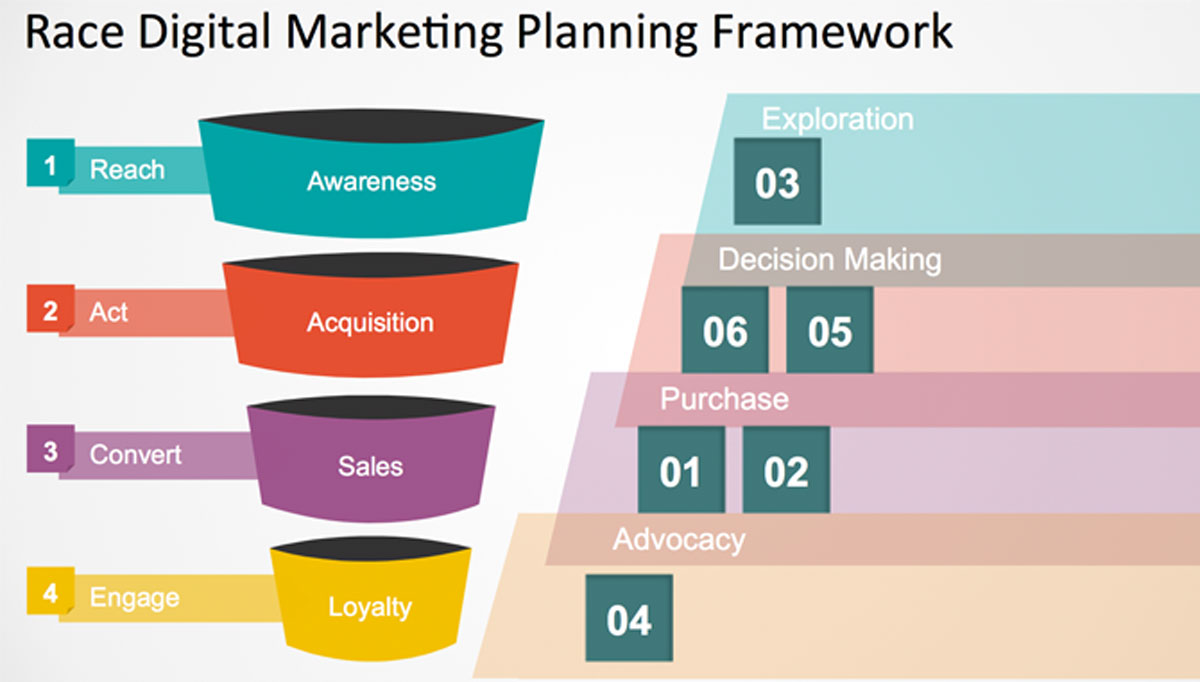
Once you’ve placed your actions along the customer lifecycle, start defining the objectives you want to reach. For this purpose, we will apply the SMART criteria to the first objective as an example.
Let’s consider creating the YouTube channel. This action is a driver for Organic Traffic. What do we want to achieve? We apply the SMART Objectives criteria to this action in the following SMART Goals Template.
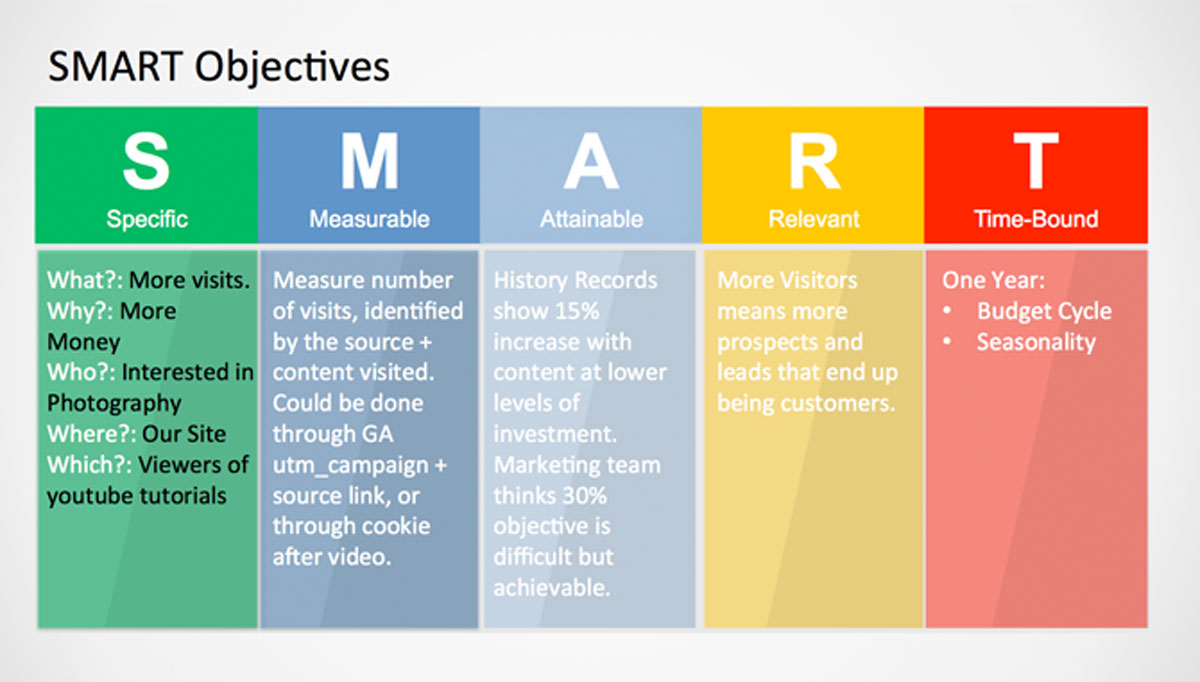
After all planned actions have a goal, and each goal has been analyzed against the SMART criteria, we complete a snapshot of the analysis conclusions in a RACE Matrix, where each row represents a funnel stage and goals, KPIs, and actions are recorded for follow-up.

Assets Analysis with Content Marketing Matrix and Content Marketing Media Matrix
Once the content SWOT analysis is complete and an actionable plan is in place across the customer lifecycle, identify the gaps between the content assets your organization creates and the content your audience may consume. At this point, you have measurable objectives. Now examine the content spectrum your audience consumes and determine whether you need to adjust your content generation strategy to fill the gap. At this stage, it is also important to review the competition and understand its content strategies.
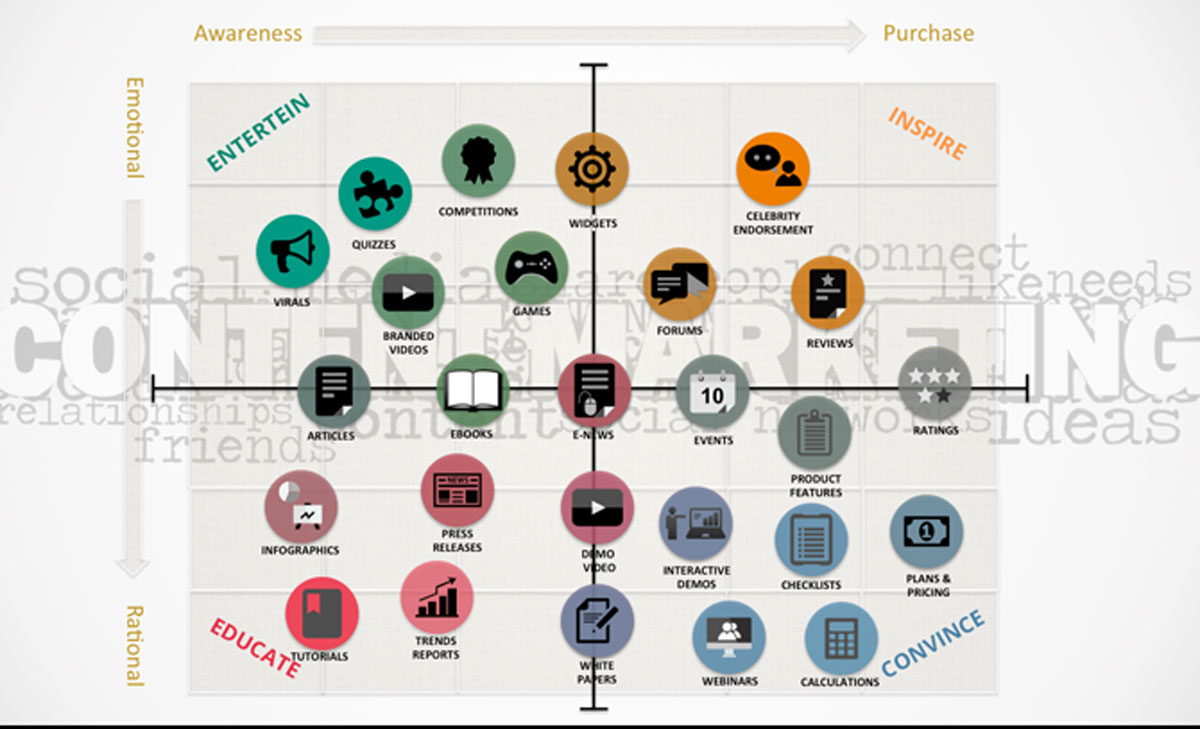
For this purpose, we propose using the Content Marketing Matrix and the Content Marketing Media Matrix. These tools are simple four (4) quadrant matrices that, used together, can provide insight into gaps in content assets.
How to Use the Content Marketing Matrix?
The Content Marketing Matrix is a simple tool designed to generate “quality conversations” between content creation teams and marketing stakeholders. It organizes asset information visually, providing insights into their potential impact on the audience and the business.
From left to right, the horizontal axis represents the buying funnel, from awareness to purchase. From top to bottom, the Vertical axis represents the emotional effect that the content tries to generate in the audience, ranging from emotional to rational. The tool places different content assets across the matrix, analyzing the marketing organization’s content objective and the emotion it reflects. During this analysis, marketers may identify GAPS in the content chain that should guide the prospect from Awareness to Purchase, balancing emotion and rationale.
Each Quadrant represents a two-dimensional marketing objective over the emotional axis and lifecycle axis:
- Educate: Create Rational content that will attract the audience through the initial stages of the funnel. The objective is to educate the audience on the product and industry’s subject-matter expertise. Ideal for Tutorials, Trends Reports, Press Releases, and Infographics. This quadrant reflects the organization’s knowledge and the willingness to share it with its digital community.
- Entertain: Create Emotional content to attract the audience through empathy into the initial stages of the funnel. The audience will invest time in these content assets to satisfy their entertainment needs. These assets include viral social content, quizzes for the user base, user competitions for an award, and branded videos on YouTube or in online games.
- Inspire: Create Emotional content to support the purchasing decision and guide users from customer to advocate. Generate content assets through customer interactions. In this quadrant, locate content assets related to product reviews, grant access to your users’ forum to share content with a new audience, or find influencers to talk/write about your product/service and generate shareable content with their mentions and endorsements.
- Convince: Create Rational content to complete the purchasing decision. The assets located in this quadrant should help the prospect choose your product/service. Content in this quadrant includes product features, checklists, user ratings, interactive demos, or webcasts. Finally, the obligatory content is the Plans and Pricing sheet.
To start using the matrix, download the Content Marketing Matrix PowerPoint Template, a 100% editable version of the Content Marketing Matrix with professional-quality icons that make it easy to copy and paste assets into the Matrix Map in a “post-it” fashion. The process is simple and intuitive. The user selects the content asset icon and drags and drops it over the empty matrix canvas. Iteratively, users and the audience start relocating assets across the quadrant covering the funnel. After the first iteration, stakeholders identify the gaps and plan for missing content.
How to Use the Content Marketing Media Matrix?
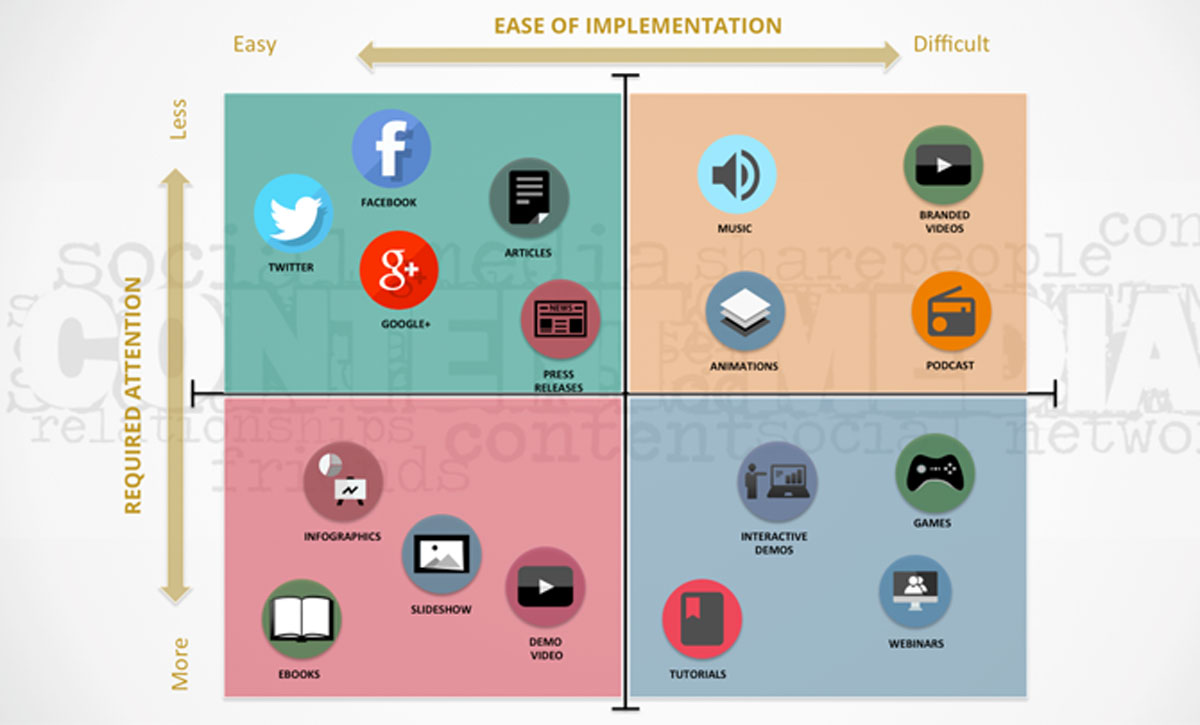
The Content Marketing Media Matrix is an intuitive tool that helps understand the relative effort of creating media assets compared to the relative attention they will generate from the audience. Once the Assets GAP is identified with the Content Marketing Matrix, the team can use the Media Matrix to prioritize efforts. Like the previous tool, this is a relative comparison that guides stakeholders in analyzing insights.
The process is simple: drag and drop the assets onto the matrix canvas and place them in the quadrants based on the effort and attention dimensions. Visually, the team can clearly identify which content is a priority and which will be less effective.
Example of Content Gap Analysis
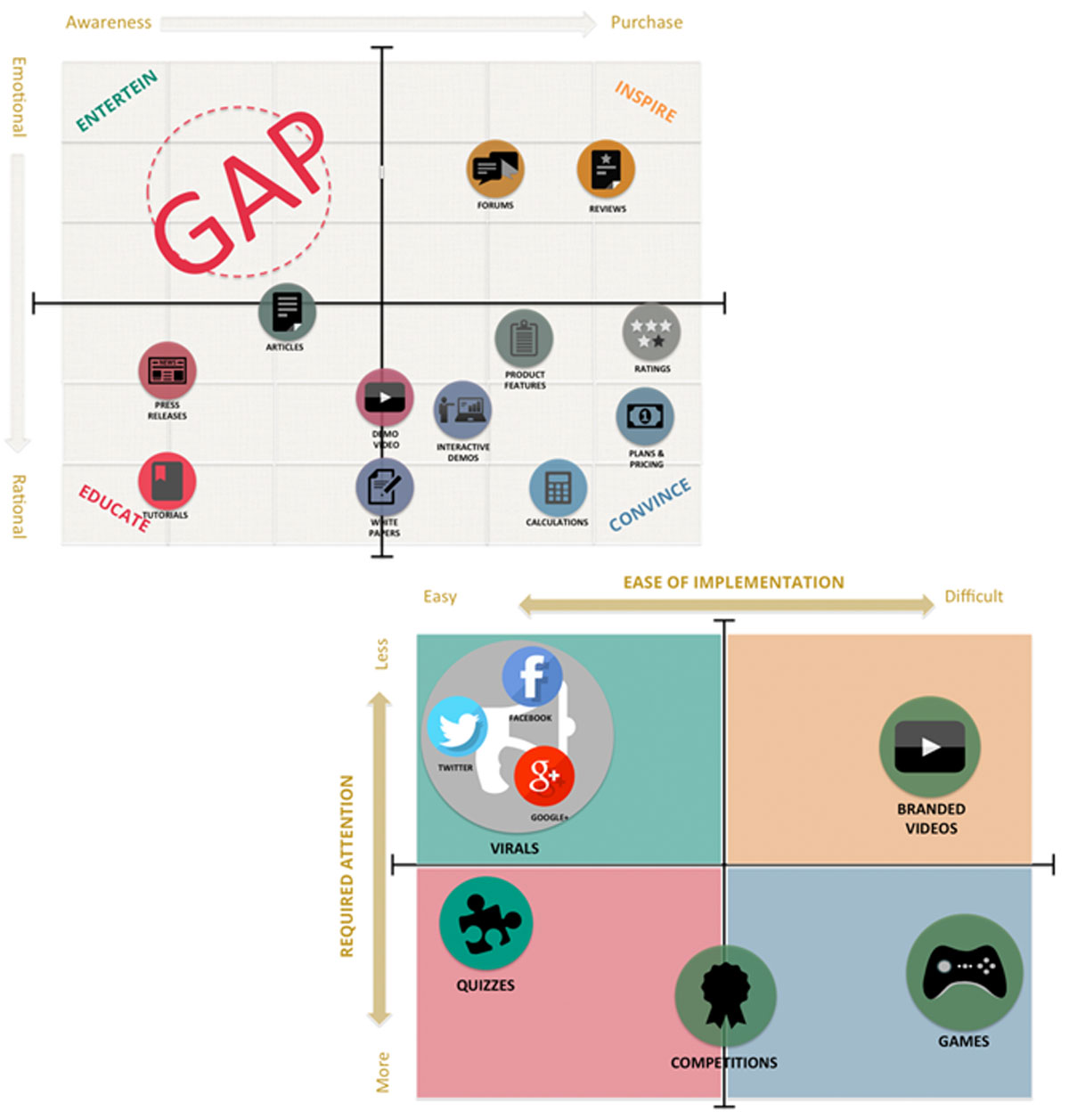
Going back to our example, we applied both matrices to show the final analysis results. The example organization’s business assets focus on the photography and web design industries, and the content that guides users through the funnel aims to create a simple, rational path. No big branding efforts. The example clearly identified a GAP in the Entertain Quadrant, which was later analyzed in the media matrix to determine which content assets to create to fill that GAP. The team decided to fill the GAP with Virals through social networks, as this was the most effortless content to generate by reusing existing assets. Even though it will not be the most engaging, it will cover the GAP, and measurable results will show the effect.
Turn Content Gaps into Pillars and Formats
The gap analysis tells you where your content mix is thin. In the stock photo example, the matrix showed plenty of educational material and almost nothing in the Entertain quadrant. Finding the gap is only useful if it changes what the team produces next quarter, and that is what content pillars do.
Define Three to Five Content Pillars
A content pillar is a broad theme your brand can credibly own over time, tied to a business objective and broken down into narrower topic clusters. Fewer pillars produce more depth. Three to five is enough for most teams, because each pillar needs a steady stream of supporting pieces to build authority in search and recognition with the audience.
For the stock photo business, four pillars cover the full matrix. Photography Technique serves the Educate quadrant with tutorials on lighting, composition, and editing. Creator Stories fills the Entertain gap with behind-the-scenes series, monthly photo challenges, and short videos that show how popular images were made. Visual Trends serves Inspire with quarterly reports on the styles and subjects buyers are licensing. Licensing Made Simple serves Convince with pricing explainers, license comparisons, and buyer case studies. Each pillar then branches into topic clusters, so Photography Technique might hold clusters on natural light, product photography, and mobile editing, each with five or six planned articles and videos.
Match Formats to the Funnel Stage and the Effort Available
Format decisions should come from the Content Marketing Media Matrix, not habit. A format that demands high effort, such as a documentary-style video series, earns its place only when audience attention in that channel justifies the cost. A format that requires little effort but still reaches a large audience, such as a weekly carousel of featured images, deserves a fixed slot in the calendar.
Funnel stage matters as much as effort. Early-stage readers want short, searchable answers and visual content they can skim. Mid-funnel prospects respond to comparisons, detailed guides, and webinars. Buyers close to a decision look for case studies, pricing clarity, and proof that the product works for someone like them. Mapping each pillar against the stages of your customer journey shows quickly whether any stage is left without content.
Plan Repurposing from the Start
The most efficient content plans treat every large asset as a source for several smaller ones. A quarterly visual trends report can produce a webinar, a slide deck, a dozen social posts, an email series, and three short articles targeting long-tail searches. Planning those derivatives when the main asset is scheduled, rather than after it is published, keeps effort low in the Media Matrix while multiplying reach. Our guide on repurposing presentations covers practical ways to turn one deck into content for several channels.
Plan Your Content Distribution Channels
Most content marketing plans give insufficient attention to distribution, treating channel selection as a decision that follows content creation rather than an input that shapes what gets made. In practice, the channel affects the format, length, tone, and scheduling of every piece. Planning distribution early prevents a common problem: well-produced content that never reaches the people it was written for.
Start from the buyer personas defined earlier in the plan. Different audiences use different platforms at different points in their decision process. For B2B audiences, LinkedIn generates strong engagement for thought leadership and case studies. Email remains the most consistent driver of return visits among existing contacts and qualified prospects. Organic search brings in new readers who aren’t yet aware of the brand, and it increasingly feeds AI assistants that summarize answers for users, rewarding content that answers specific questions clearly and early on the page. Each channel rewards a different kind of investment, and a plan that spreads resources evenly across all of them usually underperforms on every one.
A practical distribution plan names two or three primary channels where the team invests most of its production and promotion effort, plus secondary channels where content is adapted rather than created from scratch. A blog post that serves as a primary search asset can become a LinkedIn carousel built in PowerPoint, a short email sequence and a set of social graphics, all from one production effort. Building that logic into the plan from the start delivers far more channel coverage for the same budget. To see the full picture across a quarter or a year, a marketing roadmap presentation makes it easy to spot gaps in publishing cadence before the cycle begins.
Build the Editorial Calendar and Workflow
The editorial calendar is where strategy becomes schedule. It converts the audience profiles, objectives, pillars, and distribution decisions from the previous steps into a publishing timeline the team follows week by week. Building it in PowerPoint makes sense for teams that already plan and report in slides: the calendar can be reviewed in team meetings, shared across departments as a read-only file, and updated without access to specialized software. The Content Marketing Plan PowerPoint Templates include calendar slides with fields for the content item, format, target persona, funnel stage, channel, publication date, and owner.
Anchor the calendar to business dates instead of filling a blank grid from week one onward. Product launches, industry events, quarterly reporting cycles, and seasonal demand shifts all create natural moments for content with a clear purpose. Working backward from those dates, identifying when each piece must be live, when editing has to finish, and when production needs to start, produces a calendar grounded in business priorities rather than open-ended brainstorming.
A well-built calendar shows at a glance which items are in production, which are scheduled, which channel and persona each one targets, and which funnel stage it serves. That visibility lets the editorial lead catch imbalances early, such as a quarter full of awareness content with almost nothing for prospects who are close to a decision.
Assign Roles and an Approval Workflow
Calendars fail more often because of unclear ownership than because of bad topics. For every content type, define who briefs it, who writes it, who reviews it for accuracy, who approves it, and who publishes and promotes it. A RACI matrix works well here because it separates the people responsible for doing the work from the single person accountable for signing it off, along with those who must be consulted or simply informed.
Approval is where most delays occur. Limit sign-off to one accountable person per content type, set a fixed turnaround time for reviews, and agree in advance which changes require a second review and which do not. Consult subject matter experts in product, legal, or sales only on the pieces that need them, not on every post.
Where AI Fits in the Content Workflow
AI tools can shorten several stages of the workflow when they are assigned specific tasks. They can produce first-draft outlines from a brief, suggest angles for a topic cluster, summarize interview transcripts for case studies, and adapt a finished article into social posts or email copy. CMI’s 2026 research found that the most effective B2B teams secure their marketing fundamentals first, then use AI to amplify that work rather than relying on it to replace planning.
The limitations are real and belong in the plan. Generative tools state incorrect facts with confidence, so every statistic, product claim, and quotation needs human verification before publication. Output tends toward generic phrasing that sounds like every competitor using the same tools, which weakens the brand voice the plan is supposed to build. AI-generated material can also raise copyright and disclosure questions depending on your industry. The practical approach is to document which tasks AI may assist with, who reviews AI-assisted drafts, and what quality checks apply before anything reaches the calendar’s publish column. For presentation work specifically, our guide on using AI to generate a PowerPoint presentation explains where these tools save time and where they still need a human editor.
Create the Content Marketing Plan Roadmap
After the analysis steps are complete, the content plan is in place, and the required assets are agreed, it is time to create a realistic timeline. To create the Roadmap, we suggest using a Gantt Chart Template. This slide template is suitable for visually representing tasks, resources, and time, and it’s easy to edit because it’s data-driven (you can edit it in Excel). The timeline will include the tasks involved in content creation and the tasks related to publishing each asset across different digital marketing channels, including social media marketing. You can create one slide per task if you need to subdivide tasks and provide a more detailed plan.
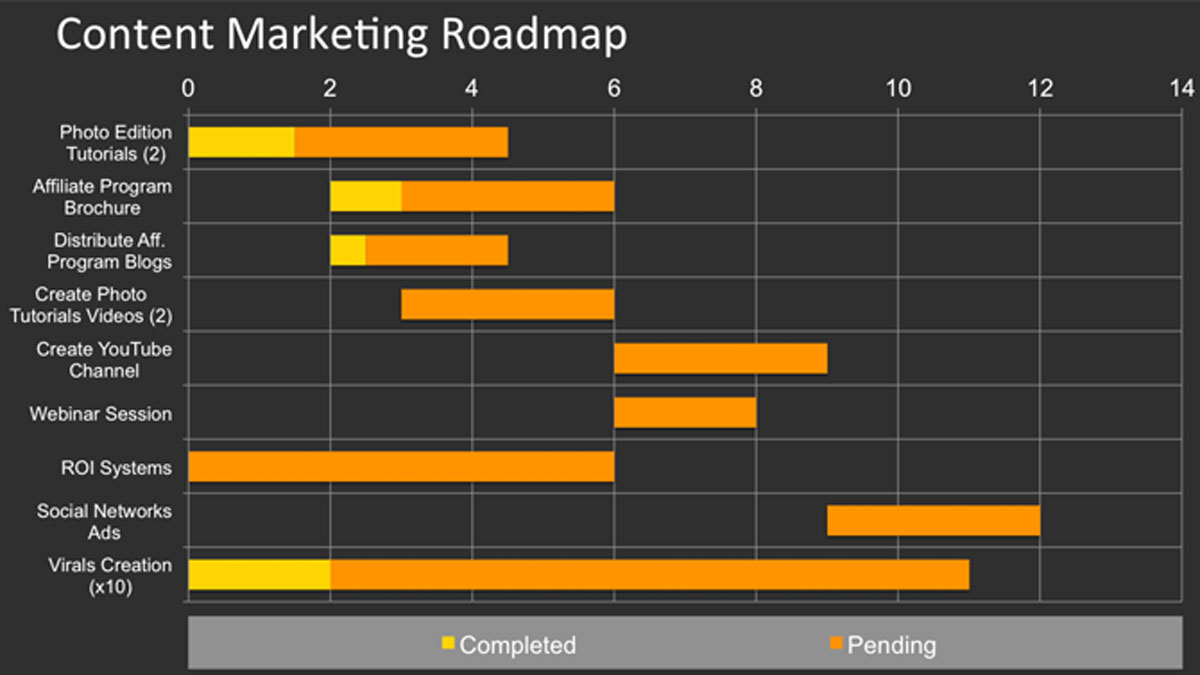
Roadmap vs. Editorial Calendar
The roadmap and the editorial calendar answer different questions for different audiences. The roadmap shows leadership what the content program will deliver each quarter: major campaigns, pillar launches, research reports, and the milestones tied to business goals. The calendar shows the content team what is due this week, who owns it, and what stage it is in. Keeping them separate lets you present stakeholders with a clean, high-level view without exposing every individual post, while the team works from the detailed schedule. If you are building the roadmap from scratch, our tutorial on how to make a Gantt chart in PowerPoint walks through the process, and the guide on how to create a roadmap in PowerPoint covers alternative layouts such as swimlanes and timelines.
Allocate Budget and Resources
The last component of the plan states what it will cost to deliver. Break the budget into in-house hours by role, freelance and agency fees, software and tool subscriptions, design and video production, and paid distribution. Estimating hours per format, for example, twelve hours for a long-form guide or thirty for a produced video, makes it easier to check whether the calendar is realistic for the team you actually have.
Use the Content Marketing Media Matrix to decide where money goes. Allocate budget to high-effort formats only in quadrants where audience attention justifies the cost, while protecting capacity for low-effort, high-attention formats every month. Reserve a small share of the budget, around ten percent, for testing new formats or channels identified in the SWOT, such as the YouTube tutorial channel in the stock photo example. That reserve allows the team to experiment without pulling resources from content that already performs.
Measure, Report, and Revise the Plan
The objectives defined with the RACE and SMART frameworks only matter if the team checks them regularly and acts on what it finds. This final stage defines how performance is tracked, who sees the results, and when the plan changes.
Track Leading and Lagging Indicators by Funnel Stage
Lagging indicators, such as revenue influenced by content or customer retention, confirm whether the plan worked, but they arrive months after the content is published. Leading indicators show earlier whether the plan is on course. For the Reach stage, track impressions, organic sessions, and keyword positions. For Act, track engagement rate, time on page and email sign-ups. For Convert, track content-assisted leads and demo or trial requests. For Engage, track repeat visits, newsletter retention, and customer use of help content. Pairing each RACE stage with two or three indicators keeps the dashboard focused on decisions, not data volume.
Set a Reporting Cadence
A monthly performance review lets the content team adjust tactics: refresh an underperforming article, move budget between channels, or replace a format that isn’t landing. A quarterly review compares results against the SMART targets and decides whether the plan itself needs to change. Leadership usually needs only the quarterly view, built as a short dashboard presentation that highlights progress against targets and the decisions required. Our guide on how to present key metrics covers how to structure those slides so the numbers tell a clear story, and teams that report channel results separately can follow the approach in how to present social media reports.
Be Honest About Attribution
Proving that a specific article produced a specific sale is difficult, and pretending otherwise damages credibility with finance and leadership. Buyers consume several pieces of content across different channels before converting, and most analytics tools credit only the last click. Report assisted conversions and content-influenced pipeline alongside last-click figures, explain your method, and keep it consistent from one report to the next so trends stay comparable.
Know When to Revise the Plan
Revise the plan when a KPI misses its target for two consecutive review periods, when the business changes direction, when a new product or market enters scope, or when audience research shows the personas no longer match who is actually buying. Small tactical changes belong in the monthly review. Changes to pillars, channels, or budget belong in the quarterly review, and a full rebuild normally happens once a year alongside the budget cycle.
Content Marketing Plan Template: A Visual Approach
A content marketing plan template gives marketing teams a reusable structure that cuts the time needed to build a new plan at the start of each cycle. Instead of rebuilding the document architecture, the team can spend its planning time on the decisions that require judgment: which topics to prioritize, which channels to emphasize and how to adjust the content mix based on the previous quarter’s results.
The most useful templates are designed around the sections a content plan needs, not around generic business document conventions. A template built for this purpose includes slides for the situational analysis, audience personas, content pillars and topic clusters, channel strategy, editorial calendar, resource allocation, and KPI tracking. The Content Marketing Plan PowerPoint Templates include 21 slides covering each component. They are fully editable, so teams can adapt both the content and the visual design to their brand standards, and they work in Google Slides for organizations that plan in Google Workspace.
B2B Content Marketing Plan: Adapting the Framework
A B2B content marketing plan follows the same framework, but B2B purchasing requires some specific adjustments. Purchase decisions involve longer evaluation cycles and multiple stakeholders, so the plan needs more than a few buyer personas. Content sequences have to map to the stages of a sales cycle that may run for weeks or months. Early-stage material such as blog posts, industry reports, and social content does a different job than content written for a prospect who has already requested a demo or entered a sales conversation.
Alignment between marketing and sales is especially important in B2B planning. Mid-funnel and late-funnel content, including case studies, competitive comparisons, pricing guides, and objection-handling resources, needs sales input to reflect the questions buyers actually ask. Building that collaboration into the planning process, instead of treating sales enablement as an afterthought, produces content that moves deals forward rather than only raising awareness.
Format choices matter as well. Long-form content such as white papers, technical guides, and detailed case studies tends to earn stronger engagement from professionals evaluating a significant purchase. Webinars and live events create a level of dialogue static content cannot match, which is why they remain effective in B2B despite the extra production effort. Our marketing deck guide and the article on marketing plan presentations offer a starting point for the visual materials B2B teams need, both internally and when working with sales.
Content Marketing Plan Examples
Seeing the framework applied to a specific context makes the planning process more concrete. The two examples below are simplified illustrations of how a content marketing plan might look for different types of organizations. Neither is a complete plan, but each shows how the core components connect in practice.
Sample Content Marketing Plan for a SaaS Company
A SaaS company targeting mid-market buyers might organize its plan around four pillars: product education, industry analysis, customer success stories, and competitive positioning. Each pillar serves a different point in the buyer’s journey. Product education, including tutorials, feature explainers, and use case guides, reaches prospects checking whether the product fits their workflow. Industry analysis builds credibility with audiences not yet in a buying process. Customer success stories, mainly case studies, support prospects further along in their evaluation. Competitive positioning content, such as comparison guides and alternative pages, serves late-stage buyers deciding between vendors.
Distribution for this plan prioritizes organic search for educational and analytical content, LinkedIn for amplifying case studies and industry perspectives, and email nurture sequences for prospects who have already engaged with the brand. KPIs include rankings for target product categories, marketing-qualified leads from content touchpoints, email engagement by segment, and content-influenced pipeline as reported in the CRM. Our sales funnel guide provides additional frameworks for presenting how these pieces move a prospect from first visit to signed contract.
Sample Content Marketing Plan for a Professional Services Firm
A consulting or professional services firm faces a different challenge. It cannot rely on product features or free trials to demonstrate value. Its main asset is expertise, so its content exists almost entirely to build credibility with an audience that may not be buying today but will be when a relevant need appears.
A plan for this kind of firm concentrates production on a few long-form formats: research reports or white papers that show analytical depth, bylined articles in industry publications, and webinars or event presentations that open a conversation with the target audience. A smaller set of high-quality pieces promoted over a long period generally works better here than high-volume publishing. Distribution centers on relationship channels such as email to existing contacts and past clients, senior partners’ LinkedIn activity, and participation in industry events. KPIs emphasize engagement quality over volume: time on page, report downloads, event attendance, and direct inquiries traceable to content. The marketing automation executive guide explains how a content program like this fits into a broader B2B marketing automation setup.
How to Present Your Content Marketing Plan to Stakeholders
A content marketing plan usually needs approval before it receives budget, and the people approving it rarely want to read the full working document. Turning the plan into a focused deck is the final step, and the analysis from the previous steps already gives you most of the slides.
Recommended Slide Order
Executive summary. Open with what the plan will achieve, what it costs, and the decision you need. An executive summary that fits on one slide lets decision-makers grasp the proposal before they see the details.
Situation and SWOT. Show where current content stands, using audit results and the SWOT matrix, in one or two slides.
Audience. Present the primary personas and the buying committee they belong to.
Objectives and KPIs. Display the RACE framework with the SMART targets assigned to each stage.
Content gaps and pillars. Use the Content Marketing Matrix to show the gap, followed by the pillars that close it.
Channels and calendar. Summarize the primary and secondary channels, and show a quarterly calendar view rather than every individual post.
Roadmap and budget. Present the Gantt roadmap alongside the budget breakdown and required resources.
Measurement plan. Explain which indicators will be tracked, how often results will be reported, and when the plan will be reviewed.
Decisions requested. Close with the specific approvals you need, such as budget, headcount, or tool purchases, and the date by which you need them.
Adapt the Slide Deck to the Room
Leadership usually needs a five-slide version covering the executive summary, objectives, pillars, roadmap with budget, and requested decisions. The content team needs the full deck, including the calendar and workflow. Sales benefits from a version focused on personas, mid-funnel and late-funnel content, and how to request material for active deals. Preparing these versions in advance avoids rebuilding the deck under pressure before each meeting. For more on structuring presentations around a decision, see our guides on stakeholder presentations and executive presentations.
Common Content Marketing Plan Mistakes
Setting KPIs Without a Baseline
A target of “increase organic traffic by 30%” means nothing if nobody recorded where traffic stood when the plan began. Capture baseline figures for every KPI during the content audit, before the first new piece is published.
Planning One Persona for a Whole Buying Committee
In B2B sales, the person who uses a product, the manager who approves it, and the finance contact who signs the contract all need different content. A plan built around a single generic persona leaves most of the committee without material that answers their questions.
Scheduling Production but Not Distribution
Calendars often list publication dates without any promotion plan. Content that is published and never distributed rarely reaches its audience, regardless of quality. Every calendar entry should include the channels it will be promoted on and who is responsible for that promotion.
Leaving Pieces Without an Owner
When a calendar item has no named owner, it slips. Assign one accountable person per item, even if several people contribute to it.
Never Retiring Old Content
Outdated articles that compete with newer ones for the same keywords split ranking signals and confuse readers. Use the content audit to consolidate or remove them at least once a year.
Reporting Activity Instead of Results
Leadership does not need to know how many posts went live last month. Report against the plan’s objectives, and explain what changed and what the team will do differently next quarter.
FAQs
How is a content marketing plan different from a content marketing strategy?
A strategy describes why an organization invests in content, who it targets, and what market position it aims to hold. A plan describes what specific content will be created, when it will be published, through which channels, by whom, and how success will be measured. A strategy without a plan tends to remain abstract. A plan without a strategy tends to produce well-organized content disconnected from meaningful business goals. Effective content marketing programs require both.
What should a content marketing plan include?
A complete content marketing plan typically includes a situational analysis covering past performance and competitive context, target audience profiles or buyer personas, SMART goals tied to business objectives, a content pillar and topic structure organized by funnel stage, a distribution channel plan, an editorial calendar, a resource and budget allocation section, and a KPI tracking framework. The depth of each section varies depending on organizational size, team structure, and planning cycle. Teams building their first plan often start with a lighter version that covers the core sections and add detail in subsequent cycles.
How do you develop a B2B content marketing plan?
Start with your target accounts and buying committee personas rather than a generic audience definition. Map content to each stage of the B2B purchase cycle, accounting for the fact that B2B decisions typically involve multiple stakeholders with different information needs. Prioritize content formats that build credibility, such as case studies, white papers, technical guides, and webinars, alongside lighter top-of-funnel content that maintains awareness. Build marketing and sales alignment into the planning process by involving sales team members in developing mid-funnel and late-funnel content. Use your editorial calendar to sequence content in a way that supports deal progression rather than just publishing cadence.
What tools do you need to create a content marketing plan?
Most teams build content marketing plans using presentation software for the plan document, a project management or editorial calendar tool to track production, and an analytics platform to measure KPIs. PowerPoint and Google Slides are the most common formats for the planning document because they are easy to share and review in team meetings. Content marketing plan templates provide a structured starting point. They cover all key sections in a pre-designed slide format, reducing time spent on formatting so planning attention can focus on strategic and operational decisions.
How often should you update your content marketing plan?
Most organizations update their content marketing plan annually, with quarterly reviews to assess KPI performance against targets and make tactical adjustments. An annual full update aligns with budget cycles and allows the team to reset goals, recalibrate audience priorities, and adjust the content mix based on the previous year’s performance data. Quarterly reviews are operational checkpoints, not full rebuilds, designed to catch execution drift and course-correct before a full quarter of off-target effort accumulates. Plans that go more than six months without any structured review tend to drift significantly from current business priorities.
How do you measure the success of a content marketing plan?
Measure success against the KPIs defined in the plan, tied to the business objectives that justified the content investment. Common content marketing KPIs include organic search traffic volume and keyword rankings, email engagement rates segmented by audience type, lead volume and quality from content touchpoints, content-influenced pipeline tracked by CRM, and customer retention metrics for post-sale content programs. Our guide on presenting key metrics covers how to build a KPI dashboard in PowerPoint that gives leadership a clear view of content performance without requiring them to navigate multiple analytics platforms.
How long should a content marketing plan be?
The length depends on organizational complexity. A plan for a small team covering a single product line might run 10 to 15 slides. An enterprise plan covering multiple product lines and international markets might span 40 or more slides. The goal is completeness and usability, not a specific slide count. A plan that team members consult regularly is more valuable than one that is thorough on paper but too detailed to navigate in practice.
What is the difference between a content calendar and a content marketing plan?
A content marketing plan defines the audience, objectives, content pillars, channels, budget, and measurement approach for a content program. A content calendar is one component of that plan: the schedule that lists each piece of content, its publication date, channel, and owner. The plan explains why and what the team will create, while the calendar shows when each item will be delivered.
Can you build a content marketing plan in PowerPoint or Google Slides?
Yes. Presentation software works well for content marketing plans because people who may not use project management tools need to review and approve the plan. A slide-based plan can hold the SWOT analysis, personas, RACE and SMART objectives, content matrices, the calendar, a Gantt roadmap, and the KPI dashboard in one file that is easy to present and update each quarter. Editable templates reduce formatting time, and most work happens in both PowerPoint and Google Slides.
Final Words
A content marketing plan earns its value when it changes what the team does each week. The nine steps in this guide move from analysis to execution: a content audit and SWOT review, a clear definition of the audience, measurable objectives, a gap analysis, content pillars, distribution choices, an editorial calendar with defined ownership, a roadmap with a realistic budget, and a measurement routine that keeps the plan current. Building each step in PowerPoint means the same work that produces the plan also produces the deck you will use to secure approval and report progress. Start with the audit, keep the first version lean, and expand it as each quarterly review shows what is working. For a deeper look at presenting the broader marketing picture, see our guide to marketing plan presentations.