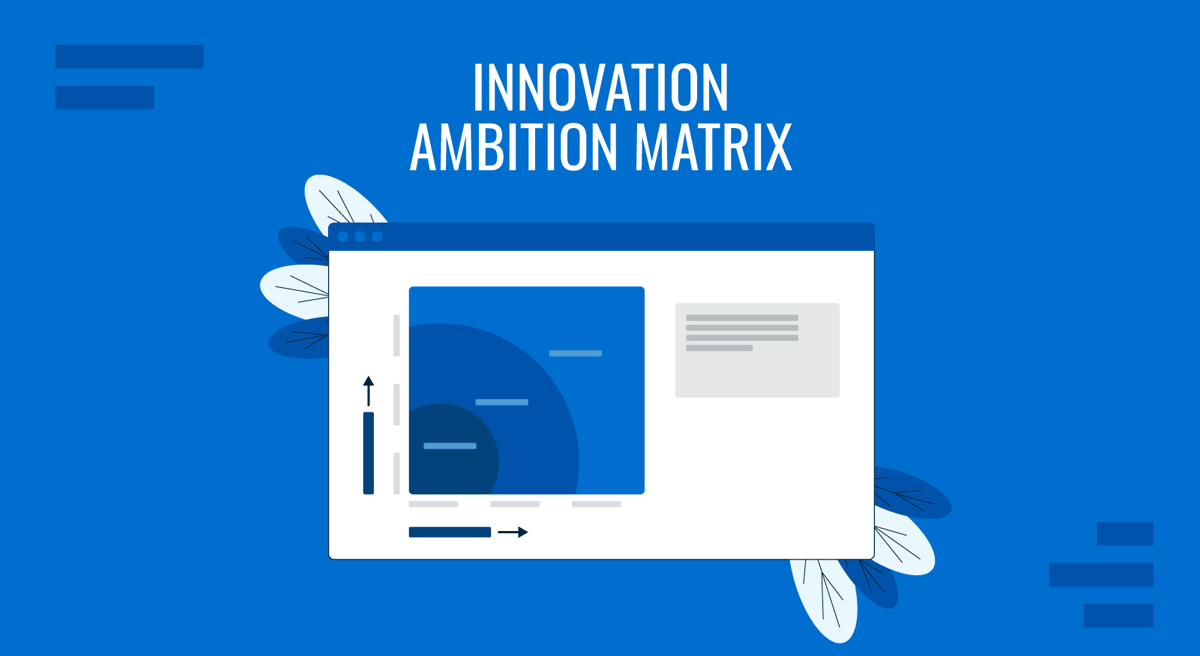
The Innovation Ambition Matrix is a planning and communication tool that helps organizations define how their innovation efforts are distributed across short-term improvements, market expansions, and long-term exploratory opportunities. When used in innovation strategy presentations, the matrix becomes a map of strategic intent. It shows what the company is building now, what it is preparing to build next, and what it hopes to unlock in the future. Presenters rely on it to clarify priorities, assess balance, and guide high-level decisions on where to allocate budgets, talent, and leadership attention.
This article explains how to structure a presentation around the Innovation Ambition Matrix. Each section follows a slide-driven logic suitable for executive audiences, strategy teams, and product leadership. You will learn how to introduce the matrix, categorize your initiatives, explain evaluation processes, and link the matrix to performance expectations and organizational structure.
The Innovation Ambition Matrix Framework
The Innovation Ambition Matrix divides innovation initiatives into three categories. Horizon 1 refers to activities that improve or extend existing products and services. Horizon 2 covers adjacent innovations in new markets or segments. Horizon 3 includes exploratory or breakthrough concepts with uncertain paths but high future potential.
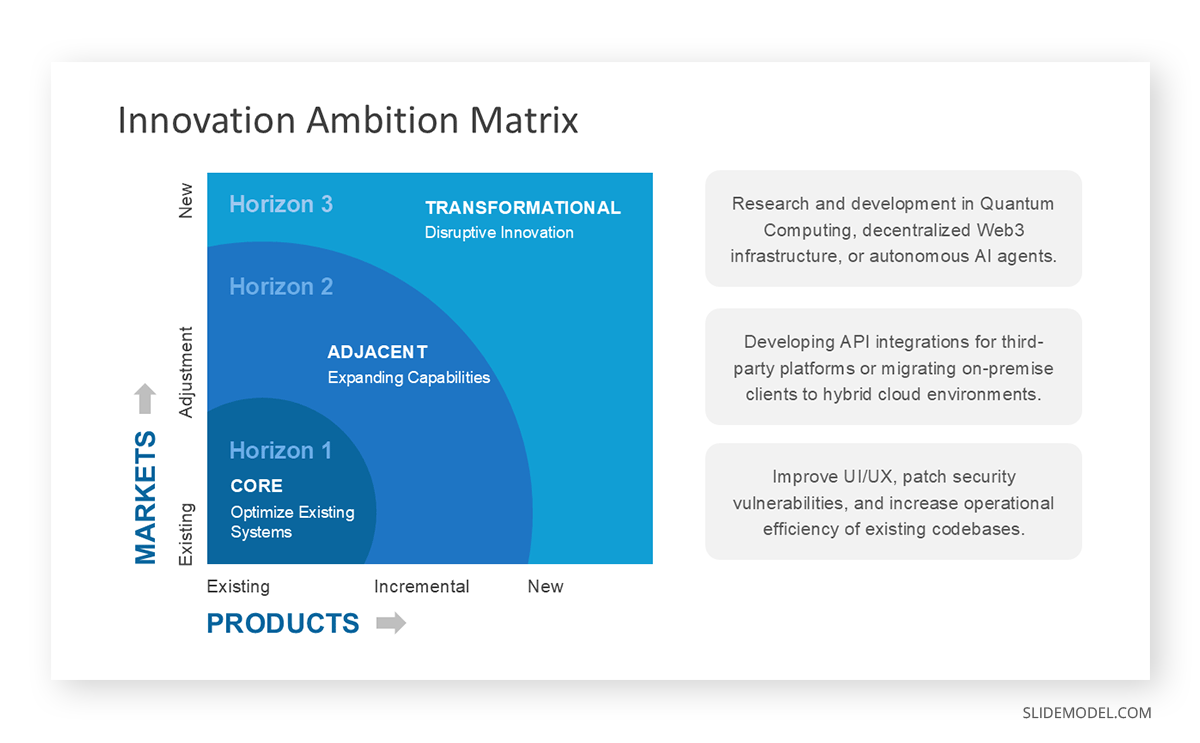
Presenters use the matrix to position initiatives on the three horizons model slide clearly. It organizes innovation work not by department but by intention, risk, and expected return.
Clarifying the Role of Each Horizon
A strong presentation does more than define the horizons. It explains why each one matters. Horizon 1 ensures stability and funds future opportunities. Horizon 2 acts as the bridge between the present and the speculative. It offers growth through diversification. Horizon 3 explores possibilities that may not generate revenue soon but can transform the company later.
By explaining these roles early in the deck, the presenter sets expectations for risk, timelines, and resource needs. The matrix gains meaning only when the horizons are connected to strategy and operational reality.
Types of Innovation Ambition Matrix Presentations
Not all Innovation Ambition Matrix presentations serve the same purpose. Some introduce innovation strategy at a high level, while others drill into specific portfolios or upcoming projects. To design the right narrative, the presenter must understand why the matrix is being shown and what decisions are expected afterward. The types of presentations differ in scale, depth, and the role of the matrix within the broader storyline.
Corporate Innovation Strategy Presentations
Executive teams often request a consolidated view of the innovation landscape during planning cycles. In this context, the matrix becomes a diagnostic tool for corporate strategy presentations. It helps leadership evaluate whether their innovation efforts rely too heavily on Horizon 1 improvements or whether their long-term aspirations lack formal projects.
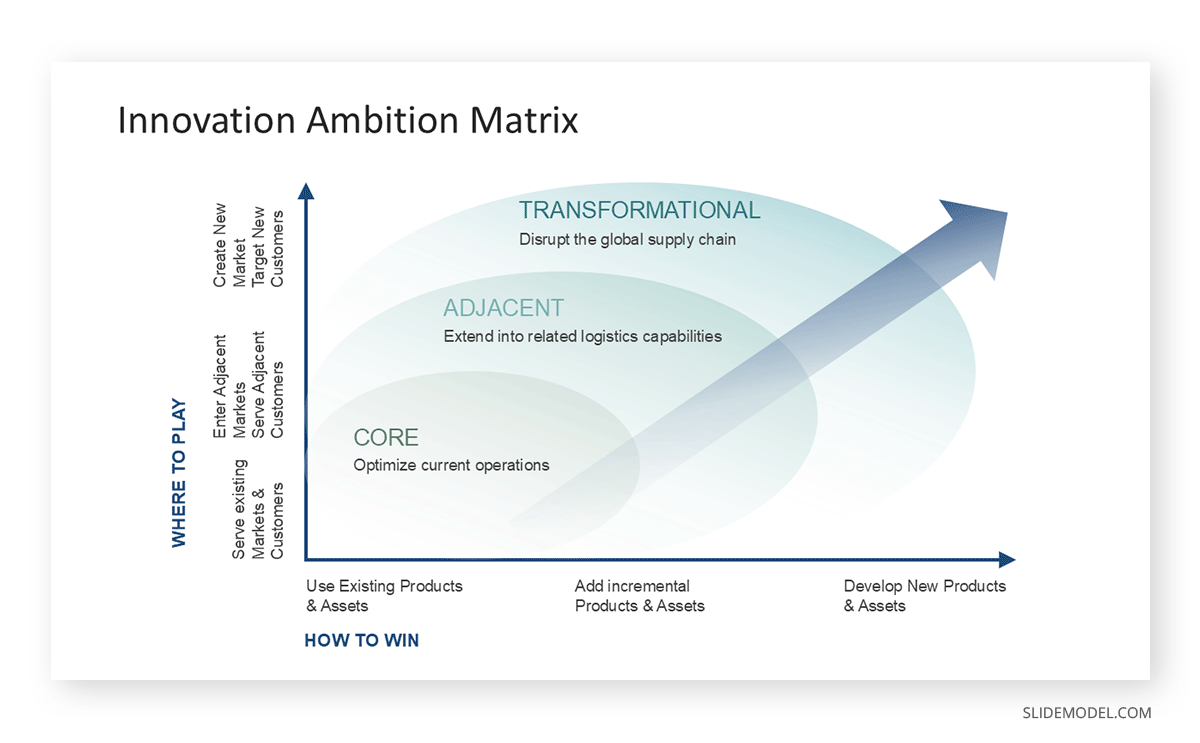
A typical strategic deck uses the matrix early in the presentation to frame the discussion. The presenter explains the organization’s current ambition profile and compares it with the desired ambition profile. This exposes gaps between actual activity and strategic intent. The deck then moves into resource implications, enabling the audience to understand how effort must shift if the organization hopes to reach its goals.
Product Portfolio Realignment Presentations
When a company revisits its portfolio, an innovation ambition matrix PowerPoint template is essential. It allows the presenter to show which products fall into incremental, adjacent, or transformational categories. This classification reveals the company’s dependence on mature offerings and whether emerging opportunities are receiving adequate investment within the portfolio management framework.
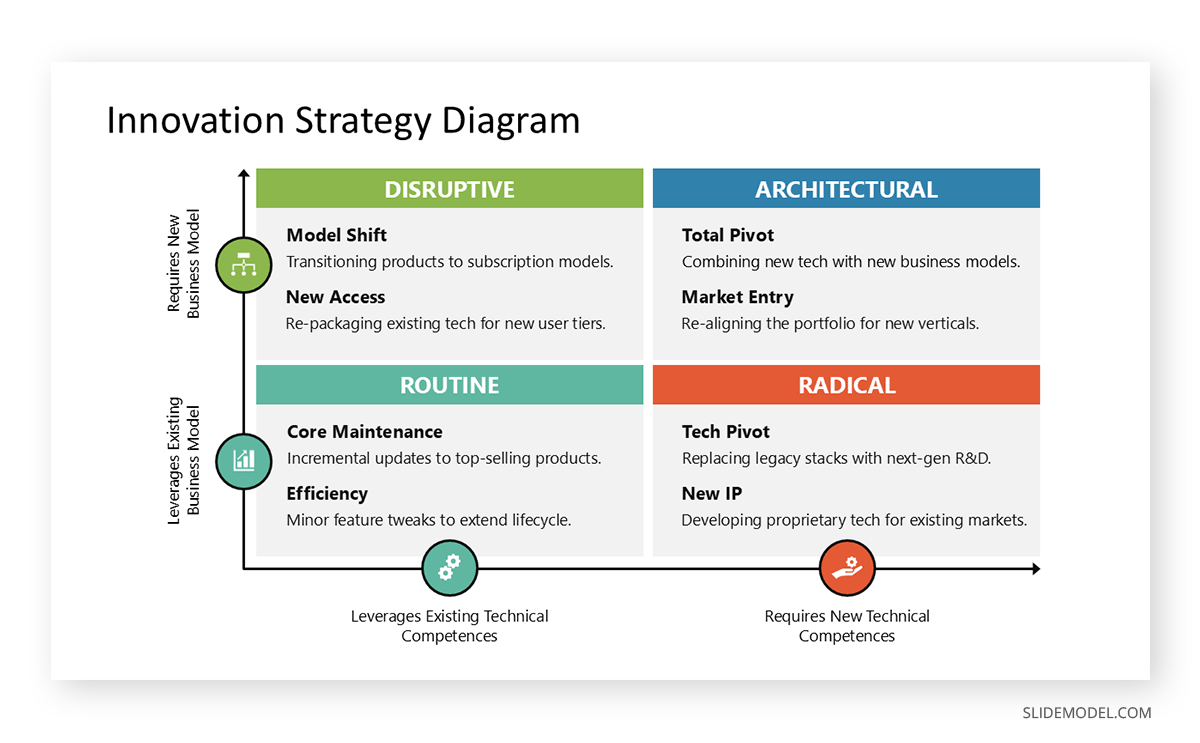
Portfolio realignment decks often include a timeline of market forces, customer insights, and performance trends before introducing the matrix. Once the matrix appears, the presenter uses it to categorize products by horizon and to suggest rebalancing actions. This may involve withdrawing investment from saturated areas, accelerating work in expansion markets, or reserving capacity for future experiments.
Startup Pitch and Growth Roadmap Presentations
Founders use the matrix to prove that their vision extends beyond a single product. It helps them describe how an initial offering seeds new lines of growth. A startup pitch deck typically includes the matrix on the product roadmap slide or the company vision section. Here, the presenter uses the matrix not as an audit tool but as a storytelling tool. It shows how the company will scale logically toward larger markets.
Horizon 1 establishes credibility, Horizon 2 shows expansion potential, and Horizon 3 gives investors confidence that the company is building toward a meaningful long-term future.
Evaluation Criteria for the Innovation Ambition Matrix
To use the Innovation Ambition Matrix effectively, organizations must apply consistent evaluation criteria when assigning initiatives to each horizon. Classification should not rely on intuition or optimism, but on structured assessment across four dimensions: strategic alignment, market uncertainty, capability stretch, and financial expectations.
Strategic alignment examines whether the initiative reinforces the current core business, extends it into adjacent spaces, or explores entirely new domains. Market uncertainty assesses the level of validated demand, competitive clarity, and available customer insight. Capability stretch measures how far the initiative pushes existing operational, technological, or organizational competencies. Financial expectations assess revenue timing, capital intensity, and acceptable return thresholds.
Horizon 1 initiatives typically demonstrate strong alignment with the current business model, low market uncertainty, limited capability stretch, and near-term revenue impact. Horizon 2 initiatives involve moderate uncertainty and require partial capability expansion, with medium-term financial returns. Horizon 3 initiatives operate in high-uncertainty environments, demand significant new capabilities, and prioritize learning milestones over immediate profitability.
Common Mistakes When Using the Innovation Ambition Matrix
Misclassifying Incremental Work as Transformational
Organizations frequently label routine product improvements as Horizon 3 initiatives to signal boldness. Minor feature upgrades, interface redesigns, or market extensions are sometimes presented as breakthrough innovations. This distorts portfolio visibility and creates a false sense of ambition. Horizon 3 should reflect a genuine strategic departure, not an incremental enhancement framed as visionary change.
Treating Horizon 3 as a Side Project
Exploratory initiatives are often isolated from core operations, lacking governance, funding continuity, and executive sponsorship. When Horizon 3 becomes symbolic rather than operationally supported, projects stall or disappear during budget reviews. Long-term innovation requires structured experimentation, defined learning goals, and protected investment.
Applying the Same KPIs Across All Horizons
Measuring Horizon 3 initiatives using short-term revenue or quarterly margin targets undermines their purpose. Each horizon requires differentiated performance metrics. Horizon 1 emphasizes efficiency and profitability. Horizon 2 focuses on validating scalable growth. Horizon 3 prioritizes learning velocity, hypothesis testing, and capability building.
Overconcentrating Investment in Horizon 1
Organizations often default to incremental improvements because they are predictable and easier to justify financially. While Horizon 1 sustains the business, over-allocation leads to stagnation. A portfolio dominated by near-term initiatives leaves the company vulnerable to market disruption and competitive displacement.
Confusing Time Horizon with Risk Level
The matrix is not solely about timing. Some Horizon 2 initiatives may carry higher execution risk than certain Horizon 3 experiments. Classification must reflect strategic distance and business model shift, not just projected launch dates.
Failing to Update the Matrix Regularly
The Innovation Ambition Matrix should function as a living portfolio tool. When it is reviewed only during annual planning cycles, it becomes static and disconnected from evolving market realities. Regular reassessment ensures alignment with strategy shifts, competitive pressure, and emerging opportunities.
Ignoring Capability Gaps
Placing initiatives in Horizon 2 or Horizon 3 without evaluating internal capabilities leads to execution failure. Transformational ambitions require new talent, processes, and technological infrastructure. Without deliberate capability planning, aspiration exceeds operational readiness.
FAQs
What is the Innovation Ambition Matrix?
The Innovation Ambition Matrix is a strategic portfolio framework that categorizes initiatives into three horizons based on their distance from the core business. It helps organizations balance short-term improvements, medium-term expansions, and long-term exploratory bets while aligning innovation efforts with overall strategy.
How is the Innovation Ambition Matrix different from the Three Horizons Framework?
The matrix is derived from the Three Horizons model but is often adapted for portfolio visualization and presentation use. While the Three Horizons Framework emphasizes temporal evolution, the matrix format focuses on strategic intent, risk exposure, and resource allocation across current and future initiatives.
What is the ideal investment ratio across the three horizons?
Many organizations use a reference ratio such as 70% in Horizon 1, 20% in Horizon 2, and 10% in Horizon 3. However, the appropriate allocation depends on industry maturity, competitive pressure, growth targets, and risk tolerance.
Can small or early-stage companies use the Innovation Ambition Matrix?
Yes. Startup decks can use the matrix to demonstrate growth logic beyond their initial product. It helps founders show how current offerings can expand into adjacent markets and eventually support broader, long-term opportunities.
How often should the Innovation Ambition Matrix be updated?
The matrix should be reviewed at least quarterly. Innovation portfolios shift as projects mature, markets evolve, and strategic priorities change. A static annual review limits its usefulness as a decision-making tool.
Who should own Horizon 3 initiatives?
Ownership varies by organization. Some companies assign exploratory initiatives to dedicated innovation teams, while others integrate them into cross-functional units with executive sponsorship to ensure visibility and accountability.
What risks arise from overinvesting in Horizon 1?
Excessive focus on incremental innovation can create short-term stability but long-term vulnerability. Organizations may miss emerging technologies or disruptive competitors if exploratory initiatives are consistently deprioritized.
What tools complement the Innovation Ambition Matrix?
The matrix is often used alongside portfolio management dashboards, risk assessment frameworks, stage-gate processes, and strategic roadmaps to ensure initiatives are tracked, funded, and evaluated consistently across horizons.
Final Words
The Innovation Ambition Matrix is more than a visual framework. It is a discipline for managing uncertainty while protecting core performance. Organizations that rely solely on incremental improvements risk stagnation, while those that overemphasize transformation without structural support risk instability.
The matrix forces clarity. It reveals where attention, capital, and leadership energy are concentrated. When applied rigorously, updated consistently, and supported by differentiated metrics, it becomes a strategic control system rather than a presentation slide.