A new policy rarely fails because the rule itself was wrong. It fails because employees heard about it secondhand or received it as a bare announcement with no room for questions. McKinsey has reported that roughly seventy percent of change programs fail to achieve their goals, citing employee resistance and a lack of management support as the main reasons. Both problems usually start at the same point: the moment employees first hear about the change and decide what they think. A policy rollout presentation is the moment an organization can close that gap. It gives you a structured chance to explain a new rule, connect it to a reason employees can accept, and let people ask what it means for their day-to-day work.
For business professionals responsible for compliance updates, HR policy changes, security requirements, or operational procedures, the presentation often becomes an afterthought once the policy is finalized. That sequencing works against the organization, because the presentation is where resistance either takes hold or gets addressed before it spreads. This guide walks through how to prepare and structure a policy rollout presentation that gives a new rule its best chance of being understood and actually followed, from the groundwork done before a single slide is built to the follow-up that determines whether the policy sticks.
Why Most Policy Rollouts Fall Short of Adoption
The Real Cost of a Poorly Communicated Policy
When a policy is announced without enough explanation, a sizable share of employees push back before they’ve seen how it works in practice. Oak Engage’s 2023 Change Report surveyed more than 1,000 UK employees and found that well over a third were resistant to change. The broader trend is just as discouraging: Gartner data cited by Prosci shows that the share of employees willing to support organizational change fell from 74% in 2016 to 43% in 2022. Still, most of the people in the room aren’t committed opponents. They’re waiting to see whether the change makes sense, and where they land depends heavily on what they hear during the rollout.
The operational cost of getting this wrong compounds quickly. Employees who don’t understand why a policy changed tend to follow it inconsistently or quietly work around it. The questions they should have had answered in the room end up with managers who were never briefed. Prosci’s benchmarking research found that projects with excellent change management are about seven times more likely to meet their objectives than projects with poor change management. A 2025 study by The Grossman Group and The Harris Poll speaks to communication: without visible leadership and effective communication, organizations are 5.5 times more likely to fail at change, yet one in four employees say their leaders don’t communicate change well. A rollout presentation is one of the most direct levers an organization has to move those odds. It’s the first moment, and often the only one, when the reasoning behind a policy reaches every employee at the same time and in the same words.
What Sets a Rollout Presentation Apart From a Routine Update
A policy rollout presentation shares some structural DNA with other internal presentations, but its purpose is narrower, and its stakes are different. A quarterly business review informs; a policy rollout asks employees to change behavior, sometimes starting the same day the presentation ends. That shift from informing to changing behavior is what separates a rollout from an ordinary status update, and it is why borrowing structure from established change management models tends to produce better results than treating the session as a simple announcement.
The audience also arrives with a different posture. In a routine update, employees are mostly passive recipients of information. In a policy rollout, they are being asked to do something differently, which means they arrive already forming opinions about whether the change is fair or necessary before the presenter says a word. A presentation that does not account for that posture, one that simply reads the policy aloud and moves to the next slide, tends to generate more confusion than clarity. The presentation has to instruct and persuade at the same time, which requires more preparation than most teams initially budget for.
Preparing the Ground Before Building a Single Slide
Defining the Business Case and the Human Case
Every policy has a business case: a compliance requirement, a cost pressure, a risk that surfaced, or a process that stopped working. That business case is usually easy to write down, because it is the reason the policy exists in the first place. What gets skipped more often is the human case: what changes for the people who have to follow the policy, and what they lose or gain by complying.
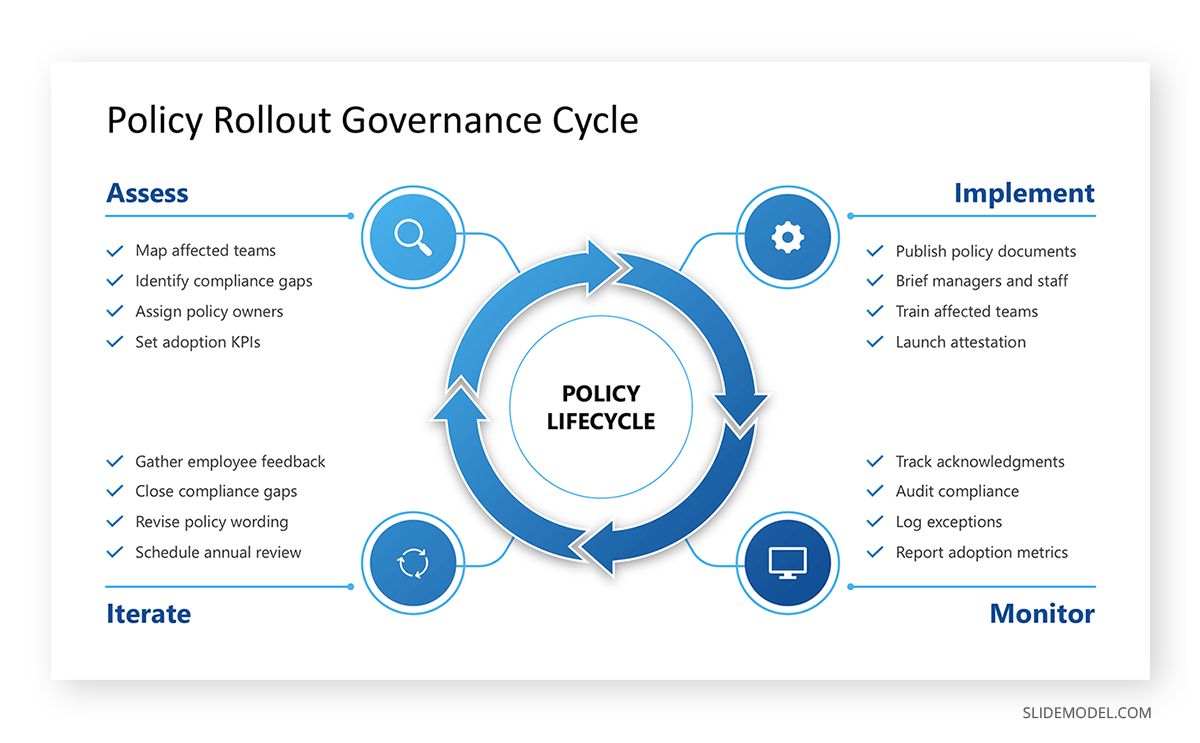
A useful way to prepare is to write both cases separately before drafting slides. The business case answers why the organization needs this; the human case answers what it actually means for someone doing their job on an ordinary afternoon. A guide to organizational change management for leaders is a useful reference here, since most established frameworks treat the human case as equally important to the business rationale, not a secondary detail to mention if time allows.
Skipping the human case is one of the more common reasons a rollout presentation lands flat. Employees can accept an inconvenient policy if the reasoning is clear and you honestly address the impact on their work. They resist a policy that feels handed down without acknowledging what it costs them to comply, even when that cost is small.
Mapping Stakeholders and Anticipating Objections
Before building the presentation, identify who in the room is likely to react most strongly, and why. Stakeholder mapping is typically associated with project work, but the same logic applies to a policy rollout: some groups will be affected more directly than others, and some will carry more influence over how the policy is perceived, often because of concerns they have raised in the past.
Applying the key principles of stakeholder management to a rollout means going through the likely audience segments and asking what each one will want to know first. A finance team hearing about a new expense policy will ask about approval thresholds. A field team hearing about a new safety policy will ask about enforcement and exceptions. Anticipating these questions before the presentation, rather than during it, allows the presenter to build answers directly into the slides instead of scrambling to respond on the spot.
This groundwork also surfaces objections that are worth addressing preemptively. If a policy is likely to be perceived as reducing flexibility or adding friction to an existing workflow, naming that trade-off directly and explaining why it was accepted tends to land better than waiting for someone in the audience to raise it as a challenge.
Structuring the Presentation for Buy-In, Not Just Awareness
Opening With Context Before the Policy Itself
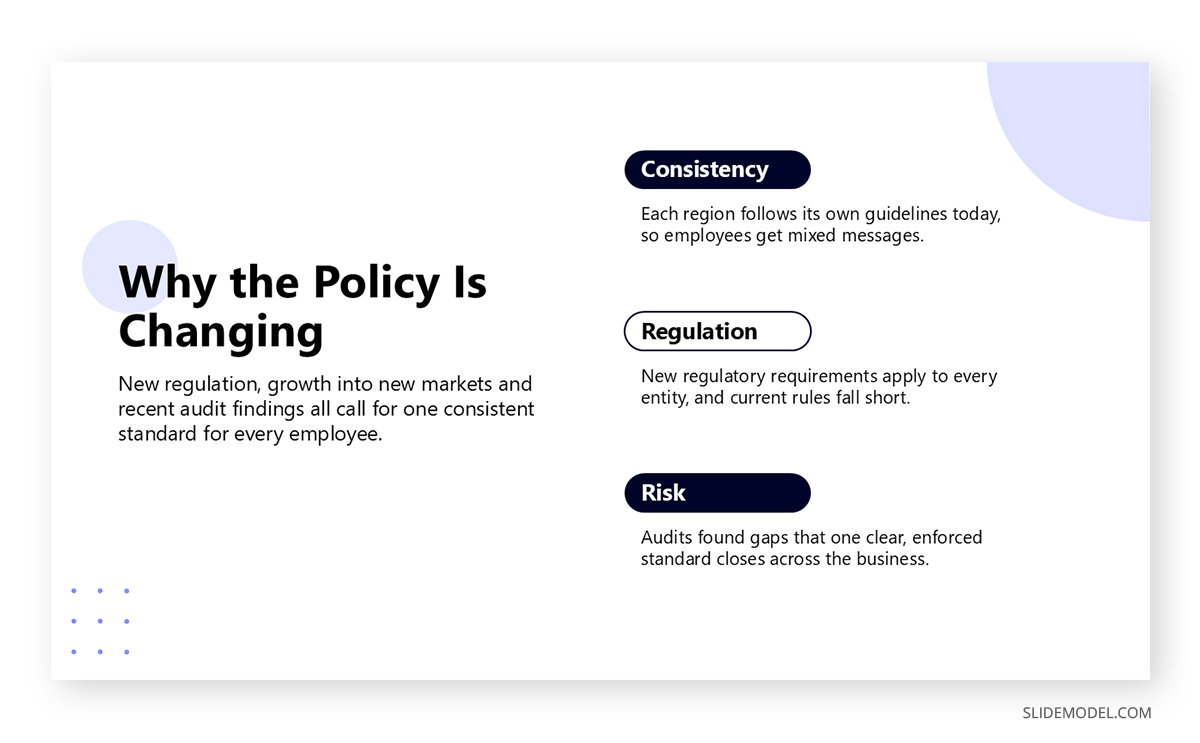
The instinct with a policy rollout is often to lead with the policy: here is the new rule, here is when it takes effect. That approach technically informs the audience, but it skips the step that determines whether they accept the policy. A stronger presentation structure opens with context: what changed in the business or the regulatory environment that made this policy necessary, followed by the reasoning that connects that context to the specific rule being introduced.
This sequencing mirrors how Kotter’s change model treats urgency: before people will accept a change, they need a credible reason to believe the current way of doing things is no longer sufficient. Skipping straight to the policy denies the audience that reasoning, which means they are left to supply their own explanation for why the change is happening, and that self-supplied explanation is rarely as generous as the real one.
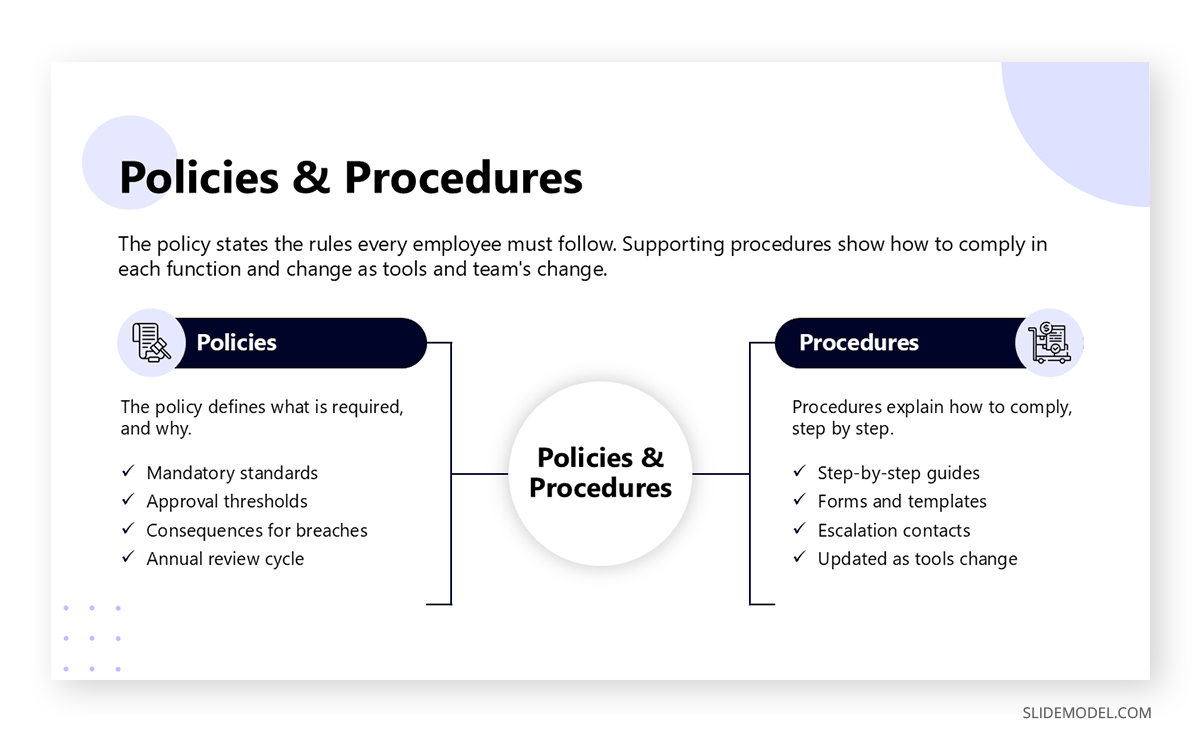
A useful opening sequence covers the situation that prompted the change and the specific problem it addresses, then introduces the policy itself only once that context is in place. By the time the policy appears on screen, the audience already understands why it exists, which changes how they receive the rest of the presentation.
Translating the Policy Into Role-Specific Impact
A policy written in legal or compliance language rarely translates cleanly into what an individual employee should do differently. The middle portion of the presentation should take the policy and break it down by role or department, showing what changes in practice for each group rather than presenting one generic explanation to a mixed audience.
This is where understanding the target audience segments in the room pays off. A finance team and a field operations team may experience the exact same policy in very different ways, and a slide that speaks to everyone at once tends to speak clearly to no one in particular. Breaking the impact down by function, even briefly, signals that the presenter has thought through the practical consequences rather than distributing a policy document and expecting the audience to interpret it themselves.
Closing this section with a clear action plan gives employees something concrete to take away: what they need to do and who to contact if something is unclear. Without this step, even a well-explained policy can stall because nobody knows where to start.
A Slide Sequence That Works for Most Rollouts
Most policy rollout decks need between eight and twelve slides. The order matters more than the number. Each slide answers the question the audience is likely to have at that point in the session.
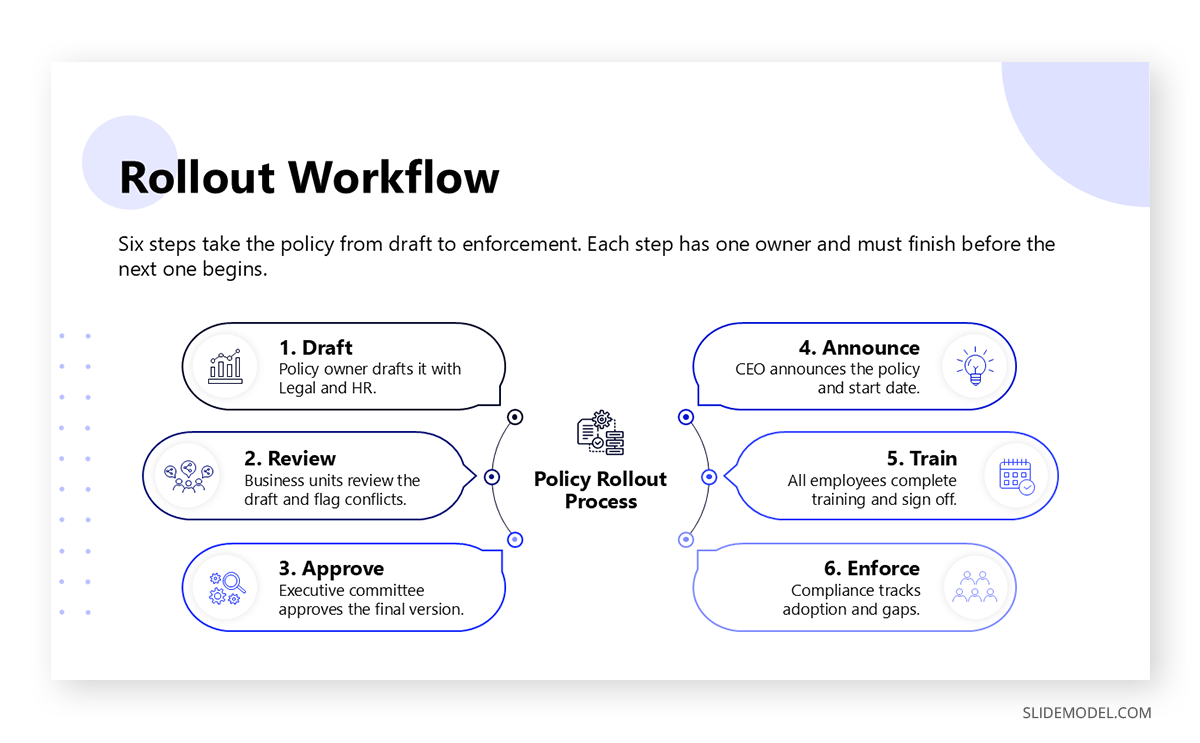
Purpose of the session. The opening slide states in a single sentence why everyone is in the room and what they will know by the end. This sets expectations and signals that there will be time for questions.
What prompted the change. One or two slides cover the trigger: a regulation that took effect, an audit finding, a security incident, or a process that kept breaking down. A single data point here, such as the number of expense reports flagged last quarter, does more work than a paragraph of explanation.
The policy in plain language. Summarize the rule in the words an employee would use to explain it to a colleague, not in the wording of the policy document. Link to the full document instead of pasting it onto the slide.
Who it affects and how. A table or a set of role-based panels shows what changes for each function. Groups the policy doesn’t affect should see that clearly, so they can stop worrying about it.
Timeline and transition period. A timeline slide shows the announcement date, any grace period, and the date enforcement begins. People retain dates shown visually far better than dates mentioned in passing.
What to do now. List the first concrete action, such as completing a form, updating a setting, or attending a training session. Give a deadline for each item.
Trade-offs and how they were weighed. Name the downsides employees will notice and explain why the organization accepted them.
Where to get help. End with a named contact, a shared inbox, or an FAQ page, followed by the Q&A.
Running the Q&A Without Losing the Room
The question segment is where a rollout either earns credibility or loses it. It is also the part of the session presenters prepare for least. Collecting questions in advance through an anonymous form, sent a few days before the session, surfaces the concerns people would hesitate to raise in front of colleagues. It also gives the presenter time to prepare accurate answers. Opening the Q&A with two or three of those anonymous questions also signals that difficult questions are welcome.
During the live session, a visible “parking lot” for questions that need a follow-up answer keeps the discussion from stalling on edge cases. The presenter should commit to a specific date for answering those questions and then meet it. Questions about legal interpretation or disciplinary consequences deserve particular caution. An improvised answer from the stage can be quoted back later as an official position, so “we will confirm that with legal and respond by Friday” is safer than a guess. A guide on how to moderate question and answer sessions covers techniques for keeping the exchange productive when the room turns skeptical.
Choosing the Right Room and the Right Messengers
All-Hands Announcements vs. Departmental Briefings
The setting where a policy is first introduced shapes how it is received. A company-wide all-hands meeting works well for policies that affect everyone in roughly the same way, such as a new code of conduct or a company-wide security requirement, because it signals that leadership stands behind the decision and treats it as important enough to address directly.
Policies with narrower or more technical impact often work better in smaller departmental sessions, closer to a training presentation, with more room for detailed questions and less pressure to keep the session short. A new procurement approval process, for instance, may only need to be explained in depth to the finance and operations teams, with a lighter summary shared more broadly for general awareness.
Choosing the wrong setting creates its own problems. Introducing a narrow, technical policy at a large all-hands meeting tends to lose most of the room, while announcing a company-wide policy only in small departmental sessions can make the change feel inconsistent or selectively enforced. Matching the format to the policy’s scope is a small decision with an outsized effect on how seriously the rollout is taken.
Preparing Managers to Cascade the Message Correctly
Managers often field follow-up questions after the main presentation ends, yet they receive the same information as everyone else at the same time, with no chance to prepare. Briefing managers a day or two before the wider rollout lets them walk into team conversations already familiar with the reasoning and ready to field group-specific objections.
This preparation matters because employees tend to trust their direct manager’s interpretation of a policy more than a company-wide slide deck, regardless of how well that deck was built. If a manager seems uncertain or contradicts something said in the main presentation, that inconsistency undermines the rollout faster than almost anything else said from the stage. Giving managers a short FAQ document and a chance to ask their own questions ahead of time closes that gap.
Manager preparation also supports employee engagement strategies more broadly, since a manager who understands and can explain a policy is far more effective at addressing concerns in the flow of daily work than a company-wide email. The rollout presentation reaches everyone once; the manager conversations that follow happen continuously, and that’s where most of the real adoption work takes place.
Planning for Remote and Hybrid Attendees
In distributed teams, many employees will experience the rollout through a video call, a recording, or a forwarded deck rather than in the room. Remote attendees lose the informal conversations that happen after an in-person session. Those conversations are often where people clarify what a policy really means. Recording the session and sharing it the same day, along with the slides and a one-page written summary, gives everyone the same reference point, whatever their time zone.
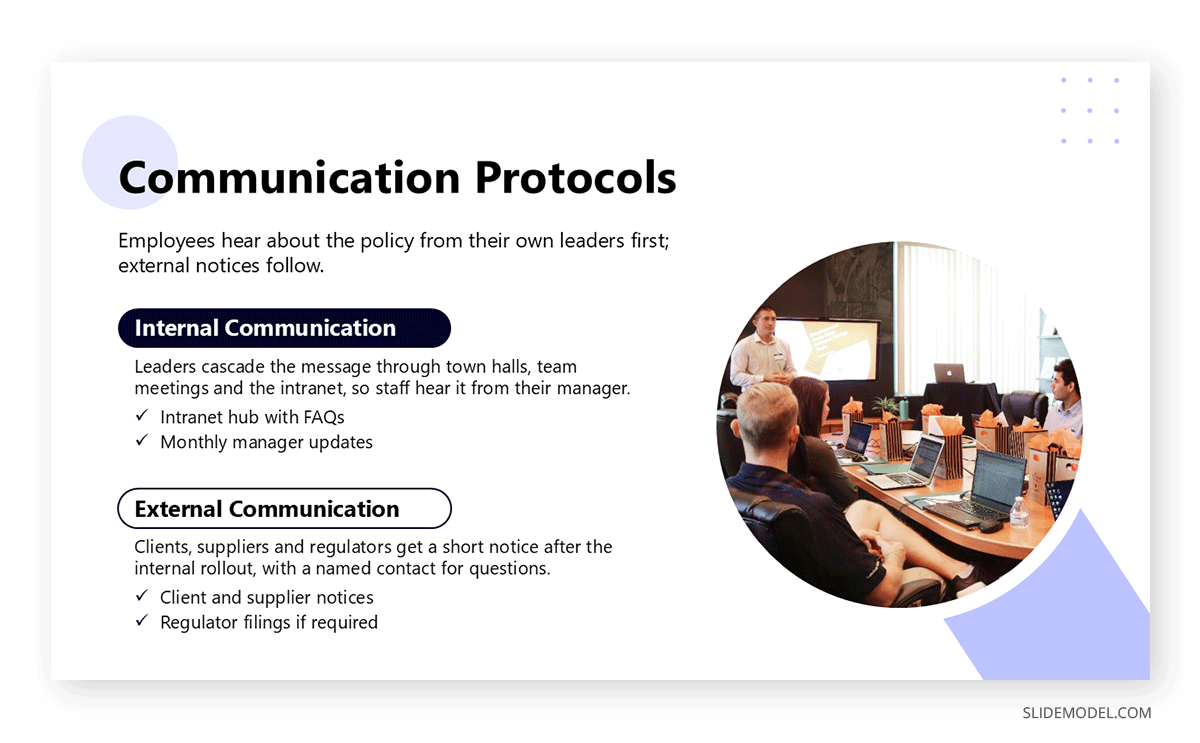
The deck itself should hold up when someone reads it without the presenter. Slides that depend entirely on spoken explanation become confusing when they circulate on their own afterward. Pairing the deck with presentation handouts solves most of that problem. Following the basics of accessibility in presentations, such as live captions, sufficient contrast, and alt text on charts, ensures the policy reaches employees who rely on assistive technology. For the live session, the practices in this guide to mastering virtual presentations help keep remote participants engaged rather than half-listening in another window.
What Happens After the Presentation Ends
Reinforcing the Policy Over the Following Weeks
A single presentation, no matter how well delivered, rarely produces lasting behavior change on its own. Policies announced once and never mentioned again tend to fade from memory within a few weeks, especially if they aren’t built into existing workflows or tools. An open door policy is a useful example: announcing that leadership welcomes direct feedback means little if managers are never seen acting on it afterward, and the same principle applies to almost any policy that depends on changed behavior rather than a one-time acknowledgment.
Reinforcement can take modest forms, such as a short reminder in a team meeting a few weeks after the rollout, or a mention in onboarding materials so new hires receive the policy as standard practice rather than a special announcement. The goal is not to repeat the original presentation, but to keep the policy visible long enough that it becomes part of how the organization normally operates, rather than something announced once and then quietly forgotten.
Documenting Acknowledgment for Compliance-Driven Policies
For policies tied to regulation, security, or workplace conduct, attending the session is not the same as acknowledging the policy. If an audit or a dispute arises later, the organization may need to show that each employee received the policy and confirmed they understood it. A presentation alone rarely provides that evidence.
A common approach is to follow the session with an acknowledgment step in the HR system or learning platform. Employees confirm they have read the final policy document, sometimes with a short set of comprehension questions on the points most likely to be misunderstood. Recording which version of the policy each person acknowledged also matters, because policies get revised. Building this step into the rollout plan from the start avoids chasing signatures weeks later. It also gives the follow-up survey a cleaner baseline for measuring how well people understood the policy.
Measuring Adoption With Surveys and Follow-Up Checks
Whether a policy rollout actually worked is rarely obvious from the room’s reaction on the day of the presentation. Applause or silence in the meeting says very little about whether employees understood the policy well enough to follow it correctly weeks later. A short follow-up survey, sent two to three months after the rollout, gives a more honest read on whether the policy landed and where confusion still exists.
Presenting those results back to the organization, with the same care applied to any other survey results presentation, closes the loop and signals that the organization is listening rather than treating the policy as settled the moment it was announced. Gathering presentation feedback directly after the rollout session, through a short form or a quick show of hands on remaining questions, can also catch confusion early enough to correct it before it spreads.
Adoption metrics do not need to be elaborate. Tracking whether the relevant process is being followed, or how many exception requests and questions still reach managers a month later, gives a reasonably clear picture of whether the rollout achieved its goal.
Where Policy Rollouts Commonly Go Wrong
Leading With Rules Instead of Reasons
Some rollout presentations open with the policy’s specific terms before giving any context: this is the new rule, here is the effective date, here are the consequences for non-compliance. That sequencing puts the audience on the defensive before they understand why the rule exists, which tends to produce compliance without acceptance. Employees follow the letter of the policy while quietly resenting it, and that resentment tends to surface later as workarounds or complaints escalated well past where they should have been addressed. Reordering the presentation so that context and reasoning come first, even briefly, changes how the same rules are received.
Presenting the Same Deck to Every Audience
A single generic deck delivered identically to every department saves preparation time but costs comprehension. Each group hears the parts of the policy relevant to them buried in material aimed at people with entirely different day-to-day responsibilities, and the sections that don’t apply to them read as noise. Building even a handful of audience-specific slides, or a short appendix addressing the questions each department is most likely to ask, usually uses preparation time better than a single deck built for an imagined average employee who doesn’t actually exist in the room.
Not Naming the Risks Employees Already See
Employees usually spot the downside of a new policy faster than presenters expect, whether that means added approval steps or reduced flexibility in how they currently work. When a presentation avoids naming these trade-offs directly, the audience notices the omission and trusts the rest of the presentation less. Addressing the risk openly, in a dedicated risk and mitigation slide or a short section acknowledging the trade-off and explaining why it was accepted, tends to build more credibility than a presentation that only lists benefits. A rollout that acknowledges its own costs reads as more honest, and that honesty is what determines whether employees trust the next policy change as well.
Burying the Effective Date
A surprising number of rollout presentations mention the effective date once, usually in the middle of a slide about policy details. Employees then leave unsure whether the rule applies tomorrow or next quarter. The date, any grace period, and the point at which enforcement begins should each appear on their own slide. They should be repeated in the closing summary and in the follow-up email. When employees disagree about when a policy started, compliance becomes uneven and disciplinary disputes avoidable.
Letting the Presenter Improvise on Sensitive Questions
Presenters who know the policy well are often tempted to answer every question on the spot, including questions about legal exposure, disciplinary outcomes, or exceptions that haven’t been decided yet. Those improvised answers spread quickly and can contradict the official policy document. Agreeing beforehand on which topics get a “we will follow up” response protects both the presenter and the organization.
Scheduling the Rollout at the Wrong Moment
Timing shapes reception as much as content does. Policies announced on a Friday afternoon, during a team’s busiest season, or in the weeks after a round of layoffs tend to be read as an attempt to slip something past people, whatever the intent. Choosing a moment when the audience has the attention to absorb the change, and the time to ask follow-up questions in the days after, gives the policy a fairer hearing.
FAQs
What is a policy rollout presentation?
A policy rollout presentation is a structured session, delivered to employees or specific teams, that introduces a new or updated organizational policy and explains the reasoning behind it, clarifying what actually changes in day-to-day practice. Unlike a policy document distributed by email, it creates space for immediate questions and gives leadership a direct channel to address concerns before the policy takes effect.
How long should a policy rollout presentation be?
Most policy rollout presentations run between fifteen and thirty minutes, with additional time set aside for questions. Complex or highly technical policies, such as a new compliance framework, may need a longer departmental session, while a straightforward administrative update can often be covered in ten minutes plus a brief Q&A.
Who should present a new policy to employees?
The most effective rollouts are usually led by someone with enough authority to answer questions credibly, paired with a subject matter expert who can address technical details. For company-wide policies, this often means a senior leader opens the session, while HR or the relevant department head handles the specifics.
Should the presentation happen before or after the policy is finalized?
Finalize the core details before the presentation, but brief managers or key stakeholders slightly earlier so they can flag likely concerns. Presenting a policy that is still subject to major changes tends to undermine confidence in the process once those changes are announced later.
How do you handle employees who openly disagree with a new policy?
Acknowledging the disagreement directly, rather than dismissing it, is usually more effective than avoiding the topic. Explaining the reasoning behind the decision while being honest about any trade-offs keeps the conversation productive, and directing unresolved concerns to a specific follow-up channel prevents the session from turning into an open-ended debate.
What is the biggest mistake to avoid in a policy rollout presentation?
Leading with the rule itself before explaining why it exists is one of the most common missteps. Employees who hear the requirement before understanding its rationale tend to see it as arbitrary, even when there’s a clear reason, which makes compliance feel imposed rather than reasonable.
Should every department receive the same policy rollout presentation?
Not necessarily. Policies that affect everyone equally can use a single company-wide session, but policies with uneven impact across departments usually land better when the core message is paired with role-specific detail, either through separate slides or a short departmental follow-up session.
How soon after the presentation should the policy take effect?
This depends on the complexity of the change. Simple administrative updates can often take effect immediately, while policies requiring new processes or new approval steps benefit from a short transition period that gives employees time to adjust before enforcement begins.
How do you measure whether a policy rollout was successful?
Common indicators include how consistently the new process is followed and how many exception requests or questions still reach managers weeks later. A short follow-up survey sent a few months after the rollout adds a more direct read on lingering confusion.
What should be included in the slides themselves?
At minimum, the context that prompted the change, the specific policy details, what changes in practice for different roles, the effective date, and where employees can direct questions afterward. A simple timeline or a risk-and-response slide often communicates more efficiently than dense paragraphs of policy text.
How do you prepare managers before a company-wide rollout?
Briefing managers a day or two before the wider announcement and sharing a short FAQ document helps them field employee concerns confidently instead of repeating information they just received.
What happens if employees still have questions after the presentation?
A named follow-up channel, whether that is a shared inbox or a point person in HR or the relevant department, gives employees somewhere to direct lingering questions instead of relying on rumor to fill the gap.
Final Words
A policy rollout presentation carries more weight than its length on the calendar suggests. It is often the single moment when an entire organization receives the same explanation, in the same words, before individual interpretations start to diverge. Treating that moment carefully, leading with context and addressing the human impact honestly, tends to change how a policy is received far more than the wording of the policy itself, especially once the managers who field the follow-up questions have been prepared as well.
None of this requires an elaborate production. It requires sequencing: reasons before rules, and role-specific impact before generic summaries, paired with a genuine channel for follow-up questions rather than a one-way announcement. Organizations that get this right treat the rollout as the start of adoption, not the end of the process, and follow up weeks later to check whether the policy actually took hold.
A new policy will always ask something of the people who have to follow it. Whether that request meets resistance or is met with genuine understanding depends less on the policy’s content than on how clearly and honestly it was introduced. A rollout presentation built around that principle gives a policy its best chance of becoming part of how the organization actually works, rather than a rule that exists only on paper.