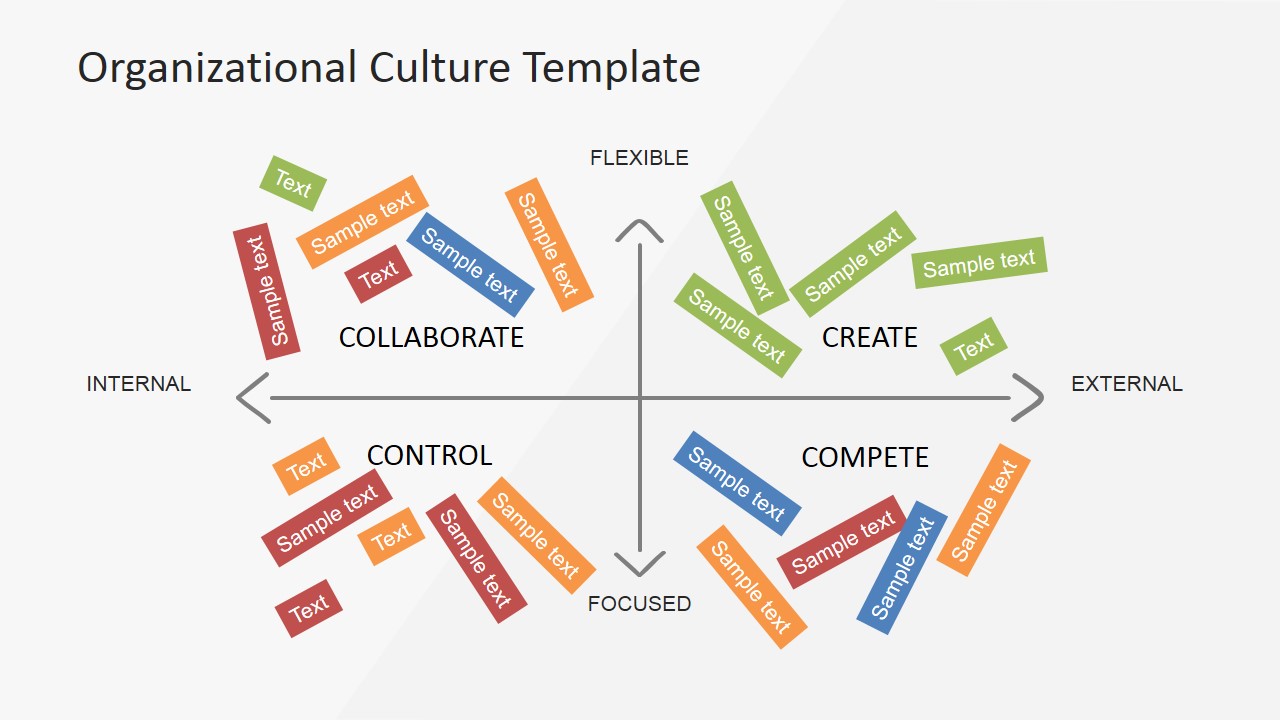
Organizational Culture PowerPoint Diagram is a professional presentation picturing the organizational culture types defined by the Competing Values Framework. Based on the identification of the Organizational Culture Assessment Instrument. The Diagram contains four quadrants that represent polarities, where each represents an Organizational Culture Type:
- Collaboration, also known as Clan culture.
- Control, also known as the Adhocracy culture.
- Competence, also known as the Market culture.
- Cultivation, or Hierarchy culture.
Organizational culture is derived from human behaviour within an organization, and the meaning the people attaches to it. There exists several models of Organizational Culture, and every of them provide insightful tool to study organizations and their people. This includes the analysis of vision, mission, values,norms, habits, symbols, systems, language and beliefs.
This professional PowerPoint Diagram provides flexible diagrams to explain each of the Organizational Culture types, as group, showing their relationships and individually, drilling down on each of them. Each object of the PowerPoint Diagrams is created using PowerPoint shapes, allowing the presenter to fully customize its properties, as size, color and effects.
Combine this presentation with any of out PowerPoint Diagrams to add additional value content, as Organizational Charts. Impress your audience with our appealing Organizational Culture PowerPoint Diagram, and create presentations that transmit your message just at a glance.
What’s inside this template
Example presentation scenarios
- An HR leader can use the four-quadrant culture map to introduce how internal, external, flexible, and focused priorities shape workplace behavior.
- An organizational development consultant can use the sticky-note quadrant slide to collect workshop observations and group employee behaviors by culture type.
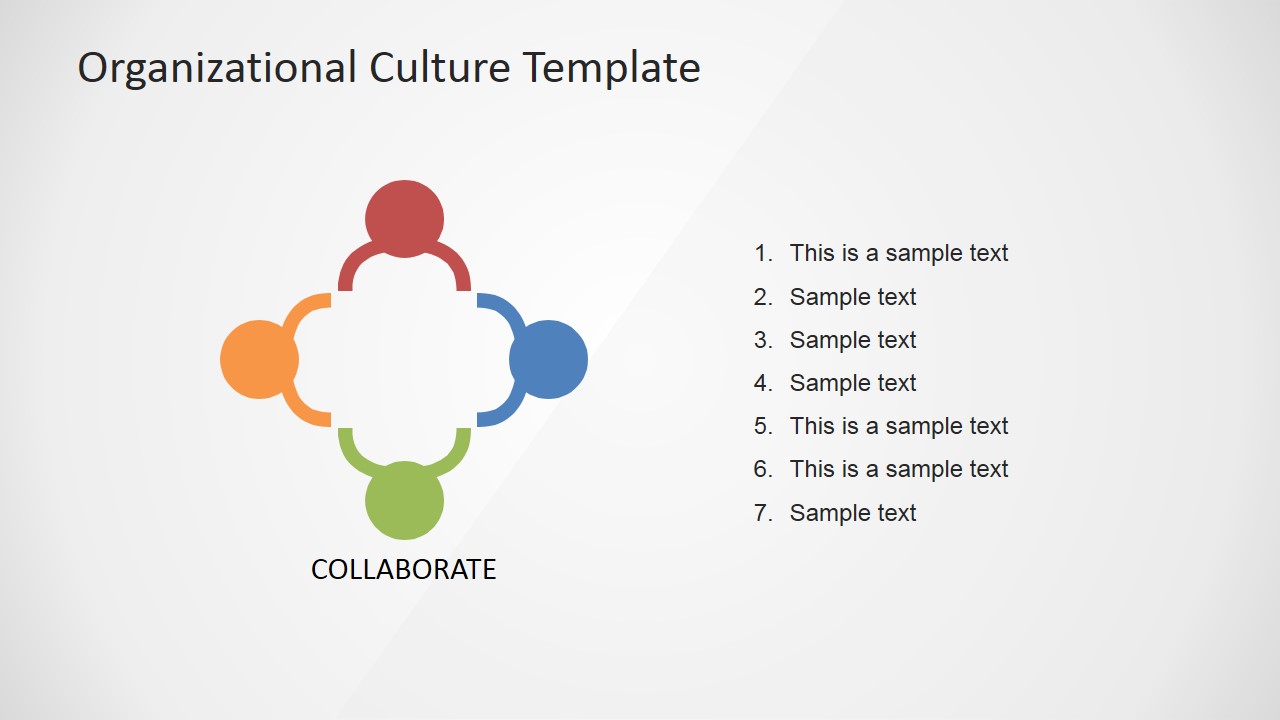
- A change manager can use the collaborate, control, compete, and create profile slides to explain the dominant culture traits that may support or resist a transformation.
- An executive facilitator can use the quadrant summary slide to compare leadership expectations across departments before deciding which culture attributes to reinforce.
Features
- 100% editable presentation template
- Compatible with Microsoft PowerPoint and Google Slides
- 16:9 aspect ratio slides
- Scalable vector shapes, icons and illustrations
- AI-Ready for Microsoft Copilot and Claude
- Instant access and download
Frequently asked questions
Q: How should a presenter explain the culture framework without making the quadrant diagram feel abstract?
A: Start with the axes before naming the culture types. Explain the tension between internal and external focus, then the tension between flexibility and control. After that, connect collaborate, create, control, and compete to recognizable behaviors. The individual profile slides help translate each quadrant into practical examples, norms, or leadership habits.
Q: Who is this template best suited for in a culture or change discussion?
A: It fits HR, organizational development, and leadership teams that need a shared language for culture assessment. The overview quadrant works well for executive briefings, while the sticky-note layout supports workshops where participants classify behaviors, risks, and desired values before discussing how the organization should move forward.
Q: Why use a quadrant metaphor for organizational culture instead of a simple list?
A: The quadrant metaphor makes trade-offs visible. It shows that culture types are not isolated labels but positions shaped by competing priorities, such as flexibility versus focus and internal versus external orientation. The separate profile slides then prevent the overview from becoming crowded by giving each culture type its own explanation space.




Organizational Culture PowerPoint Diagram
7-slide presentation template for organizational culture mapping, quadrants, and Competing Values Framework discussion
Organizational Culture PowerPoint Diagram is a 7-slide diagram template for explaining culture types in the Competing Values Framework. It includes a four-quadrant culture map, sticky-note quadrant layout, labeled quadrant summary, and individual profile slides for collaborate, control, compete, and create. It is built for Microsoft PowerPoint and Google Slides.
- Category
- Models
- Rating


 Loading...
- Aspect ratio
- 16:9, 4:3
- Item ID
- 6598-01
- Colors
 Microsoft PowerPoint
 Microsoft Copilot
 Claude for PowerPoint
Other formats supported
Subscribe today and get immediate
access to download our PowerPoint templates.