Key Result Areas define the small set of outcome domains a role, team, or business unit is accountable for. They answer a question that performance conversations rarely handle well: out of everything a person does, which results actually determine whether the role succeeded. Consulting engagements and annual planning cycles both depend on that answer, because resource allocation becomes arbitrary when accountability has never been written down.
Presenting a KRA model is harder than defining one. The framework carries weightings, measurement logic, and a link back to corporate strategy, and executives will reject any version that looks like a job description in a table. This article covers the mechanics of the KRA model, the distinction between Key Result Area and Key Responsibility Area, how weighting and cascading work, and how to build a deck that survives scrutiny from management and consulting audiences.
Understanding the KRA Model
A Key Result Area is a domain of accountability expressed as an outcome rather than an activity. “Client retention” is a KRA. “Attend quarterly client calls” is not, because it describes effort. The distinction matters operationally: outcome domains stay stable when tactics change, which is why a well-built KRA set survives reorganizations and shifts in market conditions without needing a rewrite.
Most roles carry between four and seven KRAs. Fewer than four usually signals that the role has been described too abstractly to manage. More than seven means accountability has been diluted to the point where nothing can be prioritized under pressure. The upper bound is not arbitrary. It reflects what a manager can meaningfully review in a single sitting and what an individual can hold in mind while making daily trade-offs.
The model has a second property that consulting teams exploit heavily. Because KRAs describe outcome domains rather than tasks, they aggregate cleanly. The KRAs of a regional sales director roll into the KRAs of a commercial VP, which roll into the enterprise strategic goals set by the executive committee. That vertical coherence is the reason KRA models appear in organizational design work far more often than in pure HR administration.
Key Result Area or Key Responsibility Area
In the corporate and human resources world, these two terms are often used interchangeably to refer to the core functions an employee is accountable for. However, they reflect slightly different perspectives: Key Responsibility Area highlights the duties you own, while Key Result Area focuses on the outcomes expected from those duties.
The practical consequence shows up in how each is written. A Key Responsibility Area reads as ownership of a function: “management of the vendor contract portfolio.” It defines scope and decision rights, and marks the boundary between one role and the next. A Key Result Area reads as a result condition: “vendor portfolio delivers agreed service levels at or below approved cost.” It defines what good looks like once the function has been performed.
Use Key Responsibility Areas when the problem is role clarity. Newly created positions, post-merger integrations, overlapping remits, and outsourced function handovers all need duties settled before anything can be measured. A job description built on responsibility areas gives a candidate an accurate picture of the work and gives HR a defensible basis for grading and compensation.
Use Key Result Areas when the problem is performance. Once duties are clear, the useful question becomes what those duties must produce. Result areas connect an individual to business outcomes, which is what makes them suitable for appraisal cycles, incentive design, and any performance review that needs to distinguish between people who were busy and people who moved a number. Many organizations run both: responsibility areas in the job architecture, result areas in the performance system, with a documented mapping between them.
Building the KRA Model
Deriving Areas from Strategy
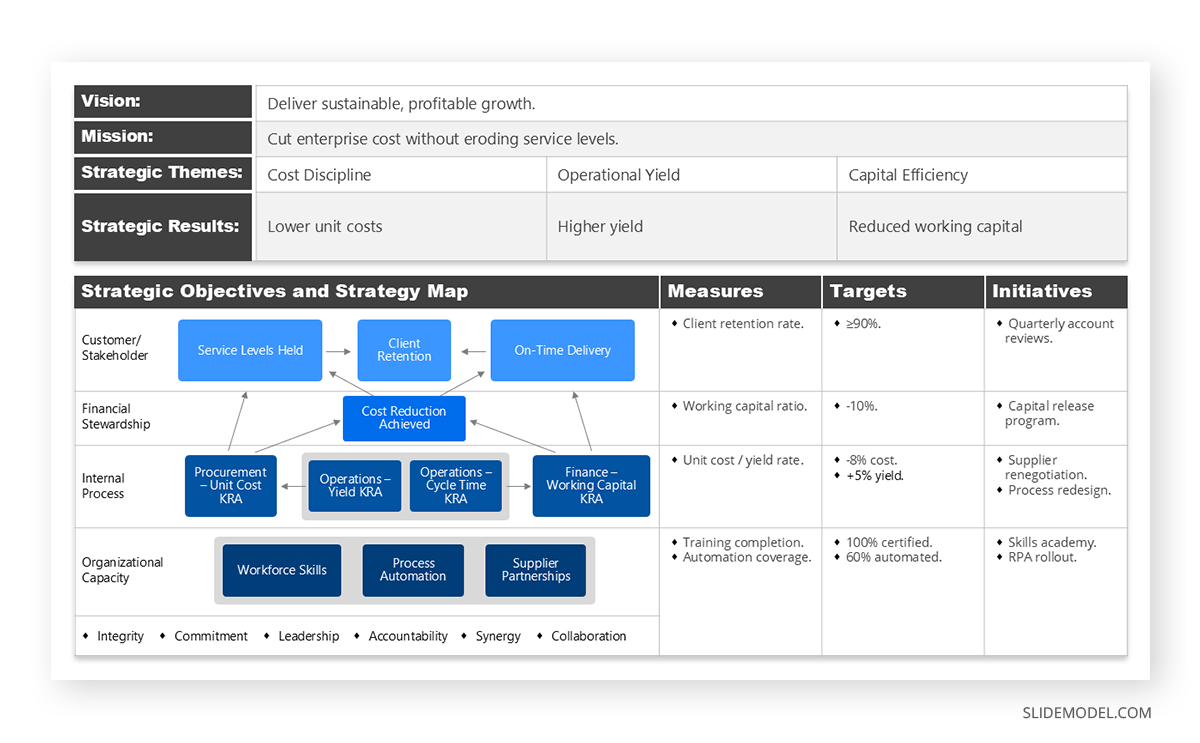
KRAs should be derived from the top down, never invented locally. Start with the corporate objectives for the planning period, identify which functions materially influence each objective, and then translate that influence into outcome domains at the role level. A cost reduction objective might produce a procurement KRA around unit cost, an operations KRA around yield, and a finance KRA around working capital. Each is distinct, owned by a single accountable party, and traced to a line in the strategic plan.
The test for a well-derived area is whether removing it would leave a visible gap in the strategy. If a proposed KRA can be deleted with no consequence at the enterprise level, it belongs in an operating checklist rather than a performance framework. Applying that test rigorously usually eliminates a third of what managers propose in the first drafting round.
Weighting and Trade-Off Logic
Weighting is where the KRA model earns its keep and where most implementations fail. Assigning a percentage to each area forces an explicit statement of relative importance, which people need when two accountabilities conflict. A plant manager weighted at 40 percent on safety and 20 percent on throughput knows what to do when the two collide. Without weights, the framework offers no guidance when it’s needed.
Practical weighting follows a few constraints. Weights sum to one hundred percent. No single area should fall below ten percent, because anything smaller has no influence on behavior and only adds administrative load. The highest-weighted area should be one the role can genuinely move, since weighting someone heavily on an outcome they do not control produces disengagement rather than focus. Weights are also period-specific: a turnaround year and a growth year should not carry identical distributions.
Attaching Measures
Each KRA needs at least one measure, and measures should be defined at the same time as the area, not bolted on later. This is where SMART goal criteria do useful work, because they force a threshold and a date onto what would otherwise remain a statement of intent. A KRA with no measure attached is a value, not an accountability.
Mixed measurement is normal and expected. Some areas support hard quantification, such as revenue or defect rate. Others, including stakeholder management or capability building, require assessed measures based on defined evidence and a stated rating scale. Consulting-grade KRA models explicitly document the evidence basis for assessed measures, which separates a defensible qualitative rating from a subjective one.
KRA, KPI and OKR in One Frame
Audiences routinely conflate these three, and a presenter who cannot separate them will lose credibility in the first ten minutes. The clean formulation: the KRA names the outcome domain, the KPI measures performance within that domain, and the objective sets the ambition level for a defined period.
Structurally, KRAs are stable, and KPIs are not. A customer service KRA around resolution quality persists for years, while the indicator used to track it might shift from average handling time to first-contact resolution as the operating model matures. That asymmetry is deliberate. It lets an organization change how it measures without renegotiating who is accountable for what.
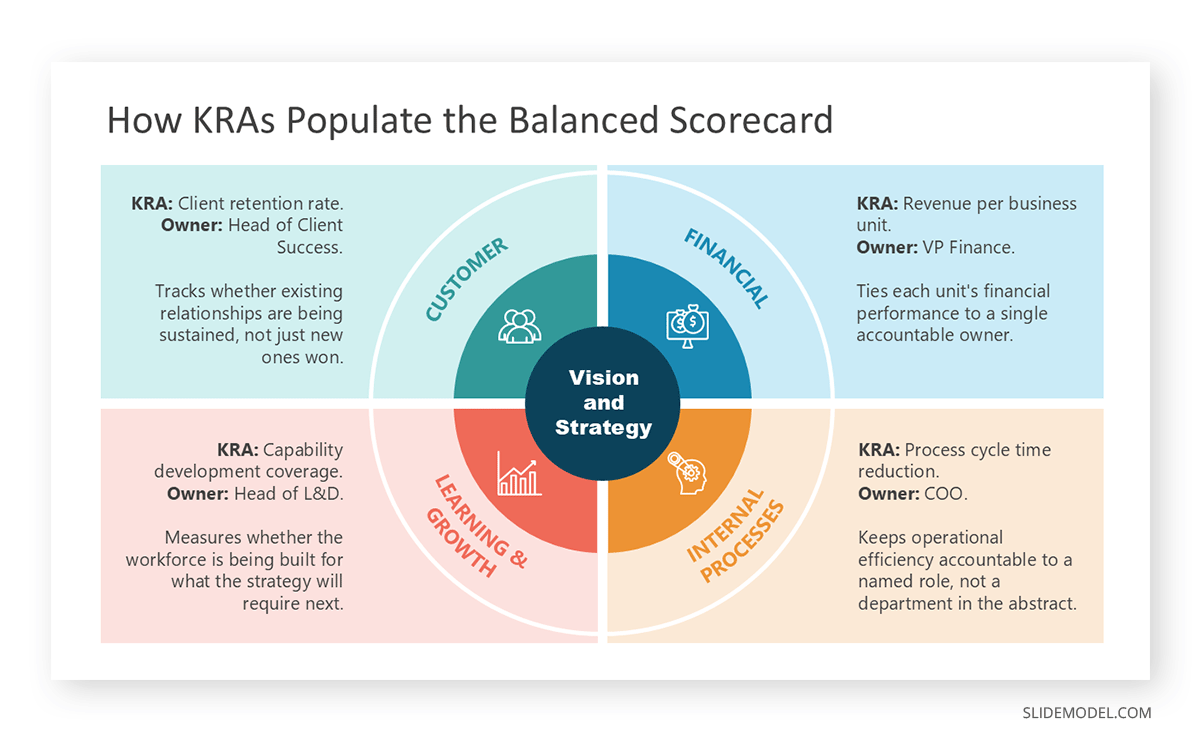
The relationship to the OKR framework is complementary rather than competitive, despite how the two are often positioned. OKRs are time-boxed and aspirational, designed to concentrate effort on a small number of shifts within a quarter. KRAs are continuous and cover the whole of a role, including the parts that must keep working while attention sits elsewhere. Organizations running both typically use KRAs as the accountability baseline and OKRs as the quarterly overlay. The same logic applies to the balanced scorecard, where KRAs populate the perspectives with named owners.
Presenting the KRA Model
Sequencing the Deck
Open with the strategic objective, not the framework. Executive audiences engage with the business problem and tolerate methodology only once they see why it is needed. A first slide showing the objective, followed by a slide showing which functions influence it, earns the right to introduce the KRA structure on slide three.
The cascade slide is the centerpiece. It shows an enterprise objective at the top, the functional outcome domains beneath it, and the role-level KRAs beneath those, with connecting lines that make the derivation visible. Audiences accept KRA sets they can trace and reject ones that appear to have been drafted in isolation, so this single slide often determines whether the model is approved.
Follow the cascade with a weighting slide. Present weights as a horizontal stacked bar per role rather than a table of percentages, because the visual comparison across roles surfaces inconsistencies that a table hides. If two directors at the same level have wildly different distributions, the audience will ask about it, and having the answer prepared shows the model was built deliberately.
Handling the Measurement Section
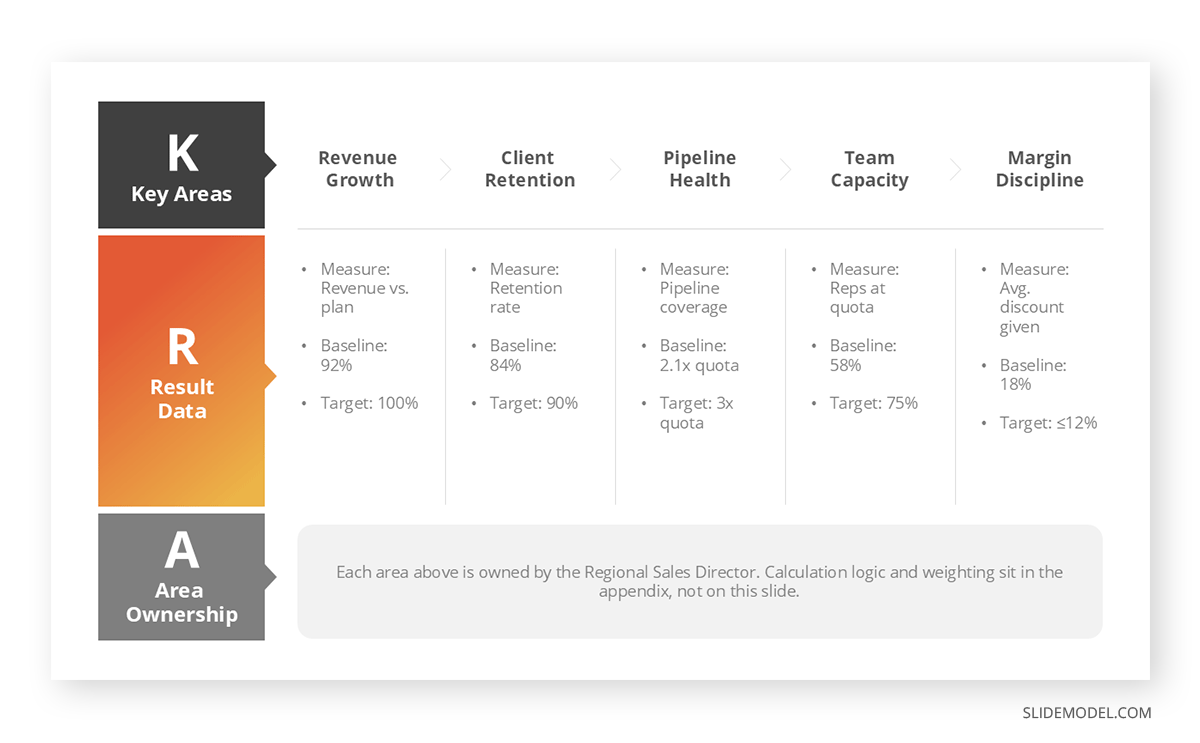
Measurement slides fail when they turn into data dumps. Show the measure, the current baseline, and the target for each KRA, and nothing else. Detailed calculation logic belongs in an appendix that you reference rather than display. Standard practice for presenting key metrics applies here: one message per slide, and no decorative precision beyond what the decision requires.
When reviewing several roles together, a consolidated view works better than sequential role slides. A performance dashboard layout showing KRA status across the leadership team lets the audience see concentration risk, such as three functions all depending on the same underperforming outcome domain. That pattern is invisible when roles are presented one at a time.
Review Cadence
KRA models degrade without a review rhythm, and the deck should state that rhythm rather than leave it implied. A workable pattern reviews measures monthly, reviews weights at the half-year point, and reviews the areas themselves annually or when the strategy changes materially. Embedding the KRA review inside the quarterly business review avoids creating a separate meeting that will eventually be canceled for lack of time.
Common Mistakes When Presenting KRAs
Opening with the Framework Rather than the Business Problem
A first slide headed “Key Result Areas” invites the audience to debate methodology before they have any reason to care. Executives engage with the objective and the accountability gap, so the framework should arrive only after those are on the table. Presenters who lead with definitions spend the rest of the session defending an abstraction instead of discussing outcomes.
Overloaded Cascade Slide
Because the cascade is the centerpiece, presenters try to fit the enterprise objective, every function, every role, and all measures onto one view. The connecting logic disappears under the volume. A cascade slide should show one objective, the functions beneath it, and the role-level areas, with everything else moved to follow-on slides. If the audience cannot trace a line from the top of the slide to the bottom in a few seconds, the slide is doing too much.
Measurement Data Dump
A table listing every KRA, every metric, several baselines, targets, variances, and RAG statuses forces the audience to read rather than listen, and the presenter loses the room. Each measurement slide should carry the measure, the baseline, and the target, with calculation detail held in an appendix that gets referenced rather than displayed.
Presenting KRA as a Job Description in Slide Form
When the layout is a two-column table of role and duties, the audience reads it as an HR artifact and stops treating it as a performance conversation. The fix is visual: express areas as outcome statements with owners and weights shown graphically, so the deck reads as accountability rather than administration.
Hiding the Weighting
Presenters often mention that areas are weighted but never show the distribution, which removes the one piece of information that reveals priorities and inconsistencies. Weights belong on a slide, ideally as a horizontal stacked bar per role, because that view surfaces the moment two peers carry very different distributions and lets the presenter address it directly.
Omitting Named Owners
A KRA slide with outcomes but no accountable person reads as a wish list, and the discussion drifts into general agreement rather than commitment. Every area on the slide should name an owner, which turns the review from a presentation into a set of decisions the audience can make.
FAQs
How many KRAs should a single role have?
Four to seven. Below four, the role is defined too loosely to manage; above seven, prioritization breaks down because nothing carries enough weight to guide a real trade-off.
Are KRA and KPI the same thing?
No. The KRA identifies the outcome domain a role owns, while the KPI is the metric used to track performance within it. One KRA can carry several KPIs, and those KPIs can change without altering the KRA.
Can a KRA be shared between two people?
Shared ownership weakens accountability and should be avoided. If two roles genuinely influence one outcome, split the KRA into distinct components, each with a single owner and its own measure.
What weighting should the most important KRA receive?
Typically 25 to 40 percent. Higher than 40 percent means the other areas stop influencing behavior; the ceiling should also reflect how much control the role actually has over that outcome.
How often should KRAs be revised?
Review the areas annually or whenever strategy shifts materially. Weights can be adjusted at the half-year point, and the underlying measures should be tracked monthly.
Do KRAs replace job descriptions?
No. Job descriptions define scope, reporting lines, and duties. KRAs define the results those duties must produce, and organizations usually maintain both with an explicit mapping between them.
How do you write a KRA for a support function?
Frame it around service outcomes rather than volume. “Systems available to the business during agreed operating hours” is an outcome; “tickets closed” is throughput and belongs in the measure layer.
Can qualitative KRAs be measured fairly?
Yes, provided the rating scale and the evidence basis are defined before the period starts. Documenting what counts as evidence is what makes an assessed rating defensible in a review.
Should KRAs be linked to compensation?
Many organizations do link them, and the weighting structure makes that mechanically straightforward. The prerequisite is confidence that every owner has real influence over the assigned outcome, or the link creates resentment.
What is the difference between a KRA and an objective?
An objective is time-bound and describes a change to be achieved. A KRA is continuous and describes a domain of accountability that persists across periods, including periods where no change is targeted.
How do KRAs cascade in a matrix organization?
Split the accountability by dimension. The functional line owns capability and standards outcomes; the business line owns commercial and delivery outcomes. Each dimension carries its own weighted areas within one combined model.
Should individual contributors have KRAs?
Yes, though the areas will be narrower and more operational than at the management level. The value is the same: clarity on which results matter when competing demands arrive in the same week.
How do you present KRAs to a skeptical executive audience?
Lead with the strategic objective and show the derivation path before showing the framework. Executives resist models presented as methodology and accept models presented as answers to a business question.
What happens when a KRA is consistently missed?
Investigate the cause before adjusting the target. Persistent misses usually indicate either an orphaned accountability, an unrealistic baseline, or a measure that no longer reflects the outcome it was chosen to represent.
Can the KRA model work alongside OKRs?
Yes, and the combination is common. KRAs hold the permanent accountability baseline while OKRs concentrate quarterly effort on specific shifts, so the two operate at different time horizons without overlapping.
Final Words
The KRA model works because it forces two decisions most organizations prefer to leave vague: which outcomes a role owns, and how those outcomes rank against each other when they conflict. Get the derivation right and the weighting honest, and the framework gives managers a defensible basis for every performance conversation that follows.
Presenting it well requires the same discipline.