One of the primary ways in which researchers, students, and faculty members communicate knowledge within scholarly communities is through academic presentations. Whether delivering findings at a conference, defending a thesis, presenting a paper at a seminar, or participating in an academic job talk, the ability to present academic work clearly and credibly matters as much as the quality of the research itself.
The academic presentation is distinct from other formats in that it must meet both intellectual and communicative standards. Committees, peer reviewers, and conference attendees expect precision in language, rigor in evidence, and logical coherence in argument. At the same time, they are human audiences who benefit from organized slides, clear explanations, and a pace that allows them to follow complex ideas without strain.
This guide covers every stage of academic presentation work: from the types and structures most commonly used across disciplines to the specific demands of thesis defenses, conference presentations, and academic job talks. It addresses how to translate written research into slide content, how to handle technical material such as equations and data visualizations, and how to prepare for the questions and interactions that academic audiences generate.
Types of Academic Presentations
Academic presentations take different forms depending on the stage of study, the audience, and the purpose of communication. A research seminar in a doctoral program, a poster session at an international conference, and a thesis defense all fall under the same category, yet each follows distinct conventions and serves a different function. Understanding these formats before selecting a structure or visual approach prevents misalignments between content and context.
Research Presentations
A research presentation is a structured delivery of ongoing or completed scholarly work to an academic audience. Its core purpose is to communicate findings, methodologies, or theoretical positions clearly enough for peers to evaluate and engage with them. The format is common across all levels of study, though what is expected from a presenter changes substantially depending on the program.
At the undergraduate level, research presentations typically accompany capstone projects, senior theses, or coursework requiring independent investigation. The emphasis is on demonstrating that the student can identify a question, gather evidence, and present conclusions in an organized way. Slide structure tends to be straightforward, and the time allotted is usually brief, between 10 and 15 minutes.
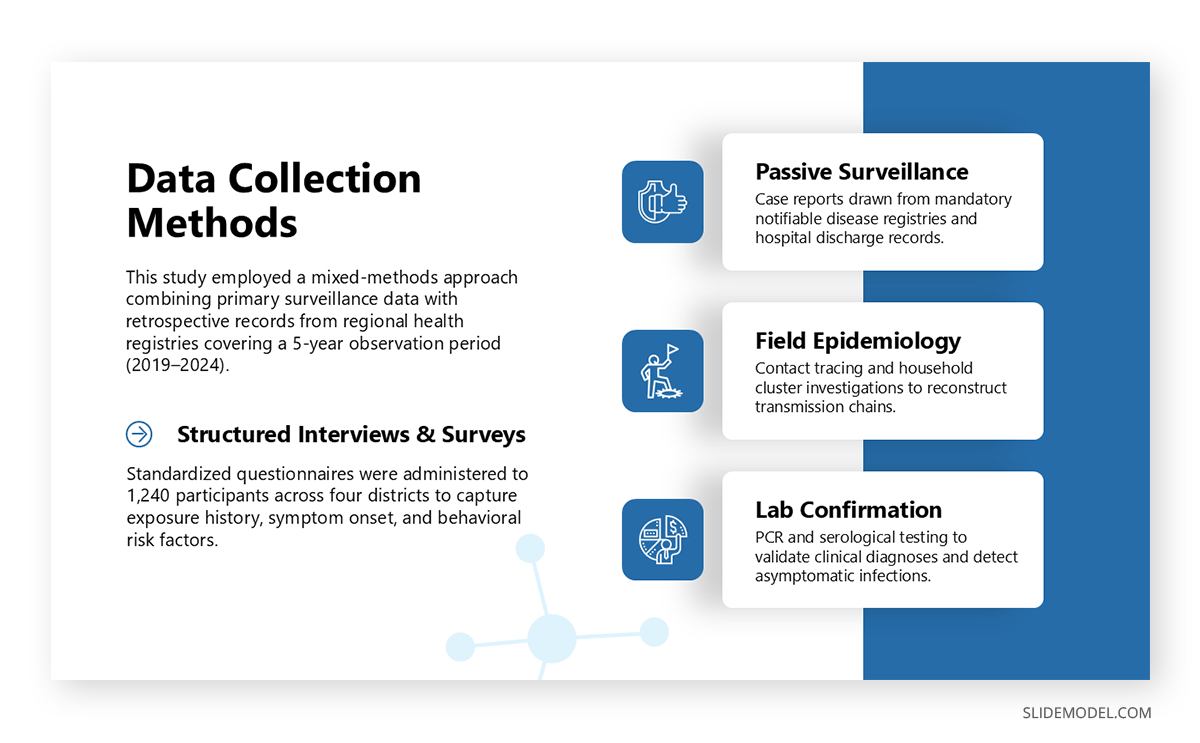
At the master’s level, research presentations are expected to show greater command of disciplinary literature and methodological reasoning. Presenters are assessed not just on what they found but also on whether their choices of method and analysis hold up under scrutiny by a specialist audience. Progress seminars and project defenses in master’s programs typically follow a structure that moves from the problem statement and literature review through the methodology to the findings and conclusions.
Doctoral research presentations are held to the highest standards. Whether delivered at a departmental seminar, a conference, or an internal review, PhD-level presentations must demonstrate independent scholarly contribution and the ability to situate new knowledge within existing debates. The audience at this level will include specialists familiar with the relevant literature, who will scrutinize the methodology, the interpretation of results, and the framing of contributions with corresponding depth.
Thesis and Dissertation Presentations
The thesis defense and the dissertation defense are the two most formal presentation types in academic programs. Both require a candidate to present completed research to an examining committee, but they differ in scope, duration, and what is at stake. Preparing for either benefits from reviewing guidance on how to structure a proper thesis defense presentation, including how to sequence argument, evidence, and conclusions to give the committee a clear picture of the work.
A master’s thesis defense is typically shorter, running between 20 and 45 minutes, and the committee will usually consist of two or three faculty members who supervised or reviewed the work. The candidate is expected to summarize the research, justify the methodology, and explain the contribution to the field. Questions from the committee follow, and the candidate must respond with sufficient depth to demonstrate command of the material.
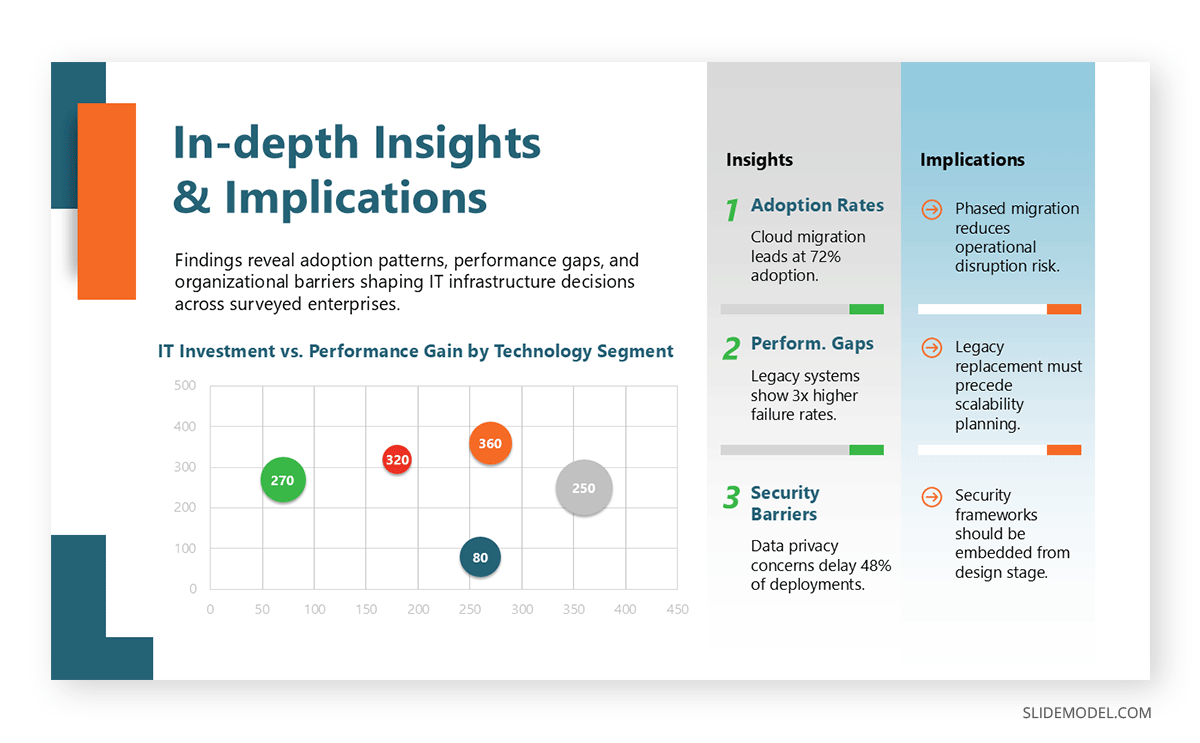
A doctoral dissertation defense is a more extended event, often lasting between 60 and 120 minutes, including the question period. The committee typically includes internal faculty and, in many institutions, at least one external examiner unfamiliar with the candidate’s specific project. This broader composition means the presentation must be accessible enough for a specialist in an adjacent area while still satisfying those closest to the research. Online formats have also created a growing category of digital dissertation presentations; online master’s thesis presentations follow similar principles but require additional attention to audio quality, screen layout, and managing questions in a remote setting.
Committees evaluating thesis and dissertation defenses bring specific expectations to each section of the presentation. The literature review must demonstrate comprehensive engagement with the field rather than a selective survey. The methodology section must justify every significant choice. The results must be presented without overclaiming, and the discussion must honestly assess limitations alongside contributions. Candidates who have internalized these expectations, rather than simply memorizing their slides, tend to handle committee questions with noticeably more confidence.
Common slide structures for thesis and dissertation presentations follow the standard academic research format: title and research question, literature overview, theoretical or conceptual framework, methodology, results, discussion, conclusions, contributions, and future directions. The final slides are often left visible during the question period so that committee members can refer back to specific data or claims as needed.
Poster Presentations
A poster presentation is a visual format used at academic conferences and symposia, in which researchers display their work on a large printed board and engage directly with attendees. Unlike a talk, the poster session is not structured around a fixed delivery slot. Presenters stand beside their poster for a designated period, and interested attendees approach at their own pace. The interaction is conversational, and the duration of each exchange depends on the visitor’s level of interest.
The academic poster session format changes both what presenters must prepare and how they must communicate. A poster cannot carry the same depth of content as a talk because visitors absorb it visually in seconds before deciding whether to engage. The layout must communicate the core question, method, and findings at a glance. Supporting detail is delivered verbally, in response to questions, rather than printed in dense text. Presenters who treat their poster as a condensed version of their paper typically produce something unreadable from a normal viewing distance.
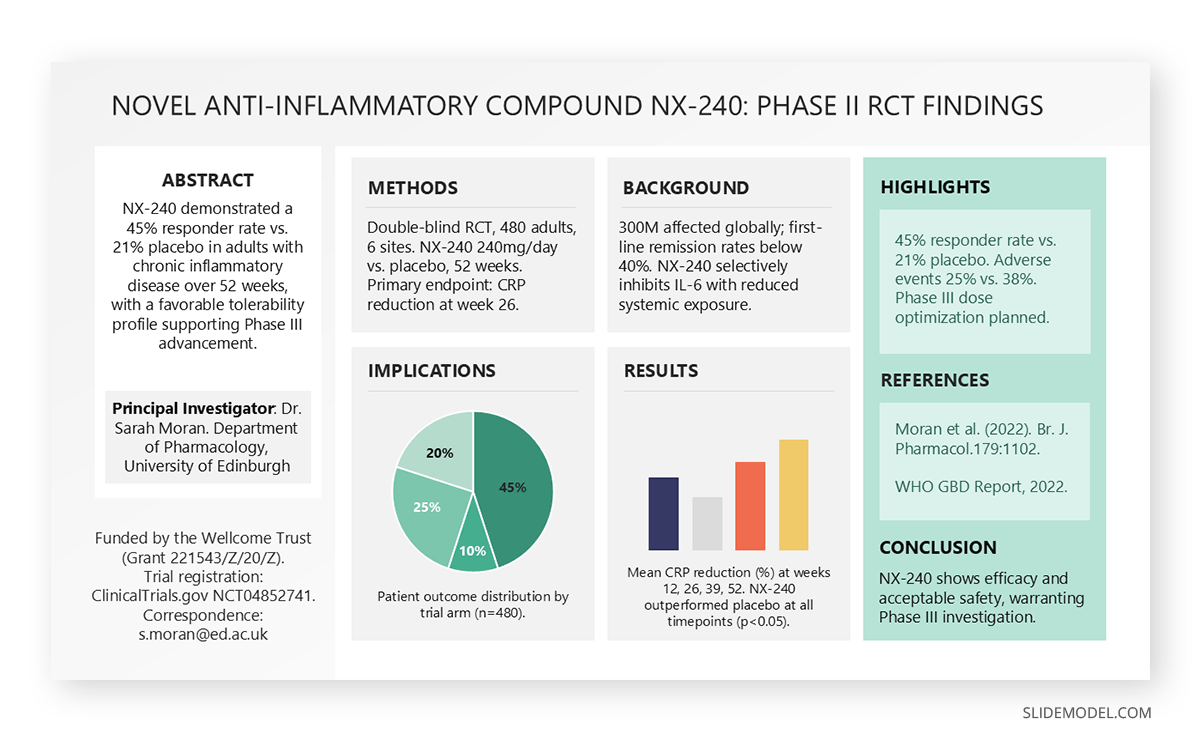
The key differences between a poster and a slide-based presentation go beyond the obvious physical format. A talk has a captive audience committed to listening for a fixed time. A poster must capture the attention of people on the move. This means that hierarchy of information, visual contrast, and the clarity of the main claim matter more on a poster than in a slide deck. Abstract language that might work in a spoken introduction often fails on a poster because there is no presenter’s voice to add context or emphasis.
Poster size standards vary by conference. The most common formats are A0 portrait (841 x 1189 mm), 36 x 48 inches, and 48 x 36 inches in landscape orientation. Conference organizers always publish their requirements, and designing for the wrong size creates practical problems that cannot be corrected on the day. Content organization on a poster typically follows a column-based layout with clearly labeled sections: background, objectives, methodology, results, and conclusions. Visual elements such as figures and tables should carry the argumentative weight wherever possible, with body text serving as a concise annotation.
Academic Video Presentations
The growth of distance learning, online degree programs, and recorded conference formats has made the academic video presentation a standard format in many institutional settings. A video presentation involves recording a narrated slide deck or a screen capture with voiceover, which is then submitted, uploaded to a learning platform, or shared with a conference that does not require live attendance.
The use cases for recorded academic presentations have expanded considerably over recent years. In distance learning programs, video formats replace live seminar presentations, allowing students to present their work asynchronously to peers and instructors. Online degree programs increasingly require video submissions as part of assessed coursework. MOOCs and open educational resources often feature researcher-presented video lectures that follow the same structure as a research talk but are optimized for solo viewing without a live audience.
Choosing video over live delivery involves trade-offs that are worth thinking through carefully. A live presentation allows for real-time interaction, including the ability to pause, adjust pacing in response to audience cues, and address questions immediately. A recorded presentation allows editing, re-recording, and polishing delivery in ways that are impossible in a live setting. For high-stakes submissions where the content must be precise and the delivery controlled, video has clear advantages. For panels or sessions where discussion and response are central to the purpose, live formats remain preferable.
Technical quality matters considerably more in video presentations than in live delivery. Background noise, inconsistent microphone levels, and poor screen resolution are distracting in ways that a physical room can partially absorb. Before recording, presenters should test audio levels, ensure the screen resolution is sufficient for readable text and graphics, and choose a background that does not visually compete with the slides. A single clean run-through recorded from the start is usually more effective than a heavily edited version assembled from multiple takes, which often introduces subtle inconsistencies in tone and pacing.
Core Structure of an Academic Presentation
A clear slide structure is among the most reliable ways to make a complex academic presentation accessible. Most presentations benefit from a consistent order that mirrors the logic of the research itself, regardless of discipline.
Recommended Slide Flow
The opening slides should establish the research context and provide the audience with sufficient background to understand what follows. The goal is not to repeat the entire literature review but to give attending peers a clear frame of reference. Context-setting also allows the presenter to define the problem space before introducing specifics.
The problem statement slide follows naturally. It should specify the research problem in plain, precise terms. Vague problem statements lose academic audiences quickly, and the problem must be narrow enough to be solvable within the scope of the work being presented. A focused problem statement is also one of the first things evaluators assess in formal defense settings.
The research objectives slide translates the problem into concrete questions or goals. These objectives anchor the rest of the presentation and give the audience a way to evaluate whether the work succeeds on its own terms.
The literature review section in a presentation need not reproduce the full review from a thesis or paper. Instead, it should identify the key bodies of knowledge the research builds on, acknowledge gaps the work addresses, and position the research within current scholarly debates.
The methodology section is where many presenters lose their audiences by including too much procedural detail. Slides should convey the approach, justify its choice, and describe data sources or analytical frameworks at a level sufficient for peer evaluation, without becoming a step-by-step technical walkthrough.
Results and findings slides should focus on what the data shows, not simply how the data looks. Interpretation matters as much as display, and the presenter must guide the audience through the significance of the results rather than leaving them to form independent conclusions.
The discussion section connects results back to the original research problem and to existing literature. Strong discussion sections acknowledge limitations without undermining the overall contribution. The conclusion and future work slides give the presentation a defined endpoint, clarifying what the research demonstrated, what remains open, and where the work is heading. References and acknowledgments are placed at the end, with citation of key sources and acknowledgment of funding bodies being standard practice in formal academic settings.
Best Practices for Slide Length by Academic Level
The number of slides appropriate for an academic presentation varies by context. A 15-minute conference presentation typically uses 12-18 slides. A thesis proposal may extend to 25 or 30 slides. A full dissertation defense often reaches 40 or more slides, accounting for detailed methodology and extended results.
A general rule is one to two slides per minute when the presenter plans to speak in detail about each slide. Acknowledgment slides and brief transition slides do not count the same way. Doctoral students presenting in progress seminars often overbuild their decks; committees tend to prefer fewer, denser slides over many thin ones.
At the undergraduate level, academic presentations are usually shorter. A 10-minute paper presentation might call for 8 to 12 slides with relatively simple content. At the master’s level, more methodological depth is expected. At the doctoral level, slides must withstand close scrutiny from evaluators who are specialists in the field.
Developing Strong Academic Content
Converting academic writing into presentation content requires choices that many researchers find uncomfortable. A thesis or journal article is written to be read, reread, and cross-referenced. A presentation is experienced in real time, in sequence, without the ability to pause or review. These are fundamentally different formats and should be treated as such.
The most common error is treating a slide as a page. Paragraphs from written work pasted into slides make the content harder to process. The presenter competes with the text for the audience’s attention. When slides contain full sentences, audiences read rather than listen, and the presenter’s verbal explanation becomes redundant or contradictory.
The translation from writing to slides should begin with the core claims. What are the two or four central ideas the audience must retain? Each major claim deserves its own slide or sequence of slides. Supporting evidence, qualifications, and methodological notes belong in the presenter’s spoken narrative rather than in slide text. Choosing precise, powerful words in presentations matters in academic contexts, but clarity and precision outweigh rhetorical effect.
Academic content also benefits from critical thinking applied to the structure itself. Before building slides, the presenter should be able to articulate why each section belongs in the deck, what it contributes to the argument, and how it connects to the sections that precede and follow it. A sequence that cannot be justified intellectually should be restructured or removed.
Visual representations of relationships between ideas can help when written explanations risk becoming too dense. Mind maps are occasionally appropriate in sections dealing with theoretical frameworks or the organization of literature, provided they are designed with enough clarity to be readable from a distance.
The tone of academic presentation content should match the field’s register. Some disciplines are highly formal; others, particularly in the social sciences and humanities, allow more narrative. Knowing the audience, their expectations, and the norms of the specific conference or program matters as much as the content itself.
Presenting Data, Equations, and Technical Content
Data, mathematical notation, and technical content introduce specific challenges in academic presentations. These elements must be legible, accurate, and explained in ways that allow audiences to evaluate their significance without a second viewing.
Equations should be formatted using proper notation. In LaTeX-based disciplines, equations displayed in a presentation should match the standard notation used in the written paper. Presenters who use PowerPoint can insert LaTeX-rendered equations via add-ins or prepare equation slides in Beamer, the LaTeX presentation framework widely used in mathematics, physics, computer science, and related fields. Regardless of the tool, equation font sizes must be large enough to read from the back of a room. Small subscripts and complex fractions that look fine on a printed page often fail completely on a projected slide.
When presenting data, choosing the right chart type is fundamental. Line charts communicate change over time; bar and column charts compare values across categories; scatter plots reveal relationships between variables. Comparison charts are particularly useful in research contexts where the presenter needs to juxtapose conditions, groups, or time periods.
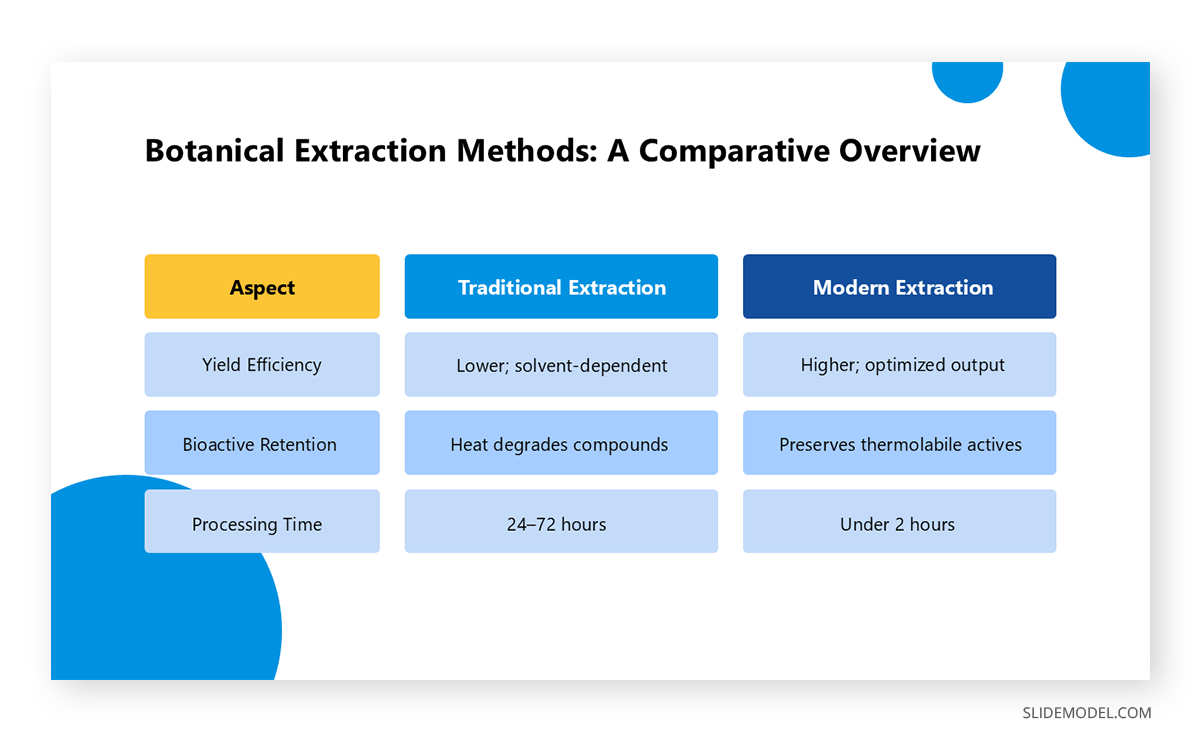
In all cases, the presenter must explain what the visualization shows. Displaying a graph without narrating its interpretation leaves the audience uncertain whether the result confirms or challenges expectations. For every data slide, the presenter should be able to explain what the axes represent, what each data series shows, and what conclusion the audience should draw.
Tables are appropriate when precise values matter, and the audience needs to compare multiple numbers across categories. However, tables that contain more than six or eight rows are rarely effective in a presentation setting. Summarize the key takeaway in a title above the table, and allow the visual structure to direct attention to the rows or columns that carry the argument.

For qualitative research, data presentation involves excerpts, coded themes, or narrative summaries. Presenters should select representative examples rather than exhaustive lists. The credibility of qualitative findings depends on the researcher’s ability to explain how the data was analyzed and why the selected examples support the stated conclusions.
Intermediate and Progress Presentations in Academic Programs
Graduate programs involve multiple formal presentations before the final defense, and each has its own set of expectations. Understanding what evaluators look for at each stage helps students prepare presentations that serve the moment rather than overreach or underperform.
Proposal Presentations
A thesis or dissertation proposal presentation introduces a research plan. At this stage, the student is asking a committee to approve the research direction, not to present completed findings. The structure emphasizes the research problem, the theoretical framework, the research questions, the proposed methodology, and the expected contribution to the field.
Committees evaluating a proposal are looking for whether the problem is well-defined, whether the methodology is appropriate and feasible, and whether the student has sufficient command of the relevant literature. Slides should reflect this by giving more space to the rationale for choices rather than to preliminary results, which may not yet exist.
Progress and Correction Sessions
Progress or correction presentations occur at intermediate points in a program, often at the end of a first or second year of doctoral research. These sessions are less formal than a defense but require honest reporting. The student should explain what has been completed, what challenges have emerged, and how the plan has evolved.
Evaluators at these sessions focus on whether the student is proceeding with intellectual independence and whether the scope of the work remains realistic. Slides should present evidence of independent analysis rather than summaries of supervisory conversations. Honest acknowledgment of difficulties is expected and valued over a polished but misleading account of smooth progress.
Committee Feedback and Internal Reviews
Some programs include committee meetings or internal reviews in which the student presents to a group of faculty members before a formal examination. These are opportunities to identify weaknesses in the research before they appear in a defense or in peer review. Presenters should come prepared with specific questions for the committee, not just a standard presentation.
The structure for internal reviews often mirrors that of the full thesis: introduction, literature review, methodology, findings, and discussion. However, in early-stage reviews, one or two of these sections may still be incomplete, and the student may present them as works in progress with clear indications of what remains to be done.
What Evaluators Expect at Each Stage
At every stage, evaluators are assessing the same fundamental capacities: command of the literature, clarity of argument, appropriateness of methodology, and intellectual maturity. What changes is the weight placed on each. At the proposal stage, methodology and literature matter most. At the final defense, the quality and interpretation of findings take precedence.
Regardless of stage, evaluators want to see that the student can respond coherently to questions and defend their choices. The ability to actively listen to a question, identify what is actually being asked, and give a precise answer is a skill that must be developed alongside presentation preparation.
How Structure Evolves from Proposal to Final Defense
The slide structure of a research presentation should evolve as the research matures. A proposal deck is forward-looking, presenting a plan and its justification. A progress presentation is both backward-looking (what has been done) and forward-looking (what remains to be done). A final defense is primarily evidence-based, presenting the completed work and its contribution.
Students who use the same slide structure at every stage miss the opportunity to communicate where they actually are in the research process. Adapting the structure to the moment signals maturity and awareness of what the audience needs from that particular presentation.
Presenting Conclusions and Academic Contributions
The conclusion section of an academic presentation is where the argument reaches its final point. In many presentations, this section receives less preparation than it deserves, resulting in endings that trail off rather than land with clarity.
A strong academic conclusion does four things: it restates the core research question, summarizes the main finding or argument, articulates the contribution to the field, and identifies directions for future research. These elements can be covered in two to four slides, depending on the complexity of the work.
The articulation of contribution is where many students struggle. Stating that research “adds to the literature” is not enough. The contribution should be specific: this study shows that X changes under condition Y, a change that previous models did not account for. Or: this analysis of texts from period Z reveals a pattern that revises assumptions about literary genre. The specificity of the contribution statement is what distinguishes a defense-ready presentation from one that still needs work.
Building a persuasive argument matters in the conclusion section as much as anywhere else in an academic presentation. The conclusion is not simply a summary; it is the point at which the presenter asks the audience to accept the significance of the work. The argument must be grounded in the evidence presented, clearly stated, and proportionate to what the research actually demonstrates.
Overstatement is a significant risk in conclusion slides. If the findings are modest but sound, the conclusion should reflect that. Exaggerating the reach of the work invites scrutiny that the evidence cannot support. Academic audiences are trained to detect overclaiming, and it undermines credibility more than modest, accurate conclusions would.
Design and Visual Standards for Academic Presentations
Academic presentations are not expected to be visually elaborate, but they are expected to be clear and consistent. Poor design can undermine credible research by making slides difficult to read, disorganized, or visually distracting.
The baseline standard is readability. Body text should not fall below 20 points in a projected presentation. Headings should be clearly differentiated from body text. Color contrast between text and background must be sufficient for easy reading under variable projection conditions.
Color should be used purposefully. In academic contexts, complex color schemes often work against the presenter by drawing attention to the design rather than the content. A two-color scheme with clear semantic use, for example, one color for emphasis and another for labels, is generally more effective than a palette chosen for visual appeal alone. Avoid using color as the only differentiator in charts or diagrams, since academic audiences may include individuals with color vision deficiencies.
Figures, tables, and charts should always be labeled. Axis labels, legends, and captions are not optional in academic work. The same standards that apply in a published paper should apply in a presentation. Presenters who show unlabeled or poorly labeled figures in a thesis defense signal a lack of rigor that can affect the committee’s overall assessment.
Understanding how cognitive biases affect your audience’s perception is a consideration worth taking seriously when designing slides. Anchoring, for example, means that the first number or claim on a slide influences how subsequent information is interpreted. Presenting data in a logical order that supports the argument is not merely an organizational choice but a factor in how the argument lands.
Font choice in academic presentations should prioritize clarity. Sans-serif fonts often project more clearly on slides than serif fonts, even in disciplines where serif is the publishing standard. Avoid mixing multiple font families, and maintain consistent sizing across slides to create visual coherence that helps audiences focus on content rather than format.
PowerPoint templates can significantly reduce design workload. An academic presentation PowerPoint template provides a consistent visual structure that meets basic design standards without requiring the presenter to make design decisions from scratch. A well-chosen academic conference presentation template or academic paper presentation template will include appropriate slide layouts for each standard section.
FAQs
What is an academic presentation?
An academic presentation is a formal communication of research or scholarly work delivered to an academic audience. It may occur at a conference, seminar, departmental meeting, thesis defense, or in an educational setting. All academic presentations share expectations of intellectual rigor, evidence-based argument, and disciplinary precision regardless of format or length.
What is the difference between an academic presentation and a conference paper?
A conference paper is a written document submitted and sometimes published in conference proceedings. A conference presentation is the live delivery of that work, or a condensed version of it, to an audience. The paper provides the full record of the research, while the presentation communicates key findings in real time.
How long should an academic conference presentation be?
Most academic conference presentations run between 12 and 20 minutes, with an additional 5 to 10 minutes for questions. Some conferences allocate shorter 10-minute slots. The program guidelines always specify the allotted time, and presenters are expected to stay within it.
What is an academic poster presentation?
An academic poster presentation is a format used at academic conferences where researchers display their work on a large printed poster and discuss it with interested attendees during a dedicated session. Posters must communicate research objectives, methods, and findings in a compact, visually accessible format.
What size should an academic poster presentation be?
Academic poster presentation size is usually determined by the conference organizers. The most common formats are A0 (841x1189mm), 36×48 inches, or 48×36 inches in landscape orientation. Presenters should always check the conference’s specific requirements before designing their poster.
What is an academic job talk presentation?
An academic job talk presentation is a formal presentation given by a candidate during an academic job interview. It typically runs 45 to 60 minutes and demonstrates the candidate’s research agenda, methodology, and contribution to the field. Hiring committees use it to assess both research depth and the ability to communicate to a broad academic audience.
How is an academic job talk different from a conference presentation?
A conference presentation addresses a specialized audience with shared expertise. An academic job talk addresses a hiring committee that may include faculty from adjacent fields, so it must be accessible to a broader audience while still satisfying specialists. It is also longer and carries higher professional stakes than a typical conference slot.
What should be included in an academic CV under presentations?
Academic CV presentations typically include the title of the presentation, the name of the conference or event, the institution or organization hosting it, and the date and location. Presentations at peer-reviewed conferences are usually listed separately from invited talks or departmental seminars, with peer-reviewed formats listed first.
What is the difference between an academic proposal presentation and a thesis defense?
A proposal presentation asks a committee to approve a research plan before the research is conducted. A thesis defense presents completed research and asks the committee to accept it as a satisfactory contribution to knowledge. The structure, tone, and evidence base of the two are substantially different.
How many slides should an academic presentation have?
The number of slides depends on the length of the presentation and the density of content per slide. One slide per minute is a workable starting ratio. A 15-minute conference presentation might use between 12 and 18 slides. A 45-minute dissertation defense may use 35 to 50 slides, including appendix slides for anticipated questions.
How should I present data in an academic presentation?
Data should be presented with clearly labeled axes, legends, and titles. Chart types should match the nature of the data: line charts for trends over time, bar charts for category comparisons, scatter plots for correlational data. The presenter must interpret the data verbally rather than simply displaying it. Every data slide should drive toward a clear conclusion.
Is LaTeX or PowerPoint better for academic presentations?
This depends on the discipline. In mathematics, physics, and computer science, LaTeX-based Beamer slides offer superior equation rendering and integrate naturally with written work. In the social sciences, the humanities, and many applied fields, PowerPoint or Google Slides is standard and provides sufficient functionality. Beamer requires more time to learn and is less accessible to non-technical collaborators.
What are common mistakes in academic conference presentations?
The most frequent problems are overloading slides with text from the written paper, spending too long on background and not enough on findings, failing to interpret data visualizations, losing track of time, and inadequate preparation for questions. Presenters who practice with a timer and receive feedback from colleagues before the conference tend to avoid most of these issues.
What is an academic integrity presentation?
An academic integrity presentation covers the principles and policies that govern honest scholarship, including attribution, proper use of sources, and the boundaries between collaboration and academic dishonesty. These are commonly delivered to students at the start of academic programs or in courses involving significant written or research work.
How should I prepare for questions after an academic presentation?
Anticipating questions is the most reliable preparation. After reviewing the presentation, list the two or four questions most likely to come from a critical audience: challenges to the methodology, alternative interpretations of the data, questions about generalizability or limitations, and connections to other work in the field. Drafting substantive responses before the presentation reduces the likelihood of being caught off guard.
What is the role of an academic advisor in an interview presentation?
An academic advisor interview presentation is a brief research presentation given by a prospective student or early-stage researcher to a potential supervisor. Its purpose is to demonstrate intellectual preparation, clarity of research interest, and the ability to communicate academic work. Students should show they have engaged seriously with relevant literature and have a clear sense of the questions they want to pursue.
Can I use animations in academic presentations?
Animations are acceptable in academic presentations if they serve a communicative purpose, such as revealing steps in a process or building a complex diagram sequentially. Decorative animations that add no clarity should be avoided. Academic audiences are not typically impressed by visual effects and may find them distracting from the argument.
What is the best academic presentation template for conferences?
The best academic conference presentation template provides clean layouts for the specific sections needed: title slide, literature review, methodology, results, and conclusions. It should use readable fonts, clear visual hierarchy, and a color scheme that does not draw attention away from the content. SlideModel offers academic presentation templates designed to meet these requirements across a range of disciplines.
How do I make a poster for an academic conference?
An academic poster presentation begins with identifying the core contribution that can be communicated visually in a limited space. The poster should be organized into clearly labeled sections: background, methods, results, and conclusions. Text should be minimal and large enough to read from arm’s length. Reviewing academic poster presentation examples from the field before designing can help calibrate expectations for layout and content density.
Should I memorize my academic presentation?
Full memorization is neither necessary nor advisable. The goal is to internalize the argument well enough to deliver it in a conversational manner, with slides serving as reference points rather than scripts. Practicing the full presentation multiple times, including responses to anticipated questions, builds the preparation needed for the presenter to speak fluently without reading from slides or delivering a rigid recitation.
Final Words
Academic presentations are a lasting professional skill that researchers and students carry throughout their careers. The ability to translate complex, rigorous work into a spoken presentation that a room of experts can follow, evaluate, and engage with is not incidental to academic work. In many disciplines, it is part of what constitutes doing the work well.
The conventions of the academic presentation are not arbitrary. They developed because knowledge claims need to be communicated in ways that allow others to assess them. A clear structure, precise language, appropriate evidence, and an honest accounting of limitations all serve this purpose. Presenters who treat these conventions as obstacles miss what makes the academic presentation a serious intellectual act.
Developing this skill takes practice, feedback, and attention to the specific demands of each audience and context. The formats and techniques covered in this guide provide a working foundation. The path to a strong academic presentation runs through rehearsal and through genuine engagement with the ideas being communicated.