Customer Development Process PowerPoint Template – A presentation targeted for different segments with the aim to describe the structured process which successful startups execute in order to grow from an entrepreneurial team of people into a established company. The PowerPoint Template provides editable versions of the Customer Development Process, and describes an holistic methodology that minimize the risk of the startup and generates sustainable business. This presentation can be adapted for the following scenarios:
- Entrepreneurs pitching a startup development process, growing strategy and customers acquisition.
- Teachers and Lecturers explaining new entrepreneurs the process of building a startup and transform it into a successful company.
- Executives trying to transform their organization from an entrepreneurial environment into a structured growing business.
- Professionals with a Product Idea who want to create a startup to commercialize it.
- Consultants who want to mentor new startups and help them structure their customer development process.
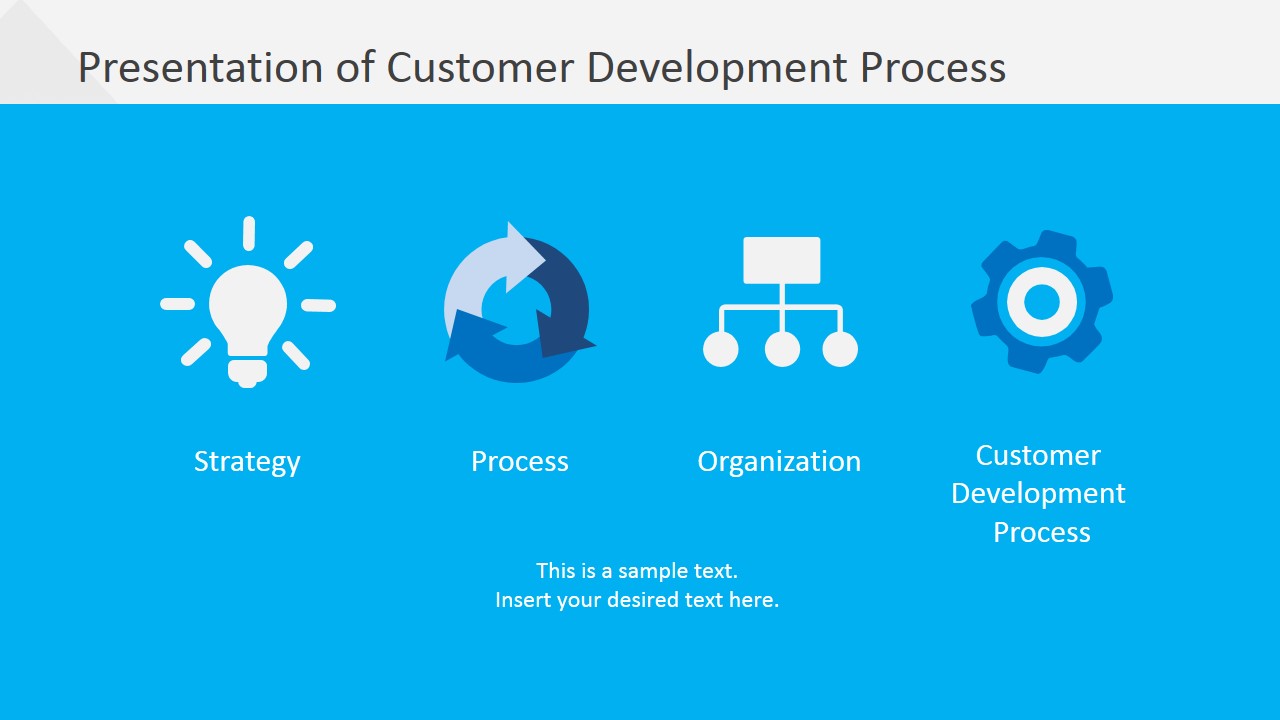
The Presentation Template provide the overall Startup Development Process
- Strategy
- Process Development
- Organization Structure
- Customer Development Process
What is the Customer Development Process?
Steve Blank first formally described the Customer Development Process in his book “The Four Steps to the Epiphany”. After years of practical experience and research, Steve Blank formalized the process which successful startups followed in order to create sustainable business. For years the academia (business schools) teached to new business owners and entrepreneurs, that the process to launch a company was through a Business Plan and a Product/Service development process. The process was straight forward, create a business plan, do the market research, create a set of assumptions, create a 5 years projection, and if the main variables (IRR, NPV) were positive, execute the plan and succeed. This process proved to be inaccurate and generated millions of dollars of losses to entrepreneurs and investors.
The mantra of the Customer Development Process is mainly that every assumption and hypothesis an entrepreneur formulates when building its company and product/service, are false, and that if not proven against a real market sample with a real experience, it will fail. Even more, testing the hypothesis against the market will not guarantee the positive outcome, but will guarantee negative tests. Based on this observation, Steve Blank explains that the process an entrepreneur needs to execute is different and needs to be focused in learning from customers, not from technology or the product itself. This simple change of focus enables the entrepreneur to develop the product and the customer base together, minimizing the risks, keeping the budget under control and constantly evolving the value proposition. Even more, developing customers for profits.
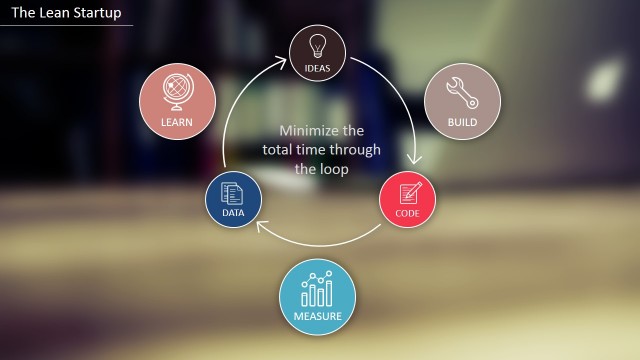
The Customer Development Process is based in four looping steps. Each step itself is a cycle, and it loops until a hypothesis is validated against customers.
- Search Phase
- Customer Discovery Cycle
- Customer Validation Cycle
- Execution Phase
- Customer Creation Cycle
- Company Building Cycle
Create amazing presentations editing the Customer Development Process PowerPoint Template. Each object of the Diagram is created 100% with PowerPoint shapes, allowing the user to fully customize the diagrams appearance, and without losing visual quality when reusing the assets in existing presentations.
What’s inside this template
Example presentation scenarios
- A startup founder can use the staged process map and milestone columns to explain how the team will move from customer discovery to company building before asking investors for support.
- An entrepreneurship instructor can use the strategy search versus execution slide and feedback loop to teach why customer evidence should guide product and business model decisions.
- A product manager can use the process iteration slide to align customer development work with product management, release planning, acceptance tests, and small releases.
- A consultant can use the organization chart and department grid to advise a venture on how founder-driven learning evolves into sales, business development, marketing, and engineering functions.
- A growth lead can use the acquisition pathway table to connect customer development questions with prospect actions, business activities, retention, revenue, and growth stages.
Features
- 100% editable presentation template
- Compatible with Microsoft PowerPoint and Google Slides
- 16:9 aspect ratio slides
- Scalable vector shapes, icons and illustrations
- AI-Ready for Microsoft Copilot and Claude
- Instant access and download
Frequently asked questions
Q: How should a presenter explain the customer development message with this deck?
A: Start with the four-stage process map so the audience sees the full path from discovery to company building. Then move into strategy, process, and organization to show what changes at each level. Use the feedback loop and milestone columns to keep the focus on evidence, learning, and repeated validation rather than a fixed launch plan.
Q: Who is this template best suited for in a business presentation?
A: It is strongest for founders, startup advisors, product managers, and instructors who need to explain how a venture tests assumptions before scaling. The visible layouts support teaching and planning: a strategy search versus execution diagram, an org structure view, and an acquisition pathway table that connects customer insight to business activity.
Q: Why does the template use loops, arrows, and stage columns instead of only text slides?
A: Customer development is an iterative method, so the circular arrows, pivot labels, and feedback loop make repeated learning visible. The stage columns on Slide 7 separate discovery, validation, creation, and company building, which helps audiences understand progression without assuming every startup moves forward in a straight line.


Customer Development Process PowerPoint Template
8-slide presentation template for lean startup customer development, process maps, and organization diagrams.
Customer Development Process PowerPoint Template is an 8-slide strategy deck for explaining lean startup growth from discovery to company building. It includes a staged process map, strategy search versus execution diagram, organization chart, feedback loop, milestone columns, and acquisition pathway table for Microsoft PowerPoint and Google Slides.
- Category
- Strategy
- Rating


 Loading...
- Aspect ratio
- 16:9, 4:3
- Item ID
- 6656-04
- Colors
 Microsoft PowerPoint
 Microsoft Copilot
 Claude for PowerPoint
Other formats supported
Subscribe today and get immediate
access to download our PowerPoint templates.