Leadership continuity is rarely tested until it is needed most, and by then a company either has an answer or it doesn’t. Only 21 percent of HR professionals report having a formal succession plan, while more than half say they have no plan at all, according to a 2024 SHRM workplace survey. Among S&P 500 companies, an estimated 61 percent still operate without a documented succession protocol for their top leadership roles. These gaps rarely surface during ordinary board meetings. They surface during a sudden resignation or a departure that catches an executive team off guard, and then the presentation meant to guide the transition either exists or gets built in a panic.
Many teams start with a set of succession planning PowerPoint templates to standardize how each department documents its leadership bench, then build the narrative and risk assessment around that structure. This guide walks through what a succession planning presentation needs to accomplish, how to structure it so executives take it seriously, and how to deliver it in a room where the subject itself makes people uncomfortable.
What a Succession Planning Presentation Is Actually For
A succession planning presentation is not a routine HR update, and treating it as one is usually why these decks get a polite nod and no follow-through. Its real function is to answer a specific question for the people in the room: if a given leader left tomorrow, would the organization have a credible next step, or would it be improvising? Framed this way, the presentation becomes less of a talent management exercise and more of a risk disclosure, closer in weight to a board presentation on financial exposure than to a slide about employee engagement scores.
That reframing changes what belongs on the page. A deck built around this risk question needs to show which roles are genuinely difficult to replace and how prepared the current bench is to fill them, then lay out what the organization is doing right now to close any gap. It should tie directly into the broader HR strategic plan rather than existing as a stand-alone document reviewed once a year and forgotten. When a succession presentation only lists names next to job titles without addressing readiness or timeline, it gives executives a false sense of security. The goal is to leave the room with a clear, current answer to the “what if” question, not a document that satisfies a compliance checkbox.
Mapping the Roles That Carry Real Risk
Not every position needs a formal succession plan, and trying to build one for every role in the company dilutes attention away from where it actually matters. The presentation should start by narrowing focus to positions where an unplanned vacancy would meaningfully disrupt operations, revenue, or client relationships. This typically includes the CEO and other C-suite roles, but it often extends further into specialized technical positions, regional leadership, or any role where a single person holds knowledge that has never been documented elsewhere.
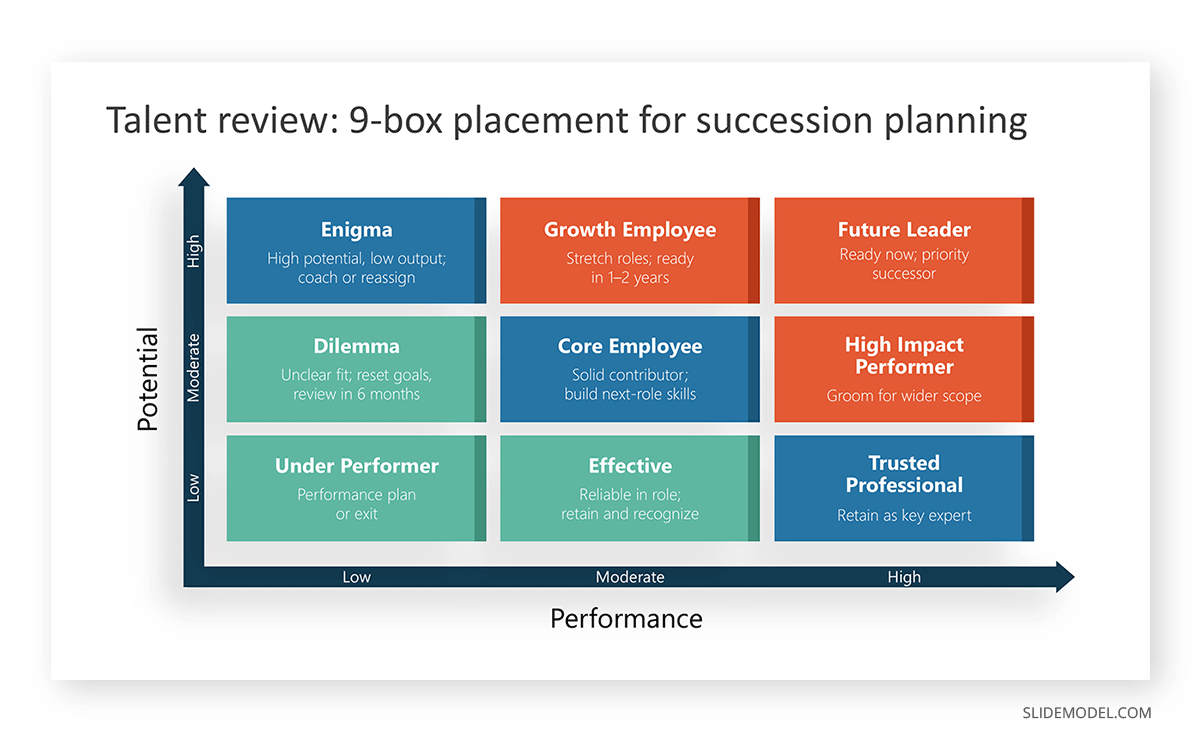
A 9-box talent review is a useful way to visualize this on a single slide, plotting each candidate’s current performance against future potential. Pairing it with a skills matrix that maps required competencies against each successor’s current capability gives executives a concrete picture of readiness, not a subjective impression. A role with no identified successor, or one where every candidate scores low against the required competencies, is exactly the kind of finding this section of the presentation exists to surface. Burying that finding, or softening it to avoid an uncomfortable conversation, defeats the purpose of building the deck in the first place.
Structuring the Presentation From Business Case to Action Plan
Once you map roles and risks, the presentation needs a sequence that carries executives from why this matters to what happens next. A succession deck that jumps straight into names and org charts without first establishing the stakes often reads as routine paperwork. The following structure keeps the narrative moving toward a decision, not a filing cabinet.
Opening With the Business Case
The first slide should state plainly why the audience is looking at this now: an upcoming retirement or a governance gap that has gone unaddressed for too long. Framing this as a short executive summary keeps it readable under time pressure, and it sets the tone for the rest of the slide deck as a business issue rather than an HR formality.
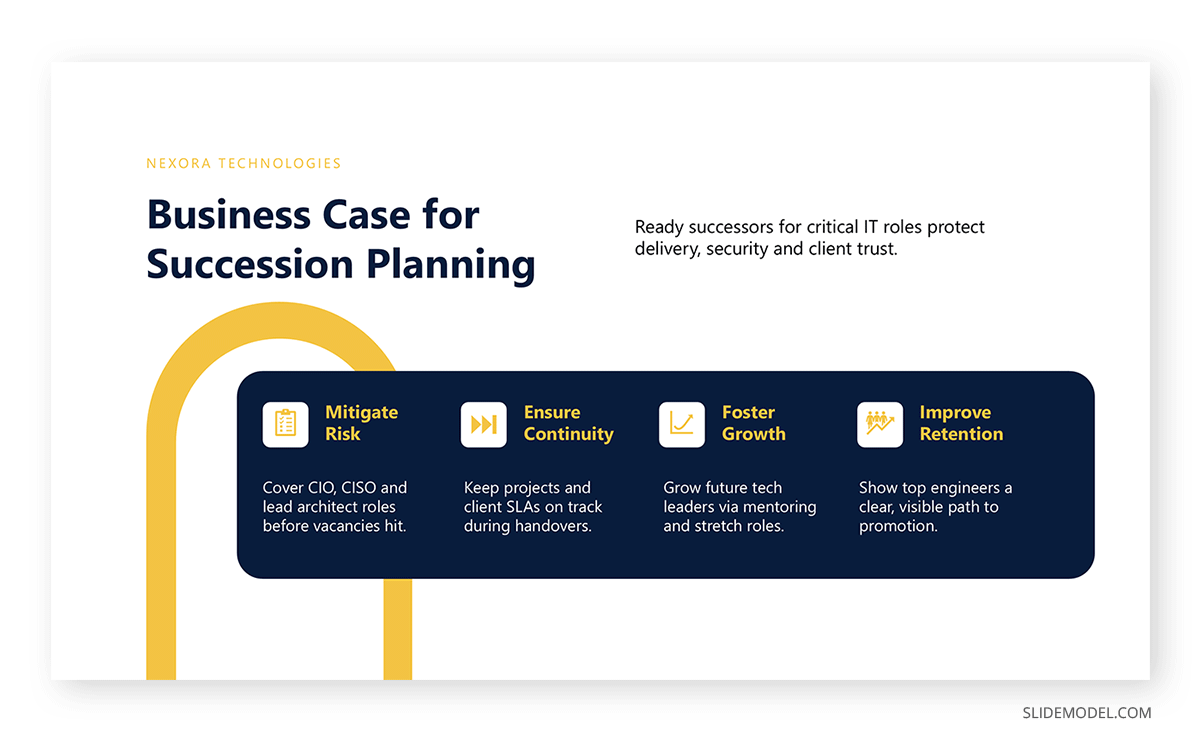
This slide also establishes who is presenting the plan and who has already reviewed it, which matters when a board or executive committee is being asked to weigh in on something as sensitive as leadership continuity. Anchoring the business case in a specific event, rather than a general sense that succession planning is good practice, is what turns a routine slide into the reason the rest of the room leans in. Vague language here tends to undercut the urgency the rest of the presentation is trying to build.
The Organizational and Talent Pipeline View
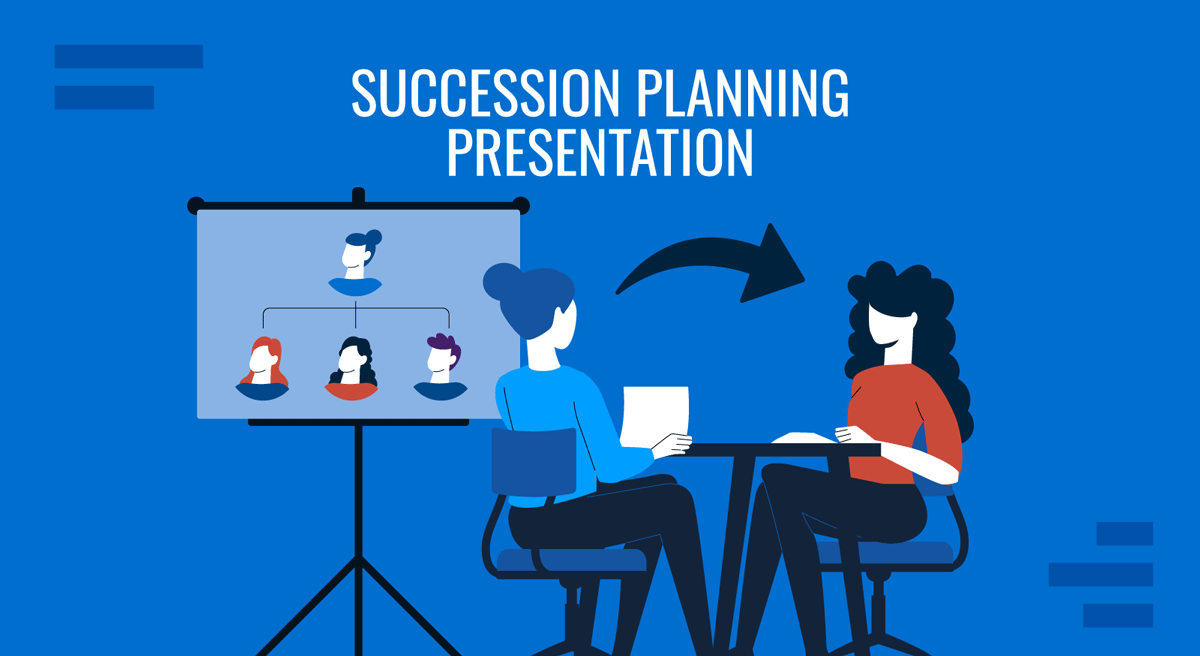
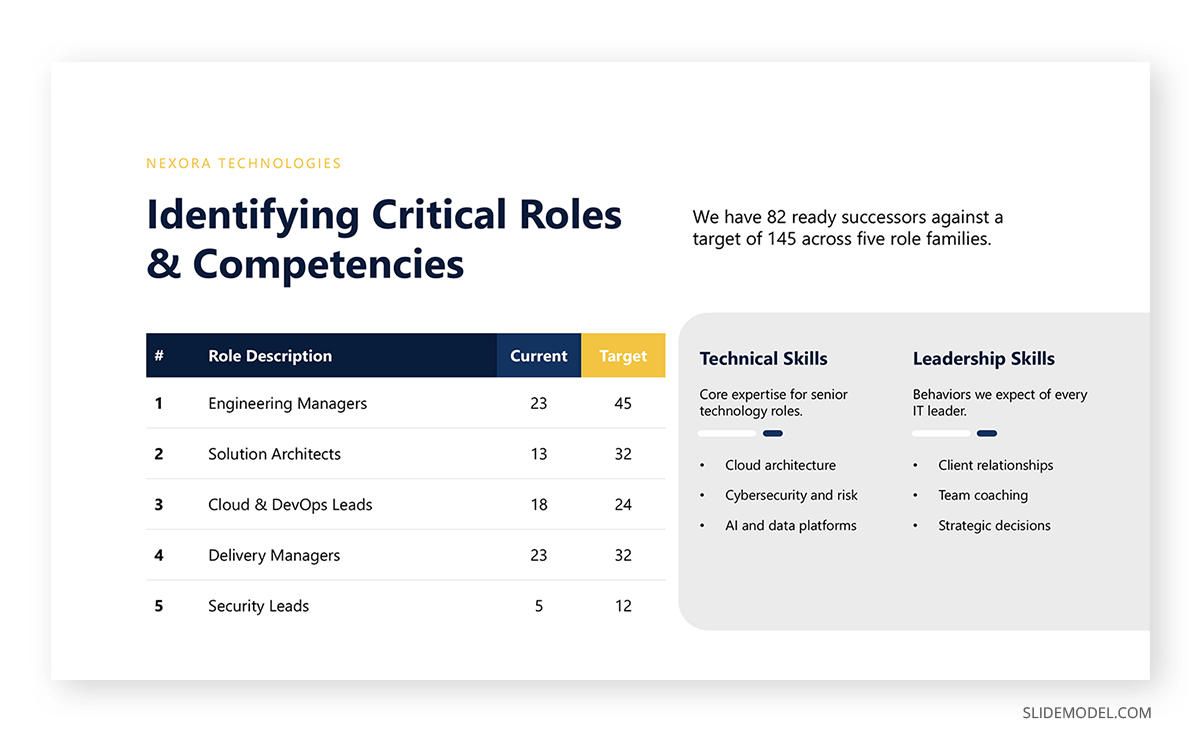
This is usually the visual center of the deck. Review the available org chart templates before building this slide to choose a format that reflects how reporting lines will actually look if the plan is executed, rather than defaulting to whatever structure was used in the last presentation. Many teams find it faster to build the org chart directly in PowerPoint so the visual stays consistent with the rest of the deck, rather than importing a mismatched graphic from another tool. Alongside the chart, a pipeline view showing each successor’s current role and estimated readiness timeline, paired with a career development plan for those still a few years out, gives the audience a sense of depth rather than a single name attached to a single role.
Governance: Naming an Owner and a Review Cadence
A succession plan without a named owner tends to go stale within a year. This section should specify who tracks readiness, how often the plan gets reviewed, and how it connects to other planning cycles already in place. Doing a quick stakeholder mapping exercise beforehand clarifies who actually needs visibility into this plan, since board members, the CEO, and department heads each need a different level of detail.
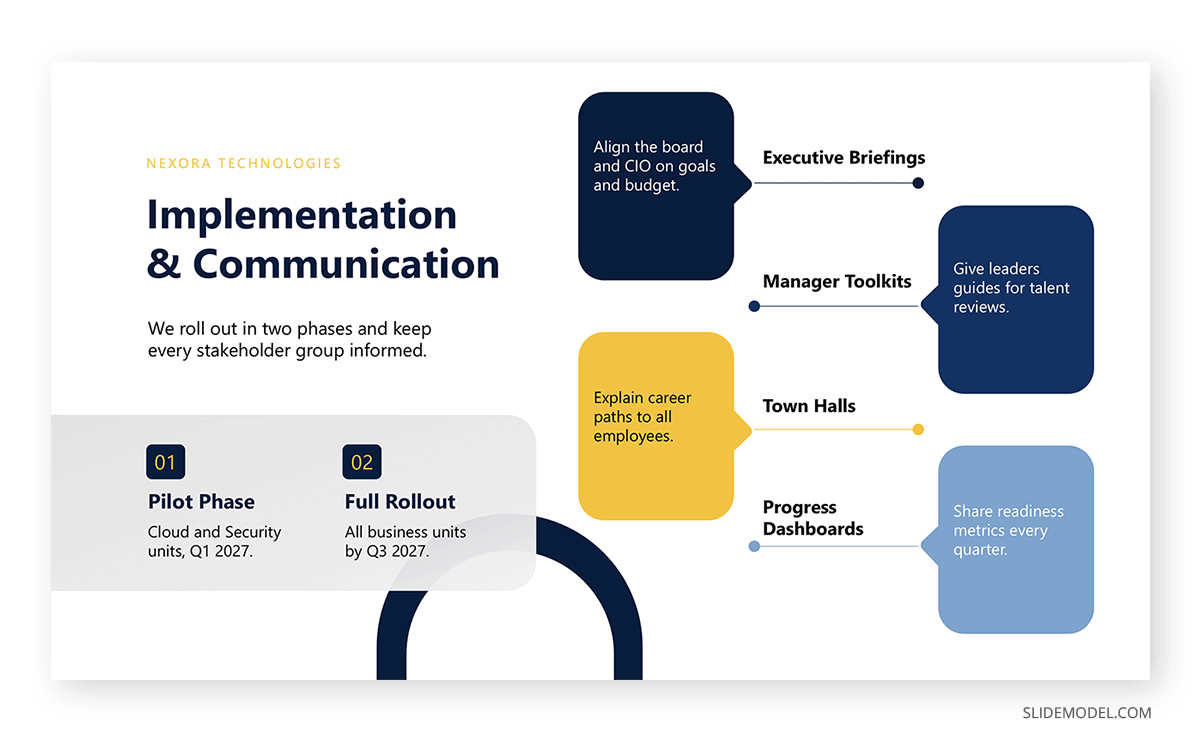
Tying succession planning back to the organization’s stated company values also reinforces that leadership development is a genuine priority, not an exercise that exists only on paper.
Closing With a Timeline and Concrete Next Steps
The presentation should end with specific commitments: which gaps get addressed first, what training starts immediately, and when the plan will be formally revisited. A simple timeline slide listing the next ninety days, the next two quarters, and when the plan gets reviewed again gives the room something concrete to hold onto once the meeting ends.
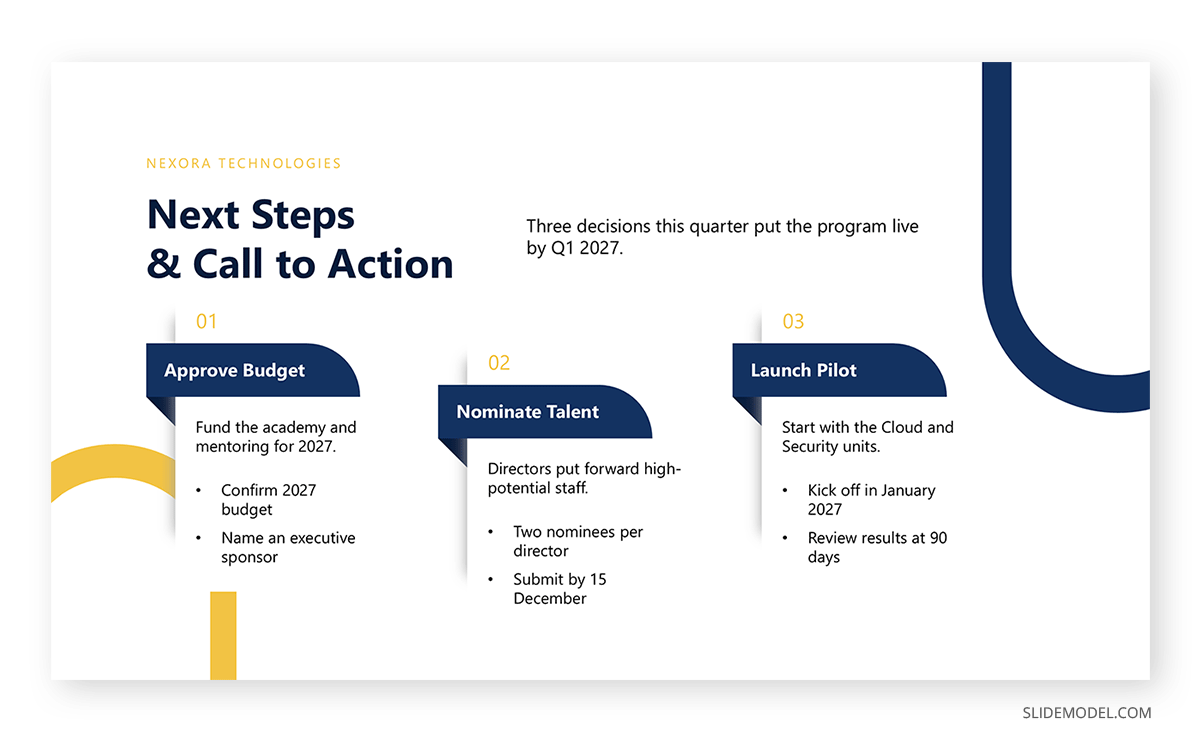
Presenters who skip this step often find the plan gets filed away without anyone circling back, which is precisely what a good succession plan is designed to prevent.
Developing Successors Before They Are Needed
Identifying a successor is only half the work; the other half is making sure that person is actually ready when the time comes. This section of the presentation should move past names and into the specific development activities underway for each candidate. A mentorship guide can inform how pairing works between a successor and a current leader, giving the candidate exposure to decisions they would not otherwise see. Formal coaching presentation sessions and stretch assignments, layered with occasional cross-functional rotations, belong in this section as concrete evidence that development is happening rather than assumed.
Without this detail, a succession plan is just a list of names with no attached path, and executives are right to be skeptical. The presentation should show, for each key candidate, what skill or experience gap remains and what specific action is closing it, ideally with a rough timeline attached. This level of specificity separates a credible plan from a wish list, and it usually takes the most work to prepare because it requires honest conversations with both the candidate and their current manager about where they genuinely stand.
Deciding Between Internal Promotion and External Hiring
No organization can promote from within for every vacancy, and pretending otherwise weakens the plan’s credibility. Some roles require specialized expertise or a fresh perspective that the internal bench simply does not have yet. This section of the presentation should be honest about which roles are being developed internally and which will likely require an external search, along with the rationale for each decision.
A useful way to ground this decision is to look at how the current performance review process rates internal candidates against the competencies the role actually requires. If a candidate has been rated highly on execution but has never managed the scale or complexity the target role demands, that is a legitimate reason to plan for an external search rather than force an internal promotion that sets someone up to fail. Presenting this reasoning openly, rather than defaulting silently to internal promotion out of loyalty or convenience, keeps the plan grounded in what the business actually needs.
Presenting the Succession Plan Without Triggering Defensiveness
Putting a name on a slide as a potential successor is not a neutral act. It signals to everyone else in the room who is being considered and, by omission, who is not. Presenters who treat this as simply reading through slides tend to miss real-time reactions: a hesitation from the current leader, a raised eyebrow from a peer who expected to be on that list. Those reactions carry more information than anything written on the page, and addressing them directly in the room, rather than moving on to the next slide, is usually what determines whether the plan gets genuine buy-in or quiet resistance afterward.
Part of what makes this conversation difficult is that succession planning touches on a leader’s own sense of relevance. Identifying someone who could eventually do a leader’s job can read, even unintentionally, as a signal that they are replaceable sooner than they would like. Reviewing basic organizational change management principles before this meeting helps presenters anticipate that reaction and frame the plan as a sign of organizational strength rather than a threat to any individual’s position. A leader who has built a credible bench is not making themselves obsolete; they are making the organization less dependent on any single person, which is a stronger position, not a weaker one.
Common Mistakes in Succession Plan Presentations
Even a well-researched succession plan can lose credibility if it falls into a handful of recurring habits. Recognizing them before the deck goes in front of executives gives presenters a chance to correct course.
Treating the plan as a one-time document
A succession plan built once and never revisited becomes outdated within a year as roles change, candidates leave, and business priorities shift. The presentation should make the review cadence explicit rather than leaving it implied.
Listing a single successor per role
Leadership development rarely follows a straight line, and naming only one candidate for a critical role leaves no fallback if that person leaves or their readiness stalls. A stronger plan shows two or three candidates at varying stages of readiness.
Skipping the honest readiness assessment
It is tempting to mark every candidate as ready to avoid an uncomfortable conversation, but this defeats the purpose of the exercise. A presentation that cannot say a candidate needs another two years of development is not being honest with its audience.
Hiding behind vague language
Phrases like building future readiness, without a specific trigger or timeline attached, read as filler rather than substance, and experienced executives notice the difference immediately.
Presenting the org chart without addressing the people on it
A chart alone doesn’t answer whether the people named are prepared, trained, or even aware they are being considered. The narrative around the chart matters as much as the chart itself.
Failing to name an owner
A plan with no one accountable for keeping it current is often the first thing forgotten once the meeting ends and daily priorities take back over.
Turning the Plan Into an Ongoing Discipline
A succession planning presentation only holds value if the organization treats it as a living document, not an artifact from a single meeting. The strongest plans get revisited on a set schedule, updated as candidates develop or circumstances change, and referenced whenever a leadership role does open up, whether that departure was expected or not. Companies with documented, actively maintained succession strategies have been shown to outperform peers without one, not because the plan itself creates value, but because the discipline behind it forces harder conversations about readiness earlier than a crisis would.
Building this discipline starts with the presentation itself: a clear business case and an honest assessment of who is ready and who is not, backed by a named owner accountable for keeping it current. Everything else, including the org chart and the development plans behind it, supports that core discipline. Organizations that treat succession planning this way tend to handle leadership transitions as a managed process rather than an emergency, which is precisely the outcome the presentation is meant to produce.
FAQs
What is a succession planning presentation?
A succession planning presentation is a structured document that identifies which leadership roles carry the highest risk if left vacant, evaluates how prepared potential successors are for each one, and lays out the specific steps the organization is taking to close any readiness gaps. It is typically presented to a board, an executive team, or senior HR leadership rather than distributed as a general company update.
Who should be included in a succession planning presentation?
The presentation generally focuses on roles that would be difficult to backfill quickly, most often the CEO and other C-suite positions, though it can extend to specialized technical roles or regional leadership depending on the organization. It should name the current leader, one or more potential successors, and the specific development activities underway for each candidate.
How often should a succession plan be reviewed?
Most organizations review succession plans at least once a year, though roles with an upcoming retirement or known departure often warrant more frequent check-ins. The presentation should name a specific owner responsible for keeping the plan current, since a plan without a defined review cadence tends to go stale quickly.
Should succession planning presentations be shared with the whole company?
No. Naming specific individuals as potential successors is sensitive information that can affect team dynamics if shared too broadly. These presentations are typically restricted to the board, the executive team, and HR leadership, with only the broader talent development strategy, not individual names, shared more widely when needed.
What is the difference between succession planning and replacement planning?
Replacement planning identifies an emergency stand-in who could step into a role on short notice, often without the full skill set the position eventually requires. Succession planning takes a longer view, developing candidates over months or years so they are genuinely ready to take on the role, not just capable of covering it temporarily.
How many potential successors should be listed for each role?
Most well-built plans list two or three candidates per critical role rather than a single name. This accounts for the possibility that one candidate leaves the organization or their development stalls, and it avoids putting the entire plan at risk if one person’s circumstances change.
What happens if no internal successor is ready for a critical role?
When the internal bench genuinely cannot support a role within the required timeline, the presentation should say so directly and outline a plan for external hiring, including when that search should begin. Forcing an unready internal candidate into a role they cannot yet handle often causes more disruption than an honest external search.
How does succession planning connect to performance reviews?
Performance review data gives succession planning a factual basis for assessing whether a candidate has the track record and competencies a target role requires, rather than relying on subjective impressions. Candidates who consistently score well against the specific skills a role demands are usually the strongest fit for accelerated development.
What makes a succession planning presentation fail with the board?
Boards tend to lose confidence in a succession plan when it relies on vague language, lists names without evidence of readiness, or has no clear owner responsible for keeping it updated. A plan that cannot answer specific questions about each candidate’s timeline and development activity reads as aspirational rather than actionable.
How does succession planning differ for a board versus department-level roles?
Board and CEO succession planning typically involves a formal governance process, often led by a nominating and governance committee, with strict confidentiality and board-level sign-off. HR and the department leader usually manage department-level succession planning directly, with more flexibility in timeline and format because the stakes and confidentiality requirements are lower.