A restructuring announcement is one of the few moments when a presentation carries as much organizational weight as a financial statement. The room reacts to more than the words spoken; it reacts to the sequence in which information appears, the tone of the visuals, and whether the presentation deck in front of employees looks rehearsed or improvised. For finance leaders, HR directors, and department heads tasked with delivering difficult news, the presentation is not a formality that follows the decision. It is the primary vehicle through which trust is either preserved or lost.
Restructuring and layoffs sit at the intersection of legal obligation, financial necessity, and human consequence. A poorly sequenced slide deck can confuse severance terms. A rushed timeline slide can make a phased layoff look chaotic rather than deliberate. A leadership team that walks into an all-hands meeting without a rehearsed narrative can undo months of careful planning in twenty minutes. Because the stakes are this high, the way a company builds and delivers a presentation on handling a layoff deserves the same scrutiny as the restructuring plan itself.
This guide focuses on the practical mechanics of communicating a restructuring or layoff through corporate presentations: how to sequence the announcement, which slides carry the message most effectively, how to design them so they read as calm and factual rather than alarming, and how to prepare the leaders who will stand in front of the room. Whether the audience is a five-person department or a global workforce, the same principles apply.
What Restructuring Communication Actually Involves
Company restructuring covers a range of changes, from merging departments and altering reporting lines to reducing headcount outright. In most cases, restructuring communication gets treated as a single announcement, when in practice it is a sequence of related messages delivered to different audiences over days or weeks. The board needs a financial rationale. Department leaders need operational detail. Employees whose roles are eliminated need clarity about their last day and their severance. Employees who remain need reassurance about the company’s direction. Each audience requires a different presentation, even when the underlying facts are the same.
Approaching a layoff presentation as a communication project, rather than a single announcement, changes how the presentation gets built. Instead of one all-purpose deck, the team produces a small family of related materials: a board-level summary, a leadership briefing for those delivering individual conversations, an all-hands deck for the wider organization, and often a public statement for external stakeholders. Reviewing organizational change management practices before drafting these materials helps teams identify which decisions belong to leadership and which belong to the people delivering the news directly. Restructuring presentations that skip this step tend to conflate audiences, cramming financial justification, individual severance terms, and company vision into a single slide deck that satisfies none of them well.
Before the Announcement: Building the Communication Plan and Mapping Stakeholders
Build every layoff presentation around a communication plan drafted well before the first meeting is scheduled. That plan identifies who needs to know what, in what order, and through which channel. Skipping this step creates the scenario every HR leader dreads: an employee learning about their own layoff from a colleague, a chat message, or a leaked spreadsheet before their manager has a chance to speak with them.
A stakeholder mapping exercise should happen early in this process. Restructuring rarely touches only the employees being let go. It affects direct managers who must deliver the news, IT teams who need to plan access removal, remaining employees who will absorb workload changes, and often customers or partners who depend on specific points of contact. Mapping these groups against their information needs clarifies which materials need to exist before the announcement date and who owns each one.
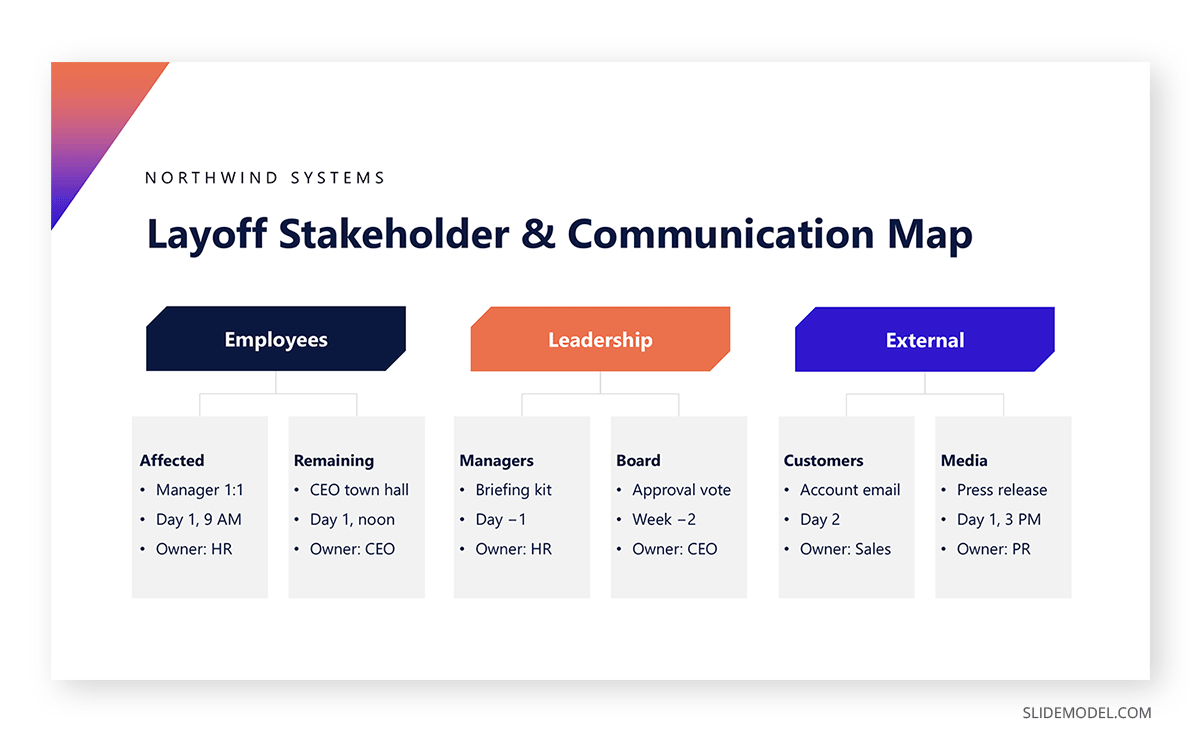
Once stakeholders are mapped, document the plan using a communication plan template that lays out the sequence: who is told first, what materials support that conversation, and what happens if information leaks ahead of schedule. Many restructuring communications fail not because the message was wrong, but because the order was wrong. Notifying department leaders after employees have already heard rumors undermines the credibility of every subsequent conversation. Building this sequencing into the plan and reflecting it in a dedicated timeline slide within the leadership briefing deck keeps everyone working from the same script.
Structuring the Layoff Presentation: The Slides That Matter
Once the plan is set, the presentation itself needs a defined structure. A layoff deck is not a marketing presentation, and it should not attempt to persuade its audience of anything. Its job is to inform clearly, sequence the information so nothing feels withheld, and give people what they need to process the news and act. The following slide types form the backbone of most presentations on handling a layoff, whether delivered to a leadership team, an all-hands audience, or a smaller department meeting. Each serves a distinct purpose, and skipping any of them tends to leave gaps that speculation fills.
The Business Case and Executive Summary Slide
Every layoff presentation should open with a slide that states plainly why the change is happening. Vague language about market conditions or unspecified headwinds tends to erode trust rather than build it, because employees can tell when an explanation is being kept deliberately thin. A stronger approach names the specific pressures driving the decision, whether that is a decline in a particular revenue line, the end of a major contract, or a deliberate strategic pivot away from a business unit, and pairs that explanation with the steps leadership already took to avoid layoffs, such as hiring freezes or reduced discretionary spending.
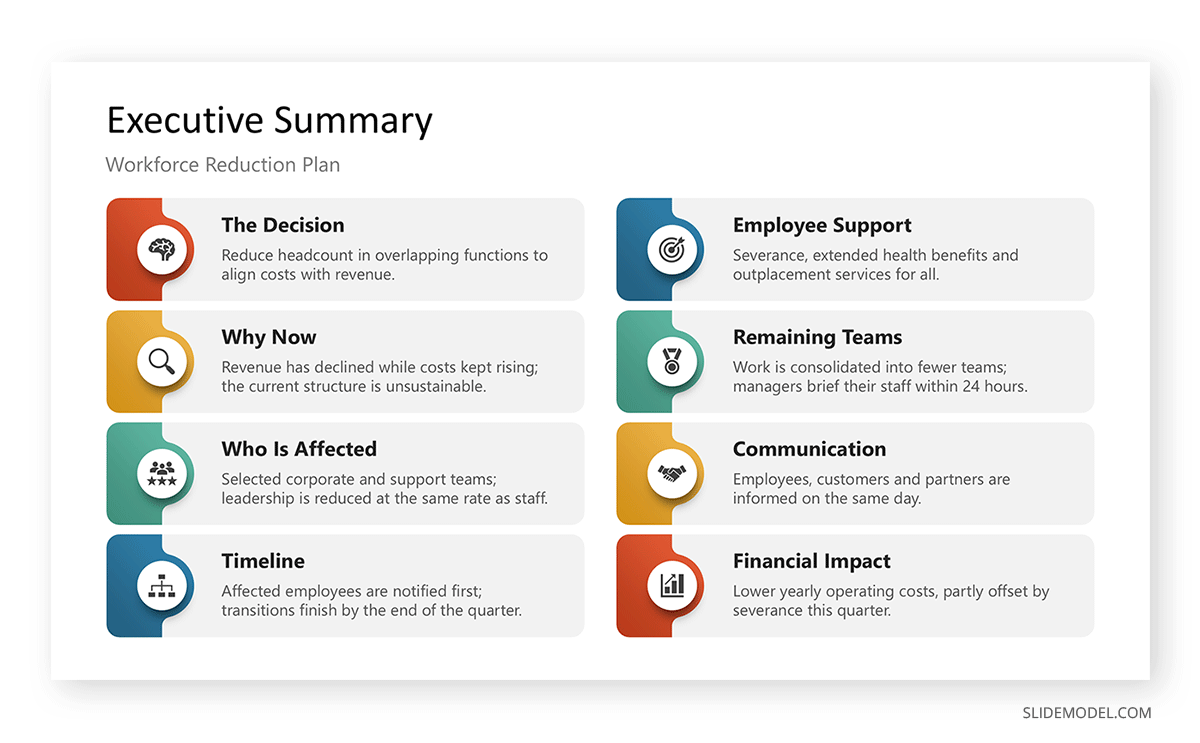
Framing this slide as an executive summary rather than a wall of text keeps it readable under pressure. Employees receiving difficult news are not in a state to absorb dense paragraphs, so reduce the business case to a small set of clearly stated facts: what changed, why the company is responding this way, and what the company already tried before reaching this decision. This slide typically anchors both the leadership briefing and the all-hands deck, though the language may be adjusted slightly depending on the audience.
The Timeline and Sequencing Slide
Restructuring rarely happens in a single moment, even when the announcement itself is delivered on one day. This includes a sequence of notifications, a final working day for affected employees, a period when severance and benefits take effect, and often a longer transition during which remaining teams absorb new responsibilities. Presenting this sequence visually, rather than describing it verbally across multiple meetings, reduces the number of follow-up questions leaders have to field individually.
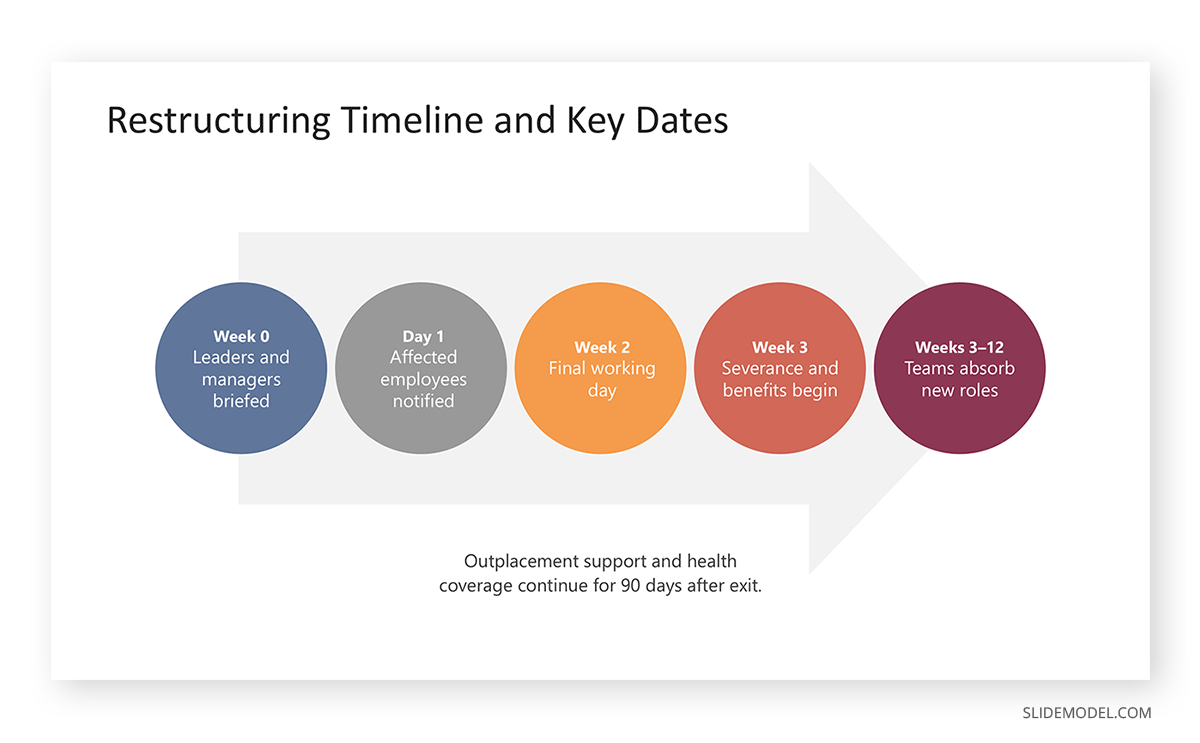
Building a clear timeline into the presentation gives employees a concrete reference point to return to after the meeting, when the emotional impact of the news makes it hard to retain details. The timeline should mark the notification date, the last working day for affected employees, when severance and final pay will be issued, when access to systems will be revoked, and when the wider organization will hear about the changes if that has not already happened. Leaving any of these dates vague invites employees to fill the gap with worst-case assumptions, which spread faster than an honest but difficult date would.
The Organizational Structure Slide
For restructurings that involve eliminating roles, merging teams, or changing reporting lines, a slide showing the structure before and after the change is one of the most useful tools available to leadership. Abstract descriptions of flattening a department or consolidating two teams are far harder to process than a simple visual comparison of the old reporting structure against the new one.
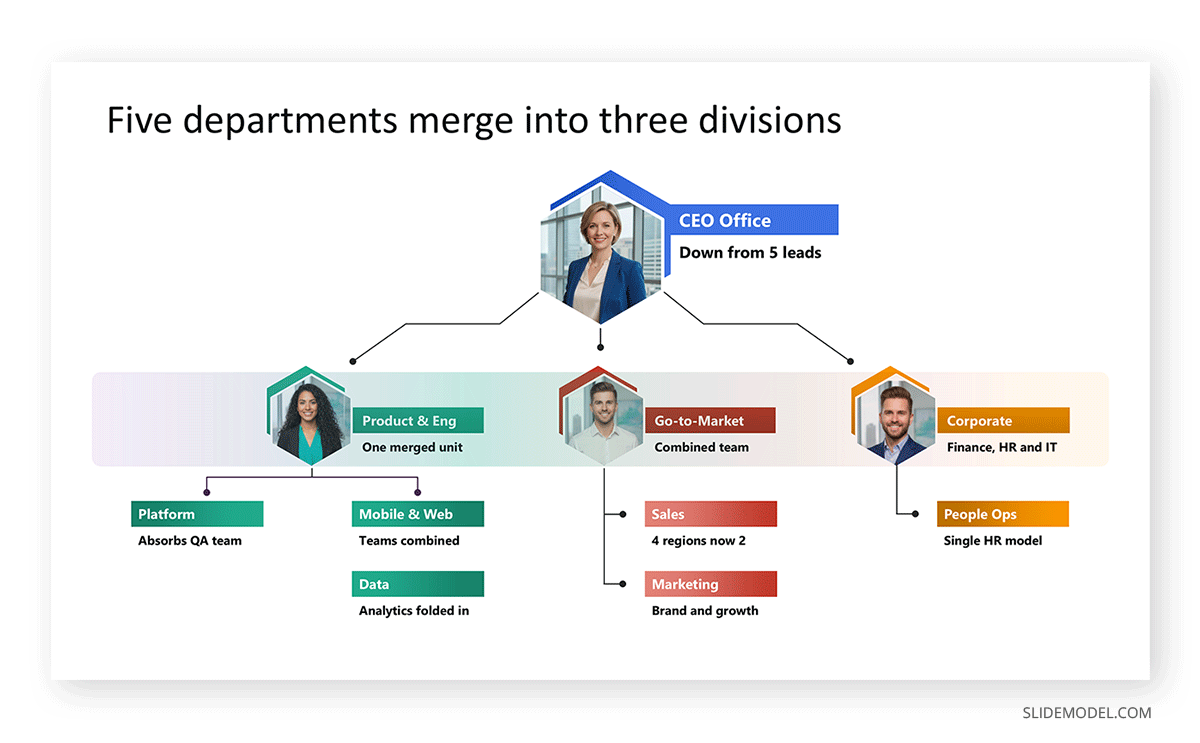
Reviewing the different types of organizational structures available before building this slide helps leaders choose a format that actually reflects how the company will operate afterward, rather than defaulting to whatever chart shape was used previously. Once the target structure is settled, building the chart directly in PowerPoint keeps the visual consistent with the rest of the slide deck rather than importing a mismatched graphic from another tool. This slide should be handled carefully: it names roles and reporting lines, not the individuals who previously held them, and it should be reviewed by HR and legal before it appears in any meeting, since an org chart shown too early or with the wrong level of detail can inadvertently reveal who is being let go before those individual conversations have happened.
The Support and Transition Plan Slide
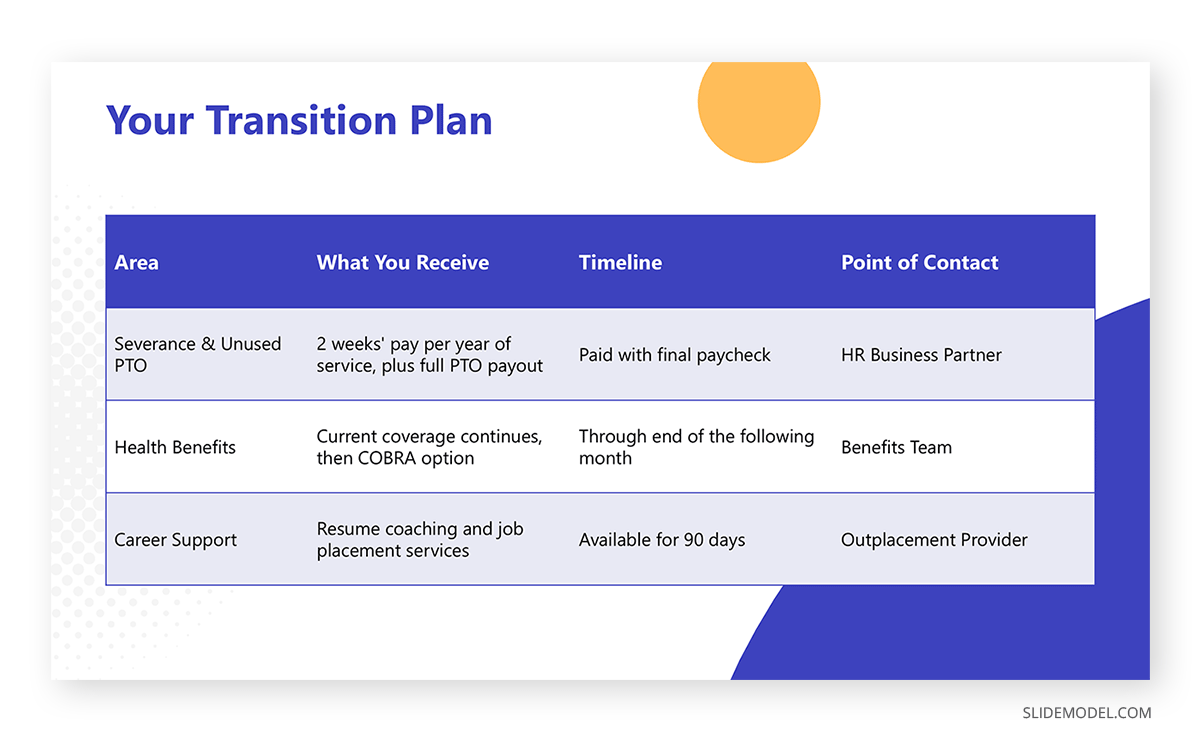
Employees leaving the company need a clear, single place to find the details of their severance, benefits continuation, and any outplacement support being offered. Scattering this information across a verbal explanation and a follow-up email often leaves people confused at the exact moment they need clarity most.
A dedicated transition plan slide should lay out severance length, treatment of unused paid time off, the timeline for health benefits, and any career support such as resume assistance or job placement services. This slide typically appears in the 1:1 conversation materials rather than the wider all-hands deck, since its content is specific to departing employees. For departments experiencing a partial reduction, a second version of this slide addresses the employees who remain, outlining what happens to the workload previously handled by departing colleagues and what support, such as temporary contractors or revised deadlines, will be provided while the team adjusts.
The Action Plan and Next Steps Slide
Every department restructuring presentation should close with a slide that tells the audience exactly what happens after they leave the room. For departing employees, this means a short list of immediate next steps: who to contact with questions, where to find severance paperwork, and what to do about company equipment. For remaining employees, it means describing what the organization is doing next, whether that is a hiring freeze review, a strategic planning session, or a defined period before considering further changes.
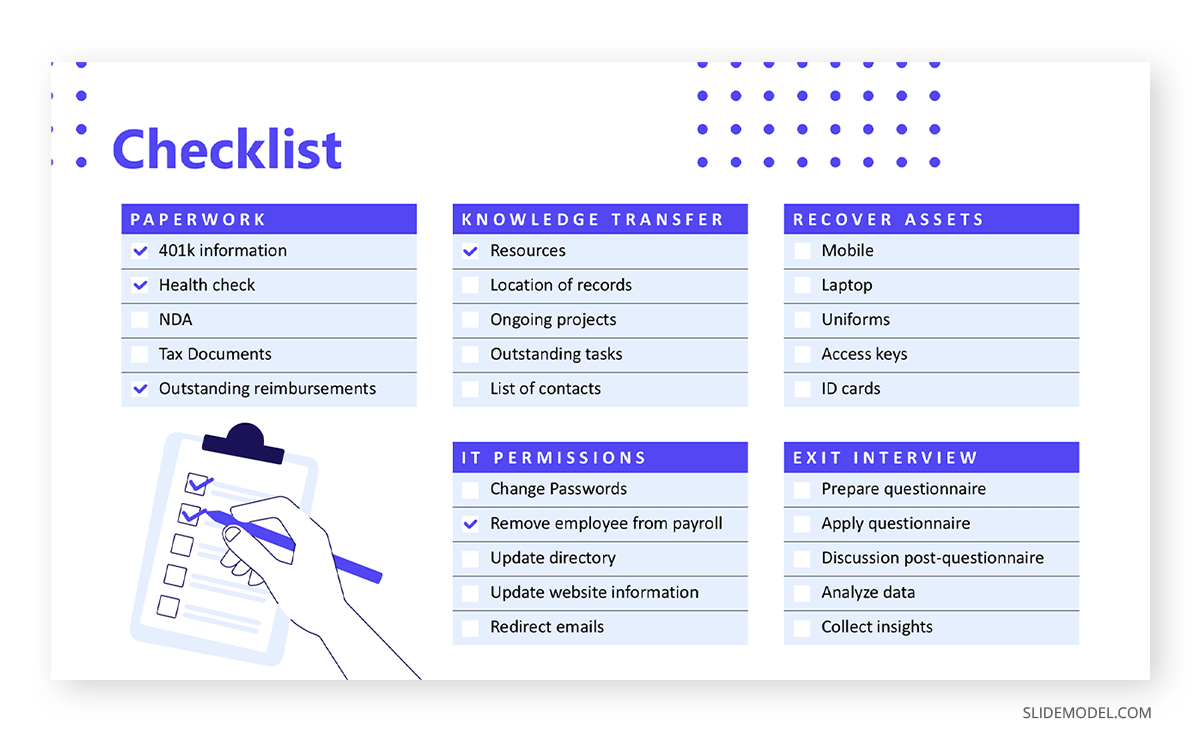
Framing this as a genuine action plan, rather than a closing slide that simply thanks people for their time, gives the presentation direction instead of letting it end on the news itself. Leaders who close on the emotional weight of the announcement, without pivoting to what comes next, tend to leave their audience without a foothold. A well-built next-steps slide gives people something concrete to hold onto as they leave the meeting.
Designing Slides for a Sensitive Announcement
Restructuring slides face a different design standard than a typical business deck. A crowded slide, a stock photo of smiling employees, or an overly polished animation can read as tone-deaf when the content concerns people losing their jobs. The visual register should be calm, restrained, and factual rather than persuasive.
Applying UX principles for presentation design is especially relevant here, because the goal is comprehension under stress rather than engagement or persuasion. Employees receiving difficult news are not processing information the way they would during a routine business review. Keep sentences short; one idea per slide is generally safer than combining several, and use color sparingly, since bright accent colors or celebratory palettes can feel jarring against difficult subject matter. A muted, neutral palette communicates seriousness without appearing cold.
Data, where it appears at all, needs particular care. If the presentation includes headcount numbers, cost savings, or department-level figures, present those metrics with context, not as raw totals. A slide that simply states a workforce reduction percentage without explanation can read as detached from the human impact of that number. Pairing any figure with the reasoning behind it, and avoiding language that reduces people to statistics, keeps the presentation grounded in the fact that behind every number is a colleague. Leaders reviewing the slide deck before delivery should specifically check whether any slide could be read as minimizing the human cost of the decision.
Delivering the Message: All-Hands Meetings and Leader Talking Points
Even the best-designed presentation deck will fail if the presenter is unprepared. Department leaders and managers who deliver 1:1 layoff conversations need more than a copy of the slides; they need rehearsal, a script for the difficult parts of the conversation, and guidance on handling emotional reactions without becoming defensive or over-explaining.
For the wider organization, an all-hands meeting typically follows the individual conversations, giving leadership the chance to address the change with the full team and take questions in real time. This meeting carries its own presentation risk: because it reaches a much larger audience at once, any inconsistency between what was said in individual conversations and what appears on the all-hands slides becomes immediately visible. Leaders should walk into this meeting with the same business case slide, the same timeline, and the same language used earlier that day, so the story holds together regardless of who is asking questions.
Delivery matters as much as content. Presenters who read directly from slides or visibly rush through difficult sections tend to come across as detached. Applying basic storytelling techniques to how the narrative is delivered, establishing context before the news and then moving deliberately into what support is available, helps leaders keep control of the room without sounding rehearsed to the point of insincerity. A brief practice run with a peer or HR partner before the real meeting catches most of these issues in advance.
Communicating with the Employees Who Remain
Layoff communication doesn’t end once affected employees have been notified. The employees who remain often experience a form of survivor guilt, having lost colleagues they worked closely with while absorbing new responsibilities almost immediately. If this group receives only the initial all-hands presentation and no further communication, disengagement and attrition tend to follow within a few months.
A follow-up presentation, delivered days or weeks after the initial announcement, gives leadership the chance to reinforce the company’s direction and reassure remaining staff that the organization has a plan beyond the immediate cuts. This is a natural moment to revisit a company values presentation, not as a way of glossing over the difficulty of the preceding weeks, but as a genuine reminder of what the organization stands for and how those values inform the decisions being made going forward.
Sustaining engagement through this period also depends on giving employees a channel to ask questions and voice concerns without going through formal HR complaints. Building specific employee engagement strategies into the months following a restructuring, such as regular check-ins, open office hours with leadership, or a dedicated feedback channel, helps surface concerns before they harden into disengagement. Leaders who treat the restructuring as fully resolved once the announcement is made typically underestimate how long the organization needs to rebuild trust.
Common Mistakes in Restructuring Presentations
Even with a solid communication plan in place, certain presentation habits tend to undermine restructuring announcements again and again. Recognizing them before the restructuring deck is finalized gives leadership a chance to correct course while there is still time.
Presenting Every Audience With the Same Deck
A single presentation built to serve the board, department leaders, and the wider workforce at once tends to satisfy none of them. Board members need financial detail that would overwhelm an all-hands audience, while employees need severance specifics that don’t belong in a boardroom summary. Splitting these into distinct decks, even when they share the same core facts, keeps each audience focused on what actually applies to them.
Showing Organizational Charts Before Individual Conversations Happen
It is tempting to prepare the finished org chart early and reuse it across every stage of the process, but showing a chart that clearly omits certain names or roles before those individuals have been notified privately is one of the fastest ways a restructuring becomes public before leadership intends it to. Org chart slides should stay out of any shared drive or rehearsal session until every affected 1:1 conversation has taken place.
Reducing the Announcement to Numbers Without Context
A slide that opens with a headcount percentage or a cost-savings figure, without pairing it with the reasoning behind the decision, tends to read as detached from the people it affects. Numbers matter and should not be hidden, but they land very differently when framed alongside the specific business pressures that made the decision necessary, rather than presented as an isolated statistic.
Skipping Rehearsal for the Hardest Parts of the Delivery
Leaders often prepare the content of a corporate restructuring presentation carefully but give little thought to how they will deliver it in the room. The hardest moments, stating that roles are being eliminated, responding to an emotional reaction, or answering a question with no good answer yet, are exactly the moments where an unrehearsed presenter is most likely to freeze or overexplain. A short practice run with HR beforehand addresses most of this.
Treating the Initial Announcement as the End of the Process
Once the announcement has been delivered, it can feel like the difficult part is over. In practice, the weeks that follow determine whether remaining employees stay engaged or start looking elsewhere. Leaders who fail to schedule follow-up communication, leaving the initial all-hands deck as the only material the organization ever shares, tend to underestimate how much ongoing reassurance it takes to rebuild trust.
FAQs
How far in advance should a team restructuring presentation be prepared?
Most communication plans begin drafting materials two to four weeks before the announcement date, giving leadership time for legal review, message testing with a small group of trusted advisors, and rehearsal. Complex restructurings involving multiple departments or countries often need longer, since severance terms can vary by jurisdiction.
Should severance details appear in the all-hands presentation, or only in 1:1 conversations?
Severance specifics generally belong in the 1:1 conversation and the accompanying written follow-up, since terms can vary by role, tenure, or location. The all-hands deck can note that support is being provided without listing individual terms that don’t apply to the entire room.
How many slides should a layoff presentation include?
Length depends on the audience, but leadership briefings and all-hands decks typically stay under fifteen slides. Anything longer risks burying the core message, the business case, the timeline, and the next steps under supporting detail that could live in a separate reference document instead.
What should happen if information about the restructuring leaks before the scheduled announcement?
The communication plan should include a contingency for this scenario, typically moving up the notification timeline for directly affected employees rather than letting rumors circulate for days. Leadership should acknowledge the leak directly rather than pretend it didn’t happen.
Should the presentation name the specific financial pressures behind the decision?
Naming specific pressures, such as a lost contract, a declining product line, or a missed revenue target, tends to build more trust than vague references to market conditions. Employees can usually tell when leaders have deliberately kept an explanation thin.
How should leaders handle questions they cannot yet answer during the meeting?
Leaders should say directly that the answer isn’t available yet rather than improvising a response that might later prove inaccurate. Committing to a specific follow-up channel or date for outstanding questions keeps the meeting from feeling evasive.
What is the best way to present the organizational chart after a restructuring?
A clear before-and-after comparison, showing the previous reporting structure next to the new one, communicates the change more effectively than a verbal description. This slide should only be shown after every affected 1:1 conversation has taken place.
How long should the all-hands meeting last?
Most restructuring all-hands meetings run between thirty and forty-five minutes, split between the prepared presentation and open questions. Meetings that run significantly longer often lose focus, while meetings that are too short can leave employees feeling unheard.
Should remaining employees receive a different presentation than departing employees?
Yes. Departing employees need a presentation focused on their individual transition, including severance and support details. Remaining employees need a presentation focused on the organization’s direction going forward and any changes to their own responsibilities.
What role should HR and legal play in reviewing the presentation before delivery?
Both should review every version of the layoff deck before it reaches any audience, check severance language for accuracy, confirm that no slide reveals protected information prematurely, and verify that messaging stays consistent across audiences.
How should virtual layoffs be handled differently from in-person announcements?
Virtual announcements require extra attention to pacing, since presenters cannot read the room the same way they would in person. Keep cameras on throughout the conversation, and build in deliberate pauses for questions.
How soon after the announcement should a follow-up presentation happen for remaining employees?
A follow-up typically happens within one to two weeks, once the immediate transition has stabilized. This gives leadership time to gather early feedback and questions from the team before addressing them directly.
Should the presentation include comparisons to layoffs at other companies?
Referencing how other organizations have handled similar situations can be useful during planning, but it rarely belongs in the presentation itself. Comparisons to other companies can come across as deflecting responsibility for the decision at hand.
What tone should the layoff presentation use?
A calm, direct, and factual tone tends to land better than either an overly formal or an overly casual register. The goal is clarity delivered with respect, avoiding both corporate distancing language and a tone that feels dismissive of the news.
Who should present the all-hands restructuring announcement?
In most organizations, the most senior leader reasonably available, often the CEO or the head of the affected division, should deliver the announcement personally rather than delegating it to HR alone. Employees read the presenter’s seniority as a signal of intent.
Final Thoughts
Communicating a restructuring or layoff well does not soften the underlying decision, and no amount of careful slide design changes the fact that people are losing their jobs. What careful presentation design does accomplish is removing the additional damage that comes from confusion, inconsistency, and the sense that information is being withheld. A well-sequenced layoff deck, delivered by a leader who has rehearsed the difficult sections, gives departing employees clarity about what happens next and gives remaining employees a reason to trust that the organization has a plan beyond the immediate cuts.
The presentation itself is a small part of a much larger process that includes legal review, severance planning, and weeks of preparation before a single slide is shown. But it is also the moment where all of that planning either lands with the audience or gets lost in the delivery. Treating the layoff presentation with the same rigor as the restructuring plan, with structured slides, rehearsed delivery, and a follow-up plan for the employees who remain, gives leadership the best chance of getting a genuinely difficult moment right.