There is a meaningful difference between having a strategy and being able to communicate it. Most organizations struggle less with forming a strategic direction and more with translating it into a document that a board can approve, a leadership team can execute, and cross-functional managers can act on. That document is the strategy deck.
A strategy deck is not simply a PowerPoint file with company goals pasted into it. It is a structured, deliberately sequenced set of slides that makes a case: here is where we are, where we need to go, and what it will take to get there. When built well, it serves as both a live presentation tool and a standalone reference that audiences can read and absorb independently. When built poorly, it becomes a slide dump that exhausts its audience and leaves decisions unmade.
This article focuses on the deck as an artifact: what it is, why organizations across industries rely on it, the forms it takes in different contexts, how to design and structure it, and the patterns that tend to undermine even well-intentioned efforts. Whether you are preparing a strategy deck PPT for a quarterly executive review, building a business strategy deck for your board, or pulling together a go-to-market strategy deck for a product launch, the principles here apply.
What Is a Strategy Deck?
A strategy deck is a curated set of slides that translates an organization’s strategic direction into a visual, shareable format. The phrase is used interchangeably with “strategy slide deck” or “strategy presentation slides.” Still, there is a functional distinction worth preserving: a strategy deck refers to the document itself, not the act of presenting it. That distinction matters because many strategy decks circulate before a meeting, are revised based on prior feedback, travel up organizational hierarchies without their authors, and are referenced long after a presentation session ends.
This dual-use nature, as both a facilitation tool during live sessions and a standalone reading document, shapes every design decision in the deck. How much text appears per slide, how densely data is presented, how charts are labeled, and how conclusions are drawn are all governed by the need to communicate effectively both with and without a presenter in the room.
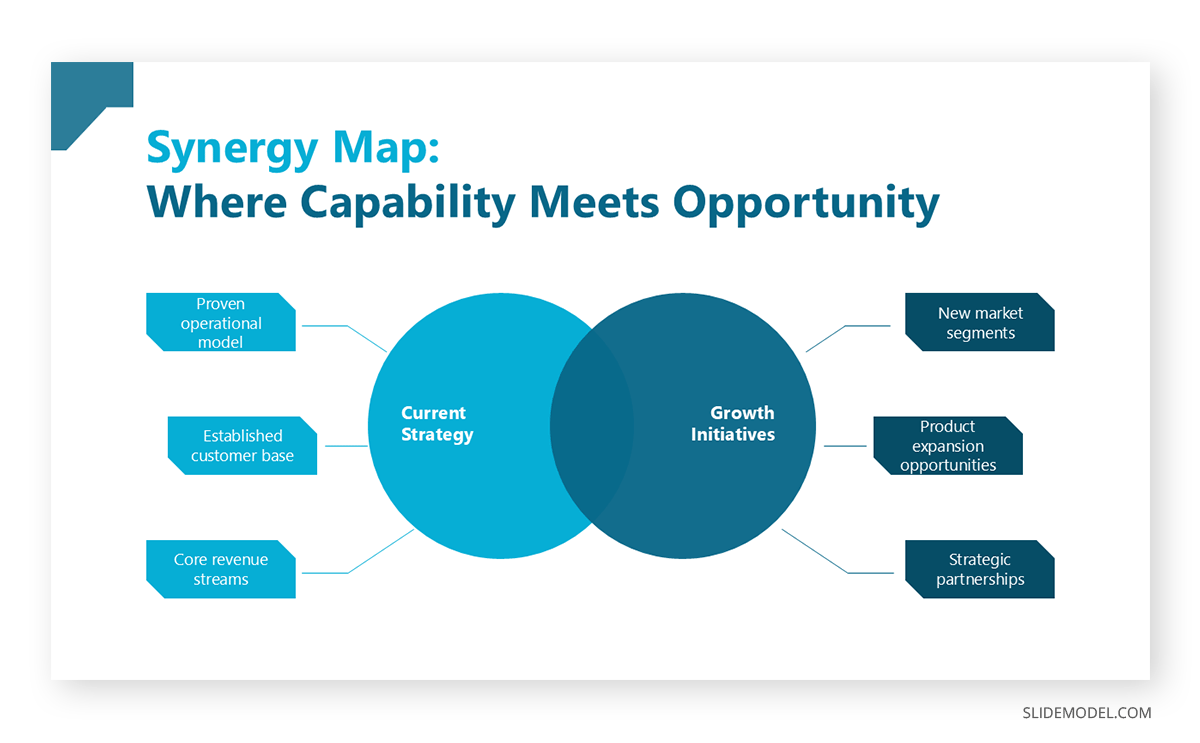
In management consulting, strategy decks typically follow a narrative structure that moves from establishing the situation to identifying the core complication, then resolving it with a clear recommendation. In corporate environments, this often takes the form of an executive summary followed by the full supporting argument. In either case, the underlying logic is the same: the reader should be able to follow the reasoning without asking questions. A strategy deck that requires the presenter to explain every slide has failed at its primary function.
This also means that a business strategy deck is not simply a visual aid. It is the primary record of the strategic argument. Long after the meeting ends, this document will be forwarded, stored, and revisited. Building it with that lifecycle in mind, rather than only for the hour in the conference room, is what separates a deck that drives decisions from one that is opened once and forgotten.
Why a Strategy Deck Matters in Business Settings
The clearest argument for building a formal strategy deck is that the process forces clarity. Before a strategy can be communicated, it must be understood, and the discipline of converting strategic thinking into structured slides often reveals gaps in the argument that informal discussions never surface. Leadership teams that work through a strategy deck together frequently arrive at sharper decisions than those that skip the documentation step entirely.
Beyond the internal discipline it provides, a strategy deck serves as the primary vehicle for stakeholder management and alignment. Boards, investors, department heads, and external partners each require a coherent view of the organization’s direction. A well-built business strategy deck provides that view in a format that respects the reader’s time: visually structured, with data supporting the argument rather than replacing it, and conclusions visible at a glance rather than buried in the narrative.
The stakes are particularly high when the audience is the board of directors. A strategy presentation for board of directors review carries significant weight: boards use these sessions to approve budgets, authorize headcount, validate market positions, and set executive priorities for the year ahead. A deck that cannot clearly state what is being asked, why it matters, and what success looks like will slow that process and erode confidence in leadership. A deck that demonstrates rigorous thinking and clear trade-offs positions the presenting team as credible and prepared.
Understanding how to build a strategy deck for stakeholders starts with understanding what each stakeholder group actually needs from it. Executives need the conclusion up front. Operations teams need the plan sequenced and resourced. Finance needs the numbers to hold up under scrutiny. Building with these different reading contexts in mind is what separates a deck that circulates widely from one that stalls on the first reviewer’s desk.
Types of Strategy Decks
Not all strategy decks serve the same purpose, and designing one effectively requires knowing which type you are building. The categories below describe the most common formats by use case and audience. This is a different lens from the content category, and it has more direct implications for how the deck should be structured, how dense the content should be, and what level of visual formality is appropriate.
Board of Directors Strategy Deck
A board-level strategy deck is the most formal and consequential of the formats. It is built for an audience that holds fiduciary responsibility for the organization, has limited time during the meeting, and typically reads the deck in advance. This means the executive summary must function as a complete argument in miniature: the business case, the key risks, the decision being requested, and the expected implications should all be visible on the first few slides.
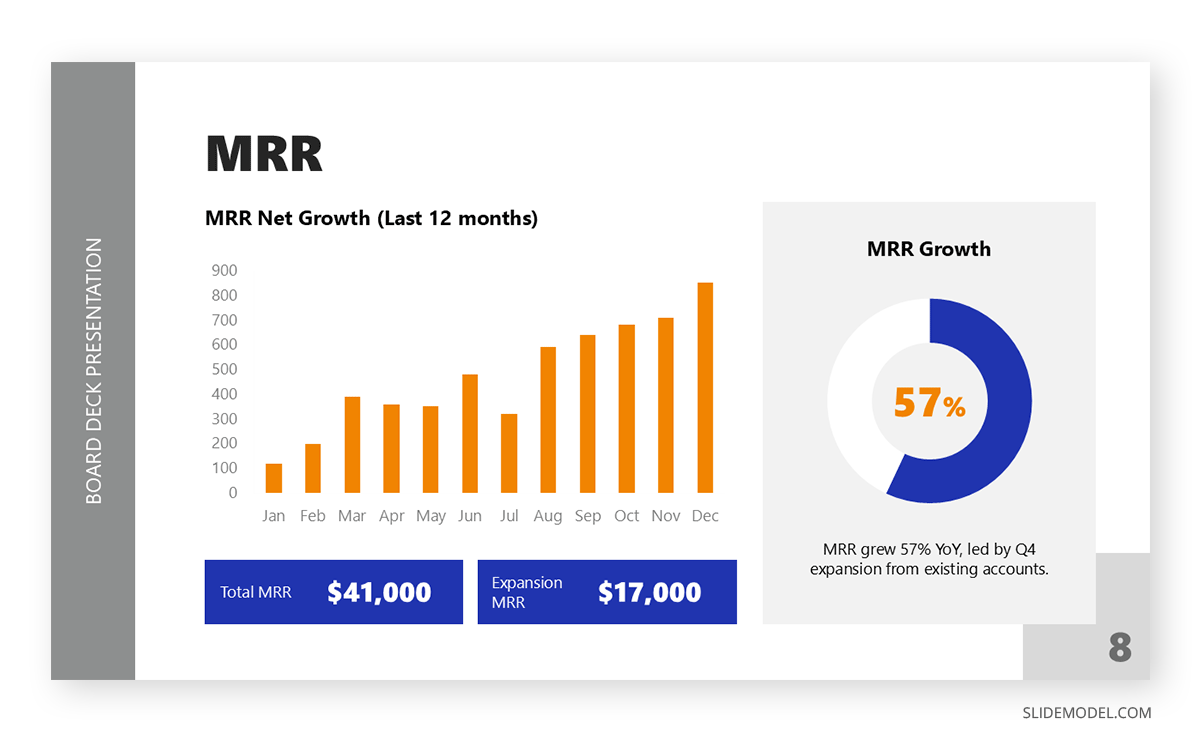
Board decks tend to be more structured and conservative in design than internal-facing decks. Visual complexity should be low, data should be current and sourced, and the narrative should flow from strategic context to specific recommendations without detours. Ambiguity about what is being asked is the most common failure mode at this level. If the board leaves the meeting unclear on the decision they were meant to make, the deck did not accomplish its purpose, regardless of how well it was designed.
Go-to-Market Strategy Deck
A go-to-market strategy deck is built around a product or service launch and is designed to align the cross-functional teams responsible for executing it. Typical audience members include marketing, sales, product, and operations leadership. Because the deck must coordinate multiple teams with different priorities, clarity on ownership, timeline, and success metrics is particularly important. For a closer look at the strategic logic that should precede this kind of deck, go-to-market strategy planning provides a useful framework for structuring the underlying analysis before the slides take shape.
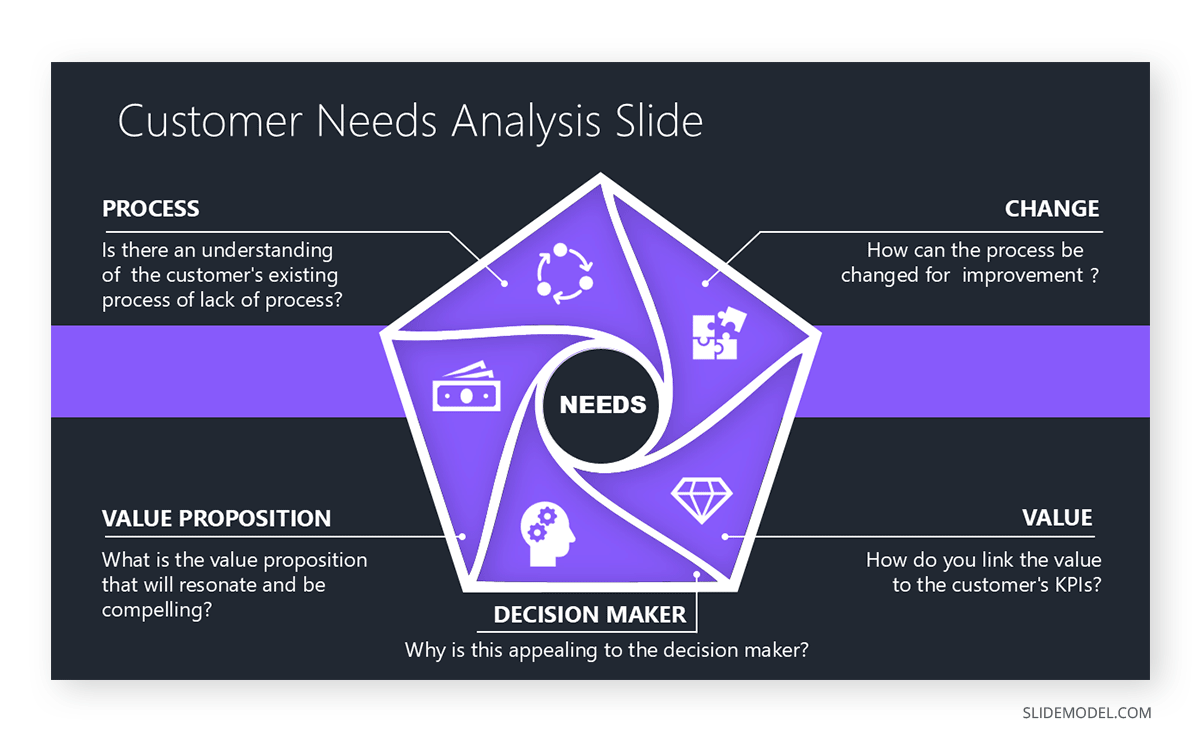
The go-to-market deck typically includes a market opportunity summary, a competitive positioning section, a channel and distribution plan, a launch timeline, and the KPIs that define a successful launch. The level of commercial detail in this deck is often higher than in a strategic planning deck, because the audience needs enough specificity to align budgets and resources across functions before the launch window opens.
Internal Alignment Deck
Internal presentation decks are built for audiences inside the organization who need to understand a strategy well enough to act on it at the team level. These are less about approval and more about comprehension. They tend to run longer and include more supporting detail than board-level decks, because the audience needs to translate the strategy into their own plans, resource requests, and quarterly priorities.
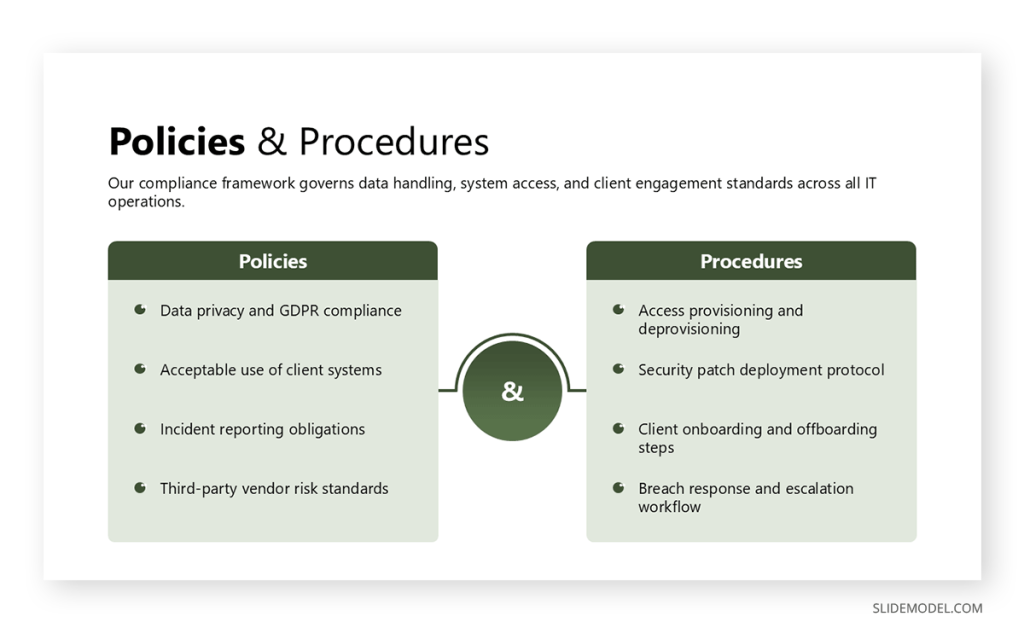
The measure of success for an internal alignment deck differs from that of the board deck: rather than a vote or approval, the goal is for every team represented in the room to leave with a clear view of how the strategy will affect their work in the coming period. That requires sufficient operational specificity to make the abstract strategic direction actionable at the functional level, which, in turn, demands more detailed coverage of timelines, ownership, and supporting resources than a governance-oriented deck would include.
Executive Briefing Deck
An executive briefing deck is a condensed format built specifically for the C-suite or senior leadership team. Time is the primary constraint, and the structure needs to match: key conclusions at the front, supporting evidence available on backup slides, and no content that does not directly serve the argument. Understanding what executive presentations require in terms of format and depth is worth reviewing before building this format, particularly regarding how much context to assume and how tightly to scope the content.
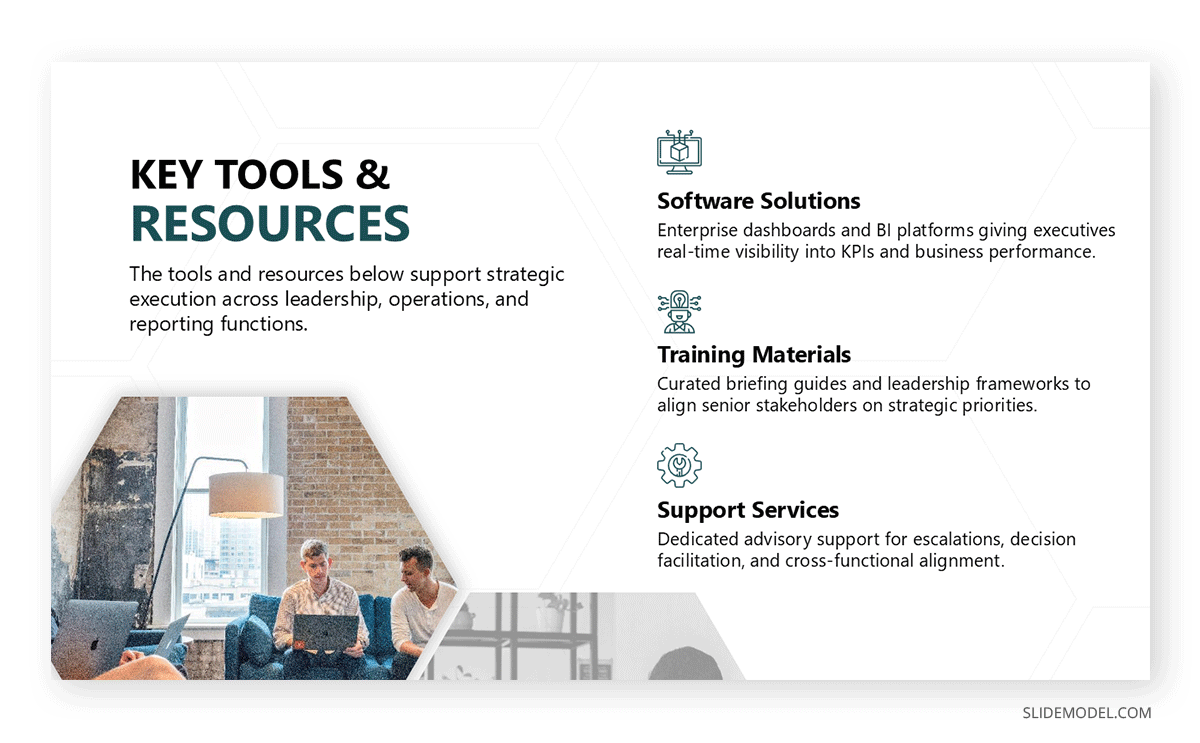
Executive briefing decks work best when built as extraction layers from a more complete strategy document, rather than as standalone artifacts. This approach ensures that the conclusions presented are backed by a fuller analysis available on request, without burdening the primary deck with details that slow the executive conversation. The backup slide section becomes an important resource here, covering questions likely to arise without forcing them into the main flow.
How to Design a Strategy Deck
Design in a strategy deck is not primarily about aesthetics. It is about argument clarity. A deck that looks polished but requires ten minutes of verbal explanation per slide is poorly designed. A deck with modest visual production but a clear, legible narrative is ready to circulate and act on. Both criteria matter, but in a defined order: clarity first, visual quality second.
Structuring Your Slides
The most reliable slide sequence for a strategy deck follows a top-down logic: lead with the conclusion, then build the supporting case. This is the basis of the Pyramid Principle, a framework that has become a standard for management consulting and executive communication. Applied to a strategy slide deck, it means the audience knows the answer before they hear the full argument, allowing them to evaluate the reasoning rather than simply waiting to understand the point.
A working slide order for most strategy decks looks like this: an executive summary slide capturing the strategic recommendation and its rationale, a situation analysis covering the current position (often supported by a SWOT analysis or competitive review), a section on strategic goals and priorities, a detailed initiative plan with owners and timelines, and a metrics section defining how success will be measured. A resources-and-investment slide and a risks section round out the argument where relevant.
The visual sequencing of a strategic planning PowerPoint matters as much as the content itself. Each slide should carry a headline that states the point (not just the topic), a visual that supports it, and no more context than the argument requires. For planning presentations that span multiple time horizons, a visual roadmap slide is often the clearest way to communicate sequencing and milestones without requiring a lengthy verbal walkthrough.
Choosing the Right Template
A good strategy deck template provides structural consistency without forcing content into formats it does not fit. The most functional templates include layouts for executive summaries, data visualization, text-plus-chart combinations, and matrix or quadrant diagrams. When selecting a strategy deck PPT template, the key criterion is whether the layouts support your planned argument structure. SlideModel’s strategic planning templates offer layouts that map directly to these structural needs, covering the most common slide types without requiring significant customization.
A PowerPoint template that lacks a clean executive summary layout or a slide built for a project timeline will require workarounds that slow production and often compromise legibility. Conversely, a well-matched template allows the team to focus on content and argument quality rather than slide construction, which is where the real work of building a strategy deck belongs. Template selection is a production decision, not a design statement, and it should be treated as such.
Strategy Presentation Best Practices
Calibrating depth to the audience is the most important variable in best practices for strategy presentations. A deck built for a board review needs different content density than one built for a department head’s planning cycle. Before designing a single slide, identify who will read the deck, when they will read it (before, during, or after a meeting), and what decision or action it is meant to support. Those inputs determine slide count, text density, and how much supporting data belongs in the body versus backup slides.
When thinking about how to present a business strategy to executives, the single most reliable approach is to lead with the conclusion on slide one. Executives do not need context before they receive the recommendation; they need the recommendation first and context second. A deck that builds slowly toward a conclusion will often lose its audience before it reaches that point, undermining even a well-researched analysis.
Narrative consistency across slides is another area where strategy decks frequently break down. Each slide should connect logically to the previous one, and that connection should be visible in the headline. If slide four states that revenue growth is concentrated in two markets and slide five addresses the investment model, the headline on slide five should read something like ‘Our current investment model does not reflect this concentration.’ If it simply says ‘Investment Model Overview,’ the logic becomes invisible, and the reader has to work to reconstruct the argument thread.
Visual consistency is a separate but related concern. Fonts, colors, chart styles, and layout grids should remain stable across the deck. Inconsistency in visual language signals that the deck was assembled from multiple sources without a unifying editorial pass, which undermines the perception of rigor even if the underlying analysis is sound. Setting visual standards before production begins, rather than normalizing them after the fact, saves significant time.
Common Mistakes in Strategy Decks
The mistakes that recur most often in strategy decks tend to cluster around two underlying problems: too much content trying to do too many things at once, and a mismatch between what the deck says and what the audience actually needs to know.
The most visible symptom of the first problem is slide overload: slides with multiple charts, long paragraphs of body text, and detailed footnotes that compete for attention with the main point. The fix is not to remove information but to decide what belongs in the deck and what belongs in an appendix or a separate reference document. The deck should carry the argument; supporting data should be available but not placed where it would obstruct the primary message on each slide.
Skipping the executive summary is a surprisingly common error in internally-produced decks, where the author often assumes the audience already has sufficient context. In practice, even audiences familiar with the subject benefit from a clear summary that frames what the deck is asking them to understand or decide. Without it, different readers leave with different interpretations of the strategy, creating alignment problems that surface later during execution.
A less obvious but equally consequential mistake is building a strategy deck without a clear ask. Many decks describe a strategic situation in detail but conclude without stating what the audience is expected to do: approve a budget, commit to a direction, escalate a decision, or acknowledge alignment. A deck without a clear call to action leaves its audience uncertain about what a successful outcome looks like, which tends to delay or dilute the decisions the deck was meant to drive.
Finally, mismatching the level of detail to the audience creates its own type of friction. Presenting a board with operational specifics they cannot act on wastes time and dilutes the strategic signal. Presenting a department head with a high-level directional deck that contains no actionable specifics leaves them unable to plan. The deck’s purpose should define the depth of its content, and that calibration should happen before the first slide is drafted.
FAQs
What is the difference between a strategy deck and a pitch deck?
A pitch deck is built to attract investment or secure a new business relationship, with emphasis on market opportunity and potential upside. A strategy deck is built for internal or governance audiences and focuses on direction, trade-offs, resource requirements, and execution planning rather than persuasion.
How many slides should a strategy deck have?
Most effective strategy decks run between 15 and 30 slides in the main body, with additional backup slides for supporting data. Board-level decks tend toward the shorter end; internal alignment decks may run longer if they need to carry enough detail for execution planning across multiple functions.
What should be included on the first slide of a strategy deck?
The executive summary. This slide should capture the strategic recommendation, the core rationale behind it, and the key decision being requested. It should be readable in under two minutes and comprehensible without requiring the rest of the deck for context.
How do I tailor a strategy deck for the board of directors?
Lead with conclusions and the decision required. Keep slide density low, ensure data is properly sourced, and include a section on risks. Avoid operational details unless they directly support the recommendation. Boards focus on strategic direction and governance, not execution management.
Should a strategy deck include financial projections?
Yes, in most cases. Financial projections anchor the strategy in business reality and allow decision-makers to evaluate feasibility. The level of detail depends on the audience: board decks typically present high-level scenarios, while internal planning decks may include detailed cost and revenue models.
What is a go-to-market strategy deck?
A go-to-market strategy deck outlines the plan for bringing a product or service to market. It typically covers target customer segments, competitive positioning, channel strategy, launch timeline, and the KPIs that define a successful launch. The primary audience is the cross-functional team responsible for executing the launch.
How do I apply the Pyramid Principle to a strategy deck?
Start with the governing thought: the single most important conclusion. Then organize all supporting points under it so that each level of the hierarchy answers the question raised by the level above. In practice, your executive summary leads with the conclusion, and every subsequent section justifies or elaborates on it.
What tools are best for building a strategy deck PPT?
Microsoft PowerPoint and Google Slides are the most widely used. For quick results, we highly recommend SlideModel.ai
How do I present a business strategy to executives without overwhelming them?
Front-load conclusions, apply a strict one-idea-per-slide rule, and move supporting data to backup slides. Plan for the meeting to run shorter than your full deck allows, and identify in advance which sections you can defer if the conversation develops differently than expected.
What is a walking deck versus a presentation deck?
A walking deck is designed to be read independently, without a presenter. It includes more text per slide to make the argument self-contained. A presentation deck relies on the presenter to supply a connective narrative. Strategy decks often need to function as both, which requires more textual precision per slide than a purely visual format.
Can the same strategy deck be adapted for multiple audiences?
Yes, with deliberate editing. The core argument typically remains the same across audiences; what changes is how much context is assumed, how much operational detail is included, and how financial data is framed. Version control and a clear master document are essential when managing multiple variants of the same deck.
What visual elements work best in strategy deck slides?
Frameworks and matrices work well for strategic trade-offs, bar or waterfall charts for financial data, timeline visuals for sequencing, and heat maps or bubble charts for portfolio prioritization. Visuals should make the argument easier to grasp, not simply more elaborate to look at.
How do I measure whether my strategy deck was effective?
The most direct indicator is whether it produced a clear decision or commitment. Secondary indicators include whether the audience asked clarifying questions about execution (suggesting they accepted the direction) rather than foundational questions about the strategy itself, and whether the deck continued to circulate and be referenced after the meeting ended.
Final Words
A strategy deck is one of the highest-leverage documents an organization produces. When built with the audience and decision in mind, it shortens alignment cycles, reduces miscommunication across leadership layers, and creates a shared reference that teams can return to as execution evolves. The investment in getting the structure and argument right before worrying about visual production consistently pays off, leading to faster decisions and fewer revisions after the fact.
The principles covered here apply whether you are working with strategy deck slides in PowerPoint, using a pre-built strategy deck template to accelerate design, or building from scratch for a high-stakes review. The fundamentals remain consistent: lead with conclusions, match detail to audience, and make the ask explicit. Applying those habits from the earliest drafting stages, rather than as a revision pass at the end, is what produces decks that do what strategy decks are supposed to do.
For teams looking to accelerate the production process without sacrificing quality, starting with a well-structured template is the most reliable shortcut. A good template handles the visual framework so the team can focus on the argument, which is where the real work of building a credible strategy deck belongs.