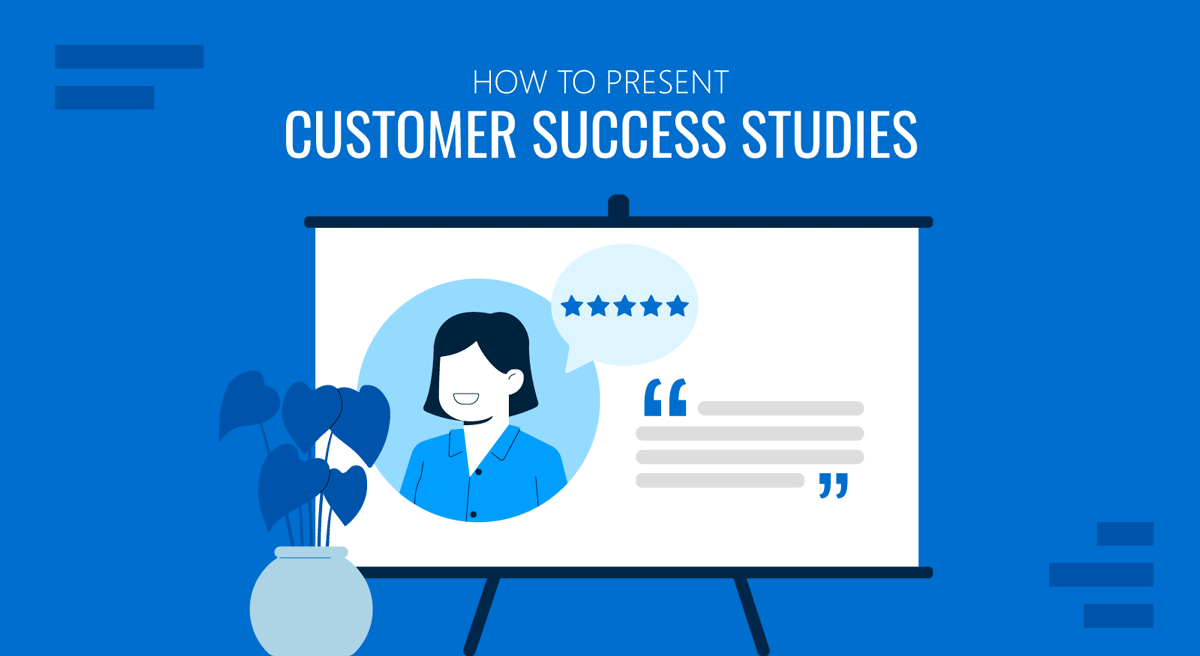
When stakeholders ask for proof that a solution works, a well-constructed customer success case study is one of the most persuasive documents a business can produce. Unlike aggregate statistics or abstract claims, a real customer story grounds performance in a specific context, demonstrating not just that results occurred, but how they were achieved and under what conditions.
For professionals in B2B SaaS environments, the customer success story case study has become a standard element of the revenue conversation at every stage of the sales cycle. Sales teams use them to reduce purchase uncertainty, customer success managers use them to calibrate onboarding expectations, and leadership teams use them to validate program direction. But having strong outcomes is only part of the work. How those outcomes are presented determines whether the audience draws the conclusions the presenter intended.
This article covers the decisions involved in turning customer success results into a structured, credible presentation, including how to frame the story, design the slides, and adapt the material for the audience.
What is a Credible Customer Success Case Study?
Not every customer outcome qualifies as presentation-ready material. The distinction between a supporting data point and a formal customer success case study comes down to narrative depth and contextual specificity. A strong case study has a defined starting point, a traceable course of action, and quantifiable results that can be evaluated by an audience with no prior exposure to the account.
Before converting a customer story into slides, it is worth evaluating whether the material meets a few practical criteria. The outcome should be specific enough to be meaningful but framed broadly enough to resonate with the target audience. If the scenario is too narrow, it may fail to generalize. If the language stays too generic, the audience will not recognize their own situation in the story.
For B2B SaaS contexts specifically, the customer success story case study also needs to address the adoption process and value realization, not just the end-state metrics. Enterprise buyers are often equally concerned with implementation complexity and ongoing support requirements as they are with headline outcomes. The customer success manager case study, in particular, needs to be honest about timeline and effort, because the audience is frequently evaluating whether a comparable path is feasible for their own organization.
The most durable structure for presenting a case study effectively follows four components: context, challenge, approach, and outcome. Context establishes relevance by describing who the customer is and what their situation was before the engagement. The challenge section should be honest and specific: vague references to operational complexity weaken the story, making it harder for the audience to recognize a parallel to their own circumstances. The approach component explains what was done, at what pace, and to what extent internal involvement occurred. This matters particularly in enterprise settings, where procurement teams want to understand what implementation actually demands. Outcomes should be presented with as much precision as the customer has agreed to share, whether that means percentage improvements, time savings, or retention figures. Where confidentiality limits disclosure, framing results as directional comparisons still adds more substance than omitting them.
How to Create A Customer Success Study Presentation
The order in which slides appear determines whether the audience arrives at the outcome data prepared to accept it. A customer success study presentation that opens with the headline metric before the audience understands the situation front-loads a claim with no evaluative frame. For instance, without the starting condition and the context of what was done, a 40% improvement in retention is a number, not a result.
Context Slide
The context slide should establish the customer profile in a format that reads in under ten seconds: industry, company size, the team that owned the decision, and the trigger that prompted the search for a solution. That last element is consistently omitted and should not be. Knowing that the customer came to the table after a failed implementation or after a funding round that changed their scale requirements gives the audience a reference point that demographic data alone cannot provide.
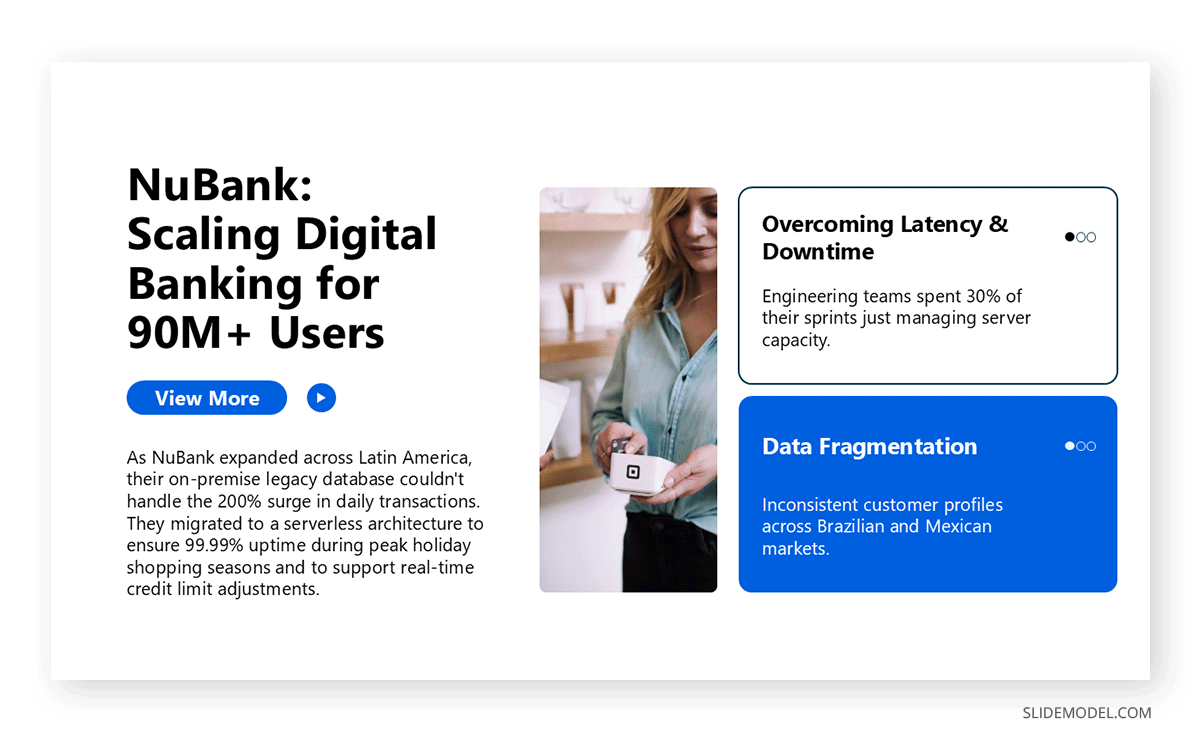
For the context slide, start by considering the heading. It should create tension, not describe situations in detail. “A 12-person team managing 8,000 accounts with no health scoring” raises an implicit question. “B2B SaaS company, 500 employees” does not. The viewer should finish reading the headline wanting to know what happened next. Thus, always aim to include a single before-state number to provide context for the severity of the situation. This anchors expectations and makes the outcome slide land with more contrast.
Remember, make the trigger event the emotional hook. The event that forced the customer to act (a failed audit, a key account lost, a sudden scale jump) is often more compelling than any demographic detail. It’s the moment the story actually started. You can learn more about this in our article on how to start a presentation.
Challenge Slide
The challenge slide should describe the problem with operational specificity. “The customer success team was spending 14 hours per week manually compiling health scores across four disconnected tools, with no consistent view of which accounts were actually at risk” is a description that the audience can test against their own situation. “Limited visibility into account health” is a category, not a problem. One invites identification; the other invites passive acknowledgment.
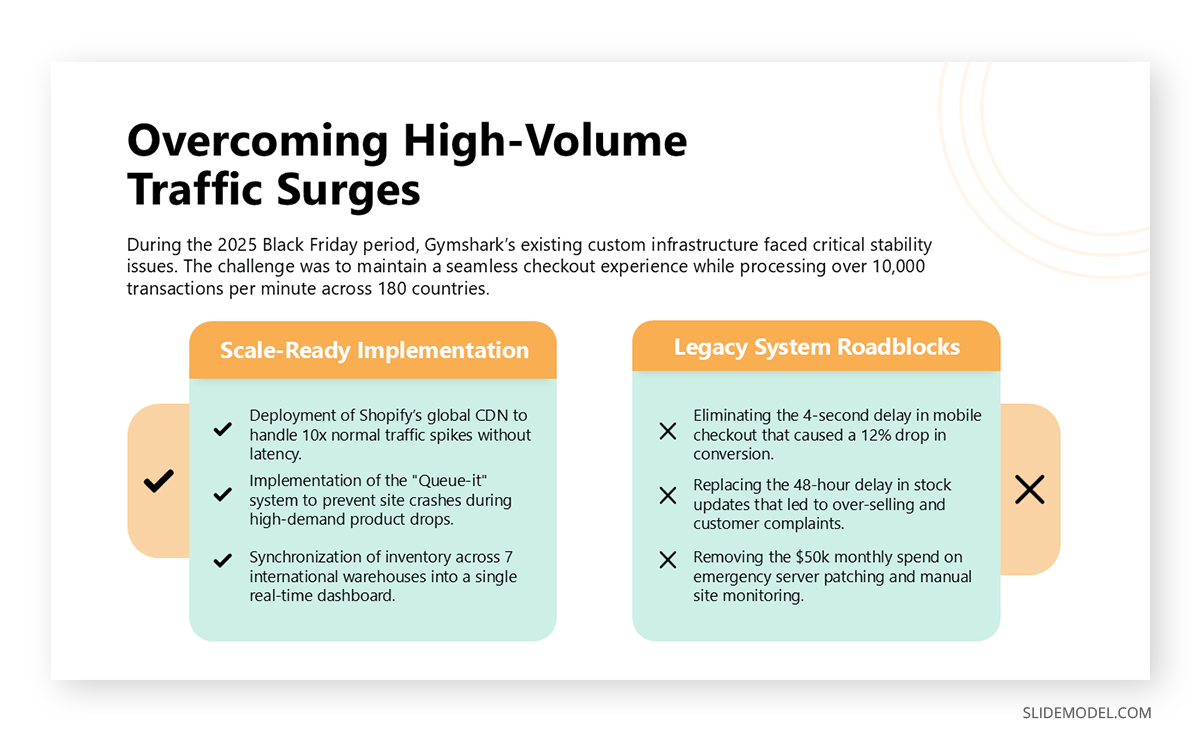
Challenge slides benefit from using the customer’s own language wherever available. A sentence from an onboarding call summary, a QBR note, or a follow-up email that captures how the customer described their problem carries more weight than the presenter’s version. This is not a testimonial slide placement. It shows the audience that the problem description is based on observation, not on the vendor’s framing of what the customer should have experienced.
Show the cost of inaction. What was happening every week because this problem went unresolved? The challenge slide needs a “so what,” a consequence that was accumulating in the background. Without it, the problem feels theoretical. Yet you should explicitly separate the symptom from the root cause. Audiences often conflate them, and so do presenters. State both: what the team was experiencing day-to-day, and why that was happening structurally. The distinction makes the approach slide more logical.
If the customer tried to solve this before your solution, say so briefly. It confirms that the problem was genuinely hard and prevents the audience from thinking, “Why didn’t they just…” It also makes your solution feel earned rather than obvious. Additionally, assign a duration to the problem. How long had this been going on? A problem that existed for 18 months carries a different weight than one that emerged last quarter. Duration signals how embedded the issue was and how difficult it would be to dislodge.
Approach Slide
The approach section is where most customer success study presentations underinvest. “We onboarded the customer and ran a training program,” tells the audience nothing. The approach slide should describe what was configured, what the customer’s team contributed, and how results developed over the first 90 days. The audience is evaluating whether the path to that outcome is one they could realistically follow.
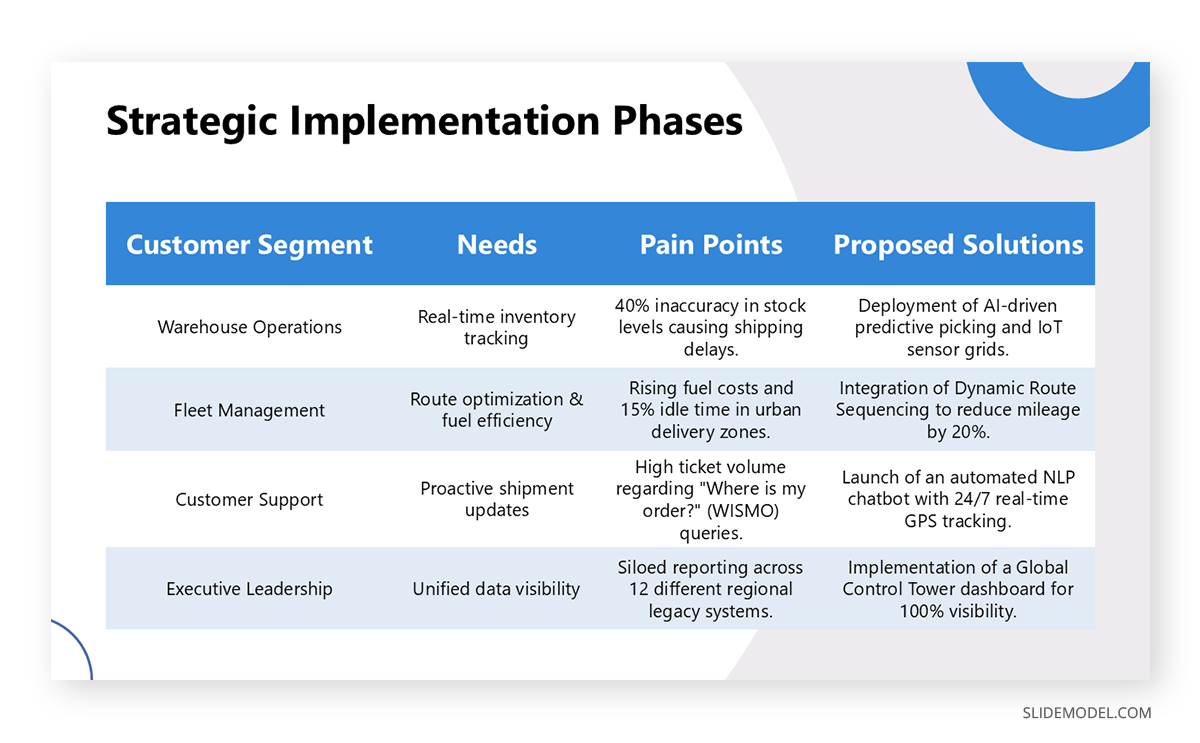
Map each solution element directly back to a specific part of the challenge. Don’t list features; show which element addresses which problem. “Because X was the root cause, we did Y” is the logical structure the audience needs to trust the outcome later.
Identify the turning point. The specific moment the customer first saw it working: when a dashboard updated in real time, when the first at-risk account was caught before churning, is often the most memorable detail on the slide. Name it explicitly. Also, state what was not changed. If the customer kept existing workflows or tools and the solution integrated around them, say so. It reduces implementation anxiety more effectively than any reassurance about ease of use.
Outcome Slide
Outcome slides should lead with the primary metric in large type, with supporting data below it. If the headline result is a retention improvement, that figure should be impossible to miss. Secondary metrics provide depth for audiences who want it, but they should not compete visually with the primary claim. A useful test before finalizing any customer success study presentation: if a stakeholder photographs a single slide and shares it without context, that slide should communicate enough for the recipient to understand what it represents.
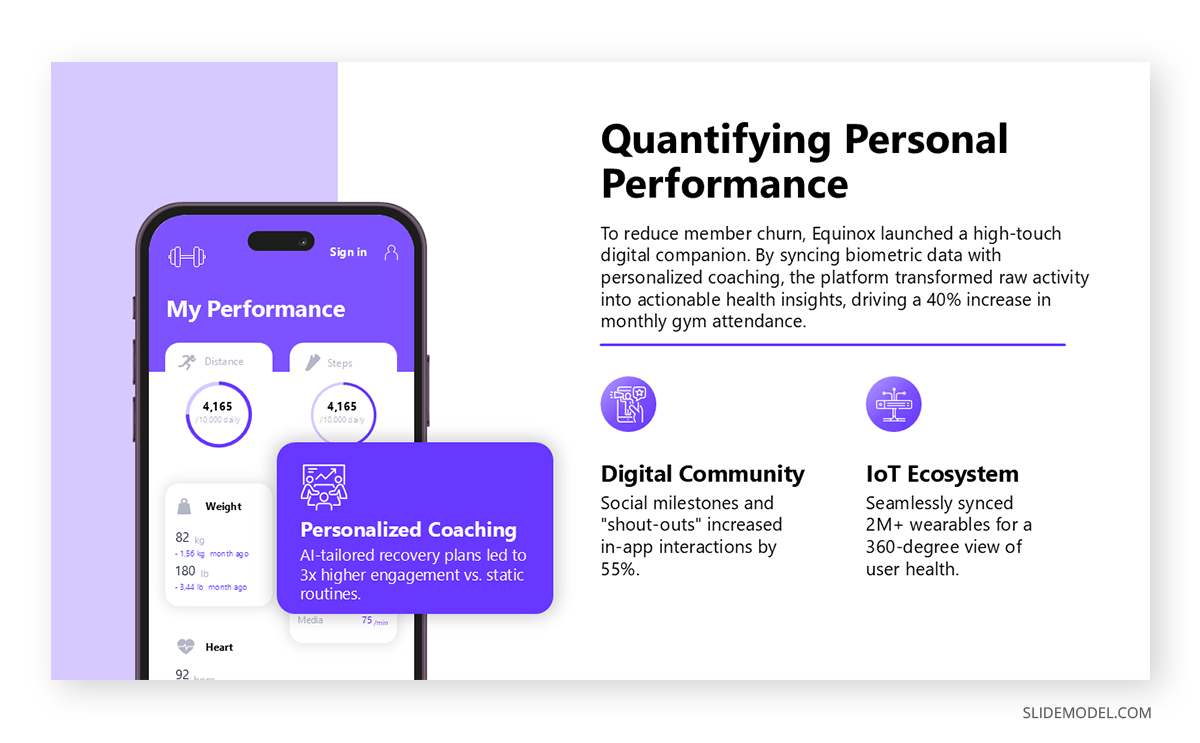
Research on social proof in presentations consistently shows that quantified outcomes generate more audience confidence than qualitative summaries, because they allow independent interpretation. This matters particularly in enterprise sales presentations, where decision-makers who were not present for the live pitch will review the deck independently and reach their own conclusions.
Use a time axis rather than a before-and-after point comparison wherever possible. A curve that starts flat, bends, and stabilizes is more credible than two isolated numbers because it shows when results appeared, how long they took to materialize, and whether they held.
Adapting the Same Story for Different Audiences
A customer story does not change between audiences, but the weight given to each component should. What varies is which part leads, how long the approach section runs, and what context surrounds the outcome. The same data can be configured differently for each room without having to rebuild the story from scratch.
For a sales audience, the context and challenge sections should be long enough for them to recognize themselves in the featured customer’s situation before the outcome appears. An audience that has identified with the problem will weigh the result more heavily than one that is still deciding whether the comparison applies to them.
For a customer success leadership study presentation, individual outcomes matter less than the pattern they represent. A single strong outcome is a story; a set of cases showing consistent results across account segments demonstrates a program. Leadership presentations should map several customer profiles against their pre- and post-engagement metrics, demonstrating that the customer success program produces repeatable results rather than isolated wins. That structural argument carries more weight with a leadership audience than any single impressive outcome.
What Changes When the Room Changes
For CSM peer reviews, the approach section becomes the most valuable part of the presentation. The outcome is already known; the audience is there to understand what decisions were made, what did not go as planned, and what the team would do differently. A customer success manager case study presented internally should include an honest accounting of where the engagement required course correction. External versions omit this section; internal ones should not.
Salesforce customer success stories case studies illustrate this well. Their published cases lead with the primary metric before the reader is three lines in, because enterprise CRM buyers arrive with a defined evaluation framework and need only to see fit demonstrated. For an audience that has not yet formed that framework, the sequencing reverses: context first, approach in enough detail to reduce implementation anxiety, outcome last. Getting that order wrong is the most common structural error in customer success study presentation design.
When the same case study needs to serve multiple audiences, the most practical approach is a modular deck in which the context and outcome slides remain fixed, and the approach section is adjusted for each room. Applying storytelling principles to that structure keeps the narrative coherent even when individual sections are swapped out.
FAQs
How soon after achieving results should you document a case study?
Wait 90 to 120 days; early metrics often reflect onboarding intensity rather than sustained behavior that the customer will maintain independently.
What do you do when a customer’s results are mixed or below expectations?
Present it internally. Documenting what was adjusted and why demonstrates analytical rigor that peer reviewers find more useful than a polished success story.
How do you keep a case study current as the customer relationship evolves?
Update it each time the customer hits a significant milestone. An outdated case study implies stagnation; a current one shows that value compounds.
Can a case study remain in use after the featured customer has churned?
Yes, if the results were real during the engagement. Churn does not invalidate those outcomes, and disclosure is not typically required unless the prospect asks.
Should the featured customer be present during the presentation?
In enterprise contexts, a live reference often outperforms a pre-produced slide, especially when the customer’s role closely mirrors the prospect’s situation.
What legal considerations apply when sharing customer performance data externally?
Generic permission to appear as a customer does not cover specific figures. Get written approval for each metric used externally before any presentation.
How do you respond when a competitor publishes similar-sounding success metrics?
Lean into specificity. A case study that names the customer and explains the metric methodology is harder to challenge than a competitor’s round number with no context.
How many customer success study slides should appear in a standard sales deck?
Four to six slides per case fit within a 15 to 20-slide deck. When multiple cases are needed, a summary grid is more efficient than full narratives for each.
How do you handle a prospect who says the featured customer is not comparable to them?
Treat it as a request for a better match. Asking which dimension feels most different usually reveals the specific concern and points toward a more relevant case.
Final Words
A customer success case study is only as useful as the preparation that precedes the first slide. Selecting a story that mirrors the audience, grounding outcomes in data with a visible baseline, and sequencing the story so context precedes results are the decisions that determine whether the presentation creates conviction. Slide design matters, but it does not compensate for a poorly matched story or an outcome the audience cannot evaluate.