Most business professionals have sat through a presentation packed with data and walked out unconvinced. The numbers were sound, the slides were clean, and the argument still failed to move anyone. What was missing was rarely more evidence. It was a story that tied the evidence to something the audience actually cared about. In corporate settings, where a budget or an entire strategy can ride on a single meeting, that gap is expensive. A persuasive story closes it by giving your facts a context in which they can do their work.
This article shows you how to craft a persuasive story built for situations where you have to convince, not merely inform. It covers the psychology behind why stories change decisions, the structures that hold a business narrative together, a full worked example you can adapt, and the harder problem most guides skip: how to win over an audience that starts out skeptical. By the end, you will have a repeatable method for turning a report into a case that people act on.
What is a Persuasive Story and Why Does it Work?
A persuasive story is a structured narrative that uses a recognizable situation and a real conflict to guide an audience toward a specific conclusion or action. A standard argument asks listeners to weigh your logic. A story asks them to follow a journey, and by the time the conclusion arrives, they have often reached it on their own. That difference matters most when the stakes are high and the room is not automatically on your side.
The evidence for this is not soft. In research popularized by Chip and Dan Heath in “Made to Stick”, audiences who heard a point delivered as a story recalled it far more often than those who heard the same point delivered as a bare statistic. Neuroeconomist Paul Zak has shown that character-driven narratives prompt the release of oxytocin, a signal linked to trust and empathy, which leaves listeners more willing to accept what follows. Understanding how storytelling works in a presentation starts with accepting that memory and trust, not raw information, are what carry a decision.
This is also the foundation of what a persuasive presentation is. A persuasive presentation uses narrative and evidence together to move people from where they are to where you want them to be. Knowing that something is true matters less if the audience has no stake in the answer. A well-told story creates that stake before the evidence arrives, which is why the skill pays off across formats, from an investor pitch to a quarterly board briefing.
The Psychology of Persuasion Behind Every Story
Persuasion has been studied for a very long time, and the most durable model still comes from Aristotle. He argued that convincing anyone rests on three appeals: credibility, emotion, and logic. Credibility, or ethos, is what the audience believes about you before you make your case. Emotion, or pathos, is the stake the story creates. Logic, or logos, is the evidence that confirms the resolution. A story is powerful because it can carry all three at once, weaving your authority and the audience’s feelings into the same sequence that delivers your proof. Balancing these appeals is the core idea behind the rhetorical triangle, and it is worth mapping your narrative against each one before you present.
Modern research adds another layer. Robert Cialdini‘s work on influence identified levers that quietly shape decisions, and two of them belong inside a business story. Social proof, the tendency to follow what similar others have done, is why a story about a peer company lands harder than an abstract claim. Authority, the weight we give to credible sources, is why naming a real client or a verifiable result strengthens the narrative. You do not need to announce or point out these levers. You build them into the character and the outcome so the audience feels the pull without being told they should. That is much of what separates a persuasive story from a merely pleasant one.
Building the Structure of a Persuasive Story
Every persuasive story needs a spine the audience can follow without effort. When the structure is clear, listeners spend less energy tracking where they are and more energy evaluating what you propose. The three moves below give you that spine, and each one solves a specific problem that trips up presenters who improvise.
Starting with a Conflict the Audience Recognizes
Every persuasive story needs a conflict, and in business, that conflict is usually a problem your audience already feels. A market opportunity slipping away, or a process quietly draining hours every week. The conflict is what gives people a reason to care about whatever comes next, so it has to be real to them, not invented for the occasion.
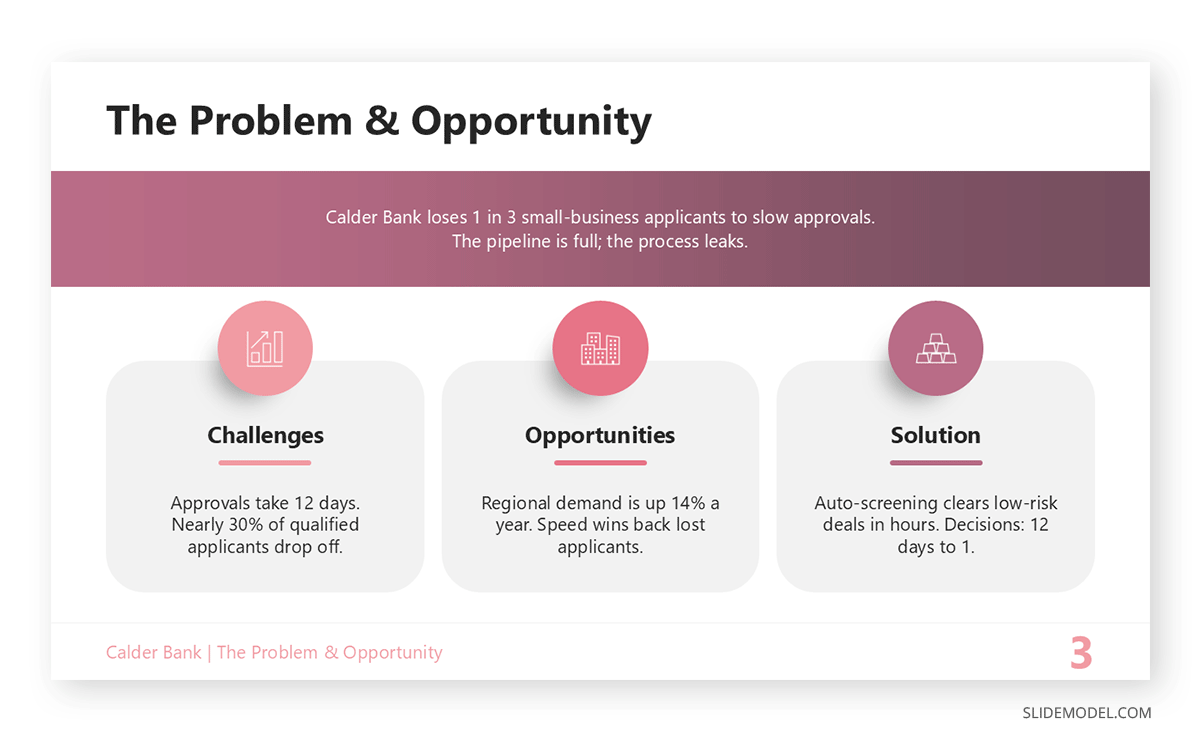
The most effective approach anchors the conflict in a specific situation rather than a general complaint about the industry. Vague descriptions of market difficulty are easy to tune out. A concrete scene, with a named role and a precise difficulty, holds attention. A strong example of a persuasive story in a sales context might follow a single client who spent six extra hours a week on manual steps that a better process would have removed. That specificity is what makes the story persuasive rather than merely illustrative, and it mirrors how you would frame the problem on a pitch deck.
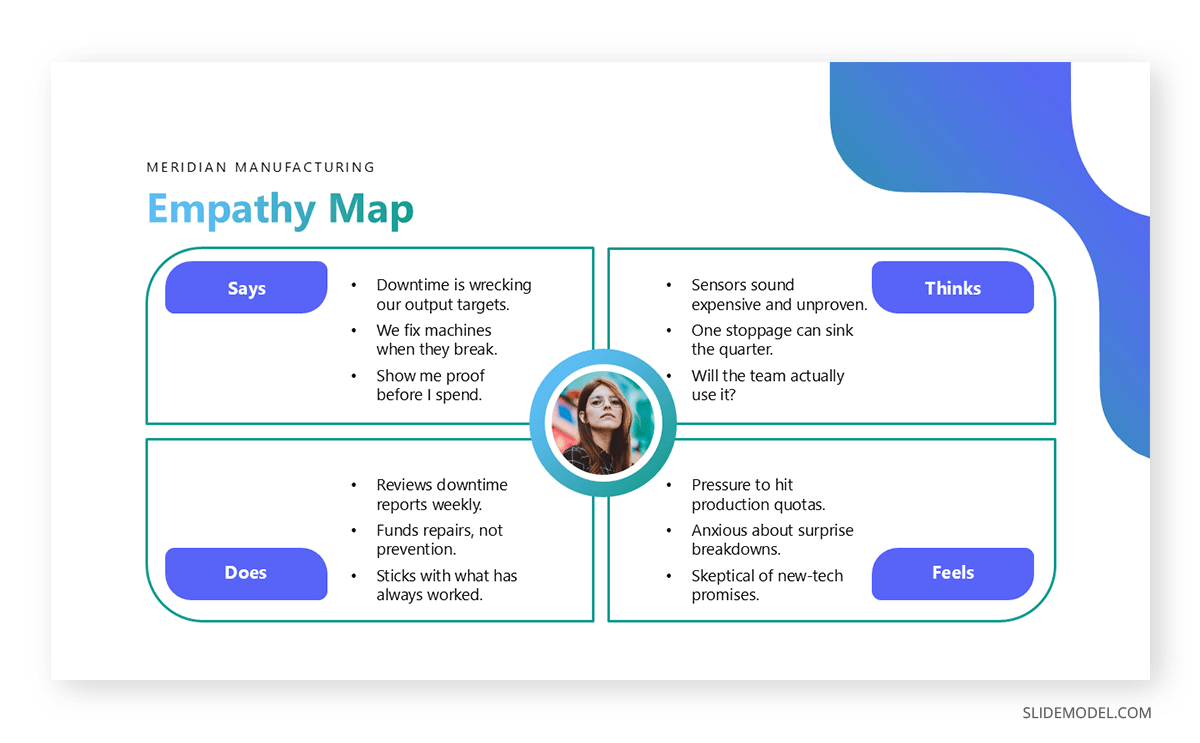
Knowing your audience in advance is essential here. The conflict you open with should reflect a tension your listeners already carry, not one you have to convince them exists. Building an empathy map before you draft is a reliable way to surface those tensions. When you understand how the audience frames the problem, you can mirror that framing in your opening scene, making the story feel immediately relevant rather than hypothetical.
Connecting the Resolution to Your Argument
The resolution is where the persuasive work actually happens. It should answer the conflict directly and connect cleanly to whatever you are advocating, whether that is a product, a budget, a new hire, or a change in direction. The audience needs to see a believable path from the problem to the solution, and the resolution is what makes that path visible.
A frequent mistake is resolving the story too quickly. A rushed resolution implies the outcome was easy, which quietly undercuts the weight of the conflict you just built. Let the resolution land before you move to your supporting evidence. This is how the audience comes to understand not only what you propose but why it matters in terms drawn from their own experience. A clear presentation structure reinforces this by keeping the narrative arc visible from the opening slide to the last.
It also helps to lean on a proven narrative pattern rather than inventing one under pressure. The Situation, Complication, Resolution model used across consulting sets up a stable state, introduces the disruption, and then delivers the answer. Nancy Duarte‘s approach contrasts what is with what could be, moving the audience between the current reality and a better future until the gap itself becomes the argument. Either pattern gives your resolution a frame that the audience recognizes, even when they cannot name it.
A Worked Example You Can Adapt
Frameworks are easier to trust when you can watch them run end-to-end, so here is a compact example built for a budget request. Imagine you are asking a leadership team to fund a new onboarding platform, and the room includes a finance lead who guards every dollar.
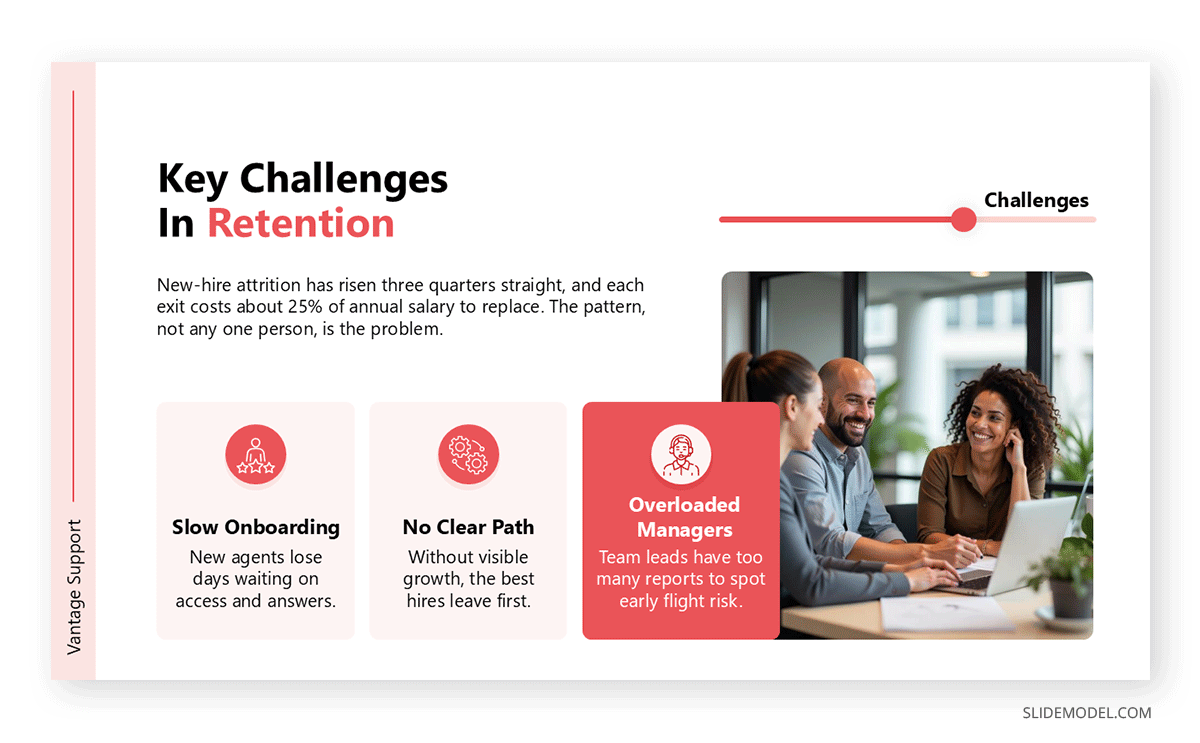
Open on the conflict. Last quarter, a regional manager named Elena lost two of her strongest new hires within ninety days. Both told her in exit interviews that they felt lost for their first month, waiting days for access and answers that never came. The scene is specific, the character is real, and the tension is one every leader in the room has felt at some point.
Deepen the complication. Elena is not an outlier. Across the company, early attrition has climbed for three consecutive quarters, and each departure costs roughly a quarter of that person’s annual salary to replace. The audience now sees a pattern rather than an anecdote, and the pattern points straight at a cost they already own.
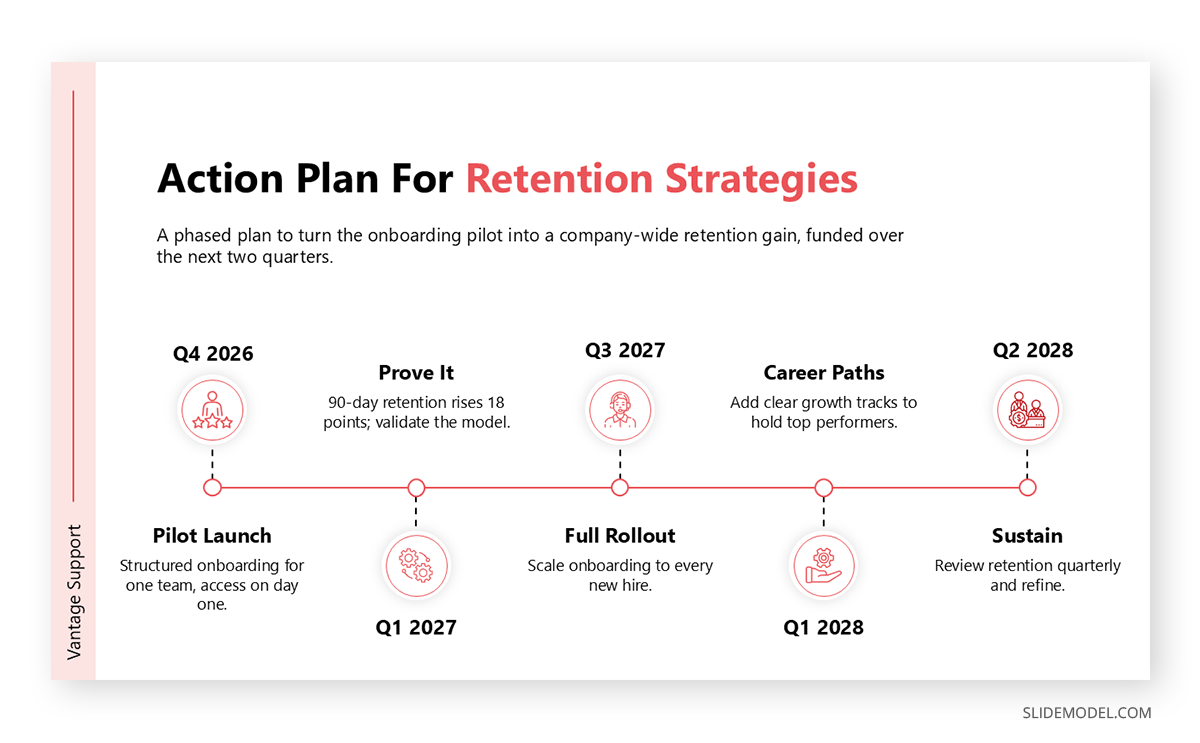
Deliver the resolution. A structured onboarding platform would have given Elena’s hires access on day one and a clear path through their first month. When a pilot team already tried this, 90-day retention rose by 18 points in a single quarter. Only now do the numbers arrive, and they read as confirmation of a story the audience has already accepted rather than data to be judged cold. Close with the ask: fund the rollout for the next two quarters. The narrative did the persuading, so the request feels like the obvious next step.
Persuading a Skeptical or Resistant Audience
In most corporate rooms, at least one person is effectively paid to say no. A finance lead protects the budget, an executive has watched the idea fail before, a peer is defending a competing priority. A persuasive story that ignores this resistance tends to collapse the moment the first hard question lands. The stronger approach builds the objection into the narrative before anyone has to raise it.
Start by naming the counterargument yourself. When you acknowledge the strongest objection out loud, you take it off the table as a weapon, and you signal that you have already done the thinking. If cost is the concern, put the cost inside the story and then show the return that answers it. Skeptical executive audiences tend to trust a presenter who volunteers the hard part far more than one who appears to be hiding it.
Lean on proof the audience cannot easily wave away. This is where social proof in a presentation earns its place: a comparable company, a named client, or a result from a pilot inside their own organization. A story that is resolved with verifiable evidence is much harder to argue against than one resolved with a promise. When you show that people like them made the same choice and benefited, you quietly shift the burden of proof onto the doubter.
Finally, prepare for the exchange after the talk. The question-and-answer session is where persuasion is often won or lost, so rehearse the objections most likely to surface and fold your answers back into the story you already told. When a hard question only reinforces your narrative, the skeptic ends up becoming your best piece of evidence.
Choosing Persuasive Presentation Topics That Support a Narrative
Not every topic lends itself equally well to a narrative, and the one you choose determines how much work the story has to do. Persuasive presentation topics work best when a genuine tension sits at the center, such as a risk worth taking or a belief worth updating. If the topic has no real conflict, the story has no momentum, and no amount of polished delivery will supply it.
When you select a topic, consider what your audience currently believes and what would need to shift for them to act. A subject like cost reduction becomes far more compelling when it is told through the experience of one team that changed its approach and saw measurable results in a quarter. The factual content is identical; the narrative gives it weight and direction. This is also the difference between a report that gets filed away and a case that gets funded.
The topic also shapes the evidence you will need. A persuasive story gains credibility when it is backed by data, but the data should arrive after the narrative has established why it matters. Leading with numbers puts the audience in judgment mode before they have any context for reading them. Topics with clear before-and-after dynamics tend to produce the strongest narratives, because the contrast between the conflict and the resolution is easy to demonstrate, and it lets you turn raw numbers into a story the room can actually feel.
Tailoring the Story to the Room
The same underlying story rarely fits every audience without adjustment, and part of persuading well is knowing what to change for each setting. A few common corporate scenarios call for a different emphasis, even though they share the same conflict-to-resolution spine.
For an investor pitch, the conflict is a market gap, and the resolution is the opportunity your company captures. Investors reward tension between a large problem and a credible path to a return, so the character is often the customer whose pain represents the whole market.
For an internal budget request, the conflict is a cost or risk the organization already carries, and the resolution is the investment that removes it. Here, the audience owns the problem personally, so the story should feel close to home, and the numbers should map to their own line items.
For a sales presentation, the character is a client who closely resembles the prospect, and the resolution demonstrates a result the prospect wants for themselves. The nearer the character’s situation is to the buyer’s, the more persuasive the story becomes. For a change initiative, such as a presentation that drives organizational change, the conflict is the cost of standing still, and the resolution is the future state that motivates people to move. Each scenario keeps the same spine, but the character, the stakes, and the evidence shift to match what the room cares about most.
How to Present a Persuasive Speech
Knowing how to present a persuasive speech is largely a matter of timing and control. The choices you make before you speak shape the delivery, which means preparation is not separate from performance. It is part of it, and it shows the moment you open your mouth.
Begin by anchoring the audience in the world of your story. Describe the situation with enough detail that people can picture it. When you name a role, a team size, or a timeline, you give listeners enough to project themselves into the scene. Concrete detail builds credibility in a way abstraction cannot, and it signals that you know the territory you are speaking about.
Pacing matters throughout, and especially during the conflict. Slowing down at the key moments lets the stakes register before you move on. Audiences are more persuaded by conclusions they feel they reached themselves, and a well-paced story gives them the room to do exactly that. Your body language contributes here, too, particularly when you pause on purpose rather than filling the silence with filler words.
End with a direct ask. A persuasive story without a clear call to action wastes the momentum it built. Once the narrative has done its work, tell the audience exactly what you want them to decide or do. In hybrid and virtual settings, make that ask even more explicit, since you lose the subtle cues of a shared room. The story handled the emotional and logical preparation; the closing ask completes it.
Slide Design and Templates That Carry the Story
Once the narrative is written, the slides have to serve it rather than compete with it. Persuasive storytelling asks for restraint on screen: one idea per slide, generous whitespace, and a visual that reinforces the beat you are narrating, rather than a wall of text the audience reads ahead of you. The strongest decks in this style feel closer to a storyboard than a document, so it helps to plan the visual sequence the way you would build a storyboard in PowerPoint, mapping each story beat to a single slide before you design anything at all.
From there, match the template to the beat. The opening conflict lands hardest on a spare slide, a single image, or a short line of text that sets the scene while the room’s attention stays on you rather than the screen. As the complication builds, a timeline template shows how the problem grew over time, turning an anecdote into a visible pattern the audience can trace. When you reach the resolution, a before-and-after comparison slide makes the contrast between the old reality and the proposed one impossible to miss, echoing the what is versus what could be structure the narrative already relies on.
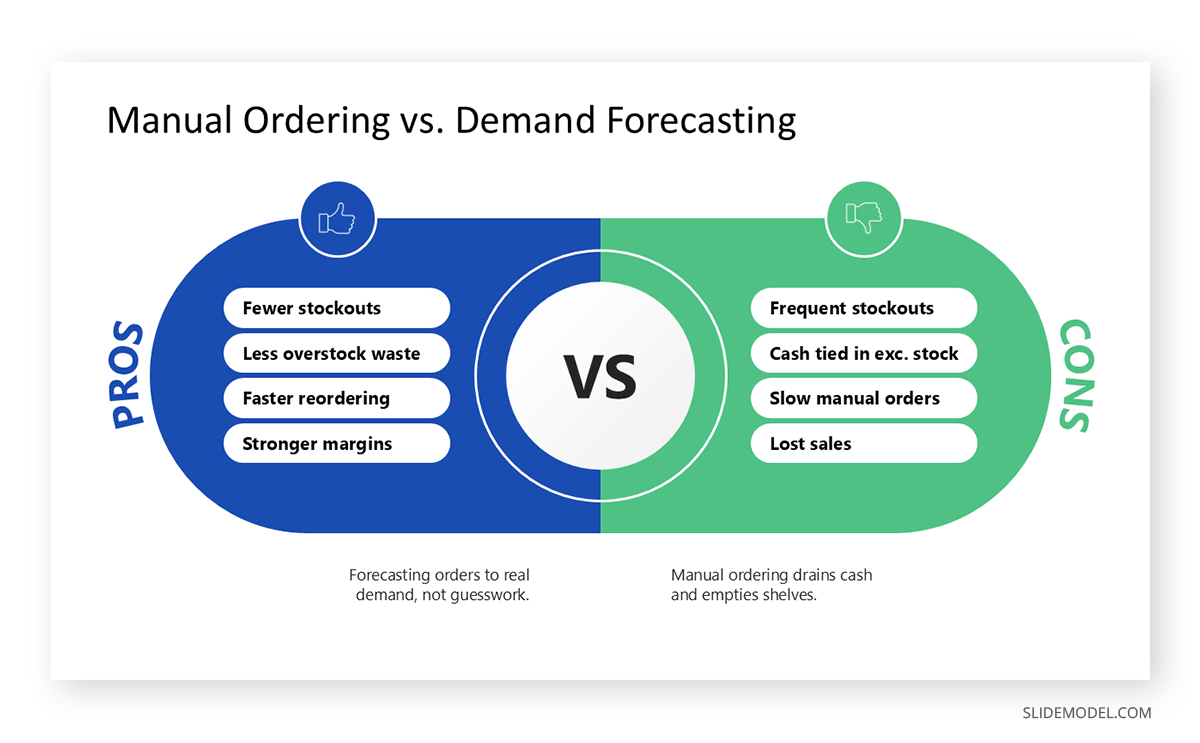
Save the data for the confirmation beat, and design it to be read in seconds. This is where a clean data presentation earns its place: one chart, one takeaway, labeled so the number you want remembered is the first thing the audience sees. A roadmap template suits the closing ask, since it lays out the path forward and makes the decision feel like a plan rather than a leap. Across every slide, keep the visual language consistent: the same typeface, palette, and layout logic, so the deck reads as one continuous story instead of a set of unrelated exhibits. Restraint is the point. When the design recedes, the story and the presenter are what the audience remembers.
Common Mistakes That Weaken a Persuasive Story
Even a well-built narrative can lose a room through a handful of avoidable errors. The most common approach is to lead with data. When numbers arrive before the story, the audience has no frame for interpreting them and slips into evaluation mode far too early. Another is choosing a conflict the audience does not actually feel, which leaves the whole narrative floating above the real decision. Presenters also tend to resolve too fast, robbing the conflict of its weight and making the solution look trivial.
A quieter mistake is hiding the objection. When you sidestep the obvious counterargument, a skeptic will raise it for you at the worst possible moment, and your silence reads as either blindness or evasion. Many presenters also forget the ask entirely. They tell a strong story, land the evidence, and then stop, leaving the audience moved but without a clear instruction on what to do next. Each of these failures is easy to catch in rehearsal if you know to watch for it, and fixing them is usually a matter of resequencing rather than rewriting.
A Quick Checklist Before You Present
Before you walk into the room, run your narrative against a short checklist. Treat it as a final pass rather than a substitute for the work above, and repair anything that comes up short while there is still time to change it.
- The conflict names a specific situation the audience already recognizes.
- The character is real and resembles someone the audience trusts or identifies with.
- The resolution connects directly to your ask and is given room to land.
- The strongest objection is acknowledged inside the story, not left for the audience to find.
- Evidence arrives after the narrative, confirming it rather than introducing it.
- The closing ask states exactly what you want the audience to decide or do.
If any item is missing, that gap is usually where your persuasion will break. Fixing it before you present is far cheaper than discovering it live, in front of the people you most need to convince.
FAQs
What is a persuasive story in a business context?
A persuasive story is a structured narrative that uses a relatable conflict and a clear resolution to move an audience toward a specific decision or action. It combines situation, tension, and outcome to give evidence an emotional and logical frame the audience can act on.
What is a persuasive presentation?
A persuasive presentation is a structured communication designed to shift the audience’s thinking or behavior toward a specific outcome. It uses narrative and evidence organized around a clear position, rather than simply conveying information for its own sake.
How is a persuasive story different from a standard argument?
A standard argument presents claims and evidence for the audience to weigh. A persuasive story conveys the same content through a narrative frame, making it more memorable and allowing the audience to reach the conclusion alongside the speaker rather than judging it from the outside.
What are good persuasive presentation topics for professional settings?
Topics with genuine tension work best: adopting a new process, reallocating budget, responding to a competitive shift, or changing how a team operates. The topic needs a real conflict at its center for the story to have forward momentum.
Can you give an example of a persuasive story used in a presentation?
A product manager might tell the story of a customer who lost hours each week to a manual workaround, then show how the proposed feature would have removed that friction and what a pilot group gained once it did. The customer’s journey makes the abstract benefit concrete and verifiable.
How do I persuade a skeptical or resistant audience?
Name the strongest objection yourself before anyone else can, put the concern inside the story, and resolve it with proof the audience cannot easily dismiss, such as a comparable company or a pilot result from their own organization. Then rehearse the likely questions so your answers reinforce the narrative you already told.
What narrative framework works best for business storytelling?
Two patterns hold up well under pressure. The Situation, Complication, Resolution model, common in consulting, establishes a stable state, introduces the disruption, and then delivers the answer. Nancy Duarte’s what is versus what could be approach contrasts the present reality with a better future until the gap becomes the argument.
What slide templates work best for a persuasive storytelling presentation?
Choose templates that match the story beats. A storyboard or spare title slide sets up the conflict; a timeline or journey layout shows the complication building over time; a before-and-after comparison slide delivers the resolution; and a clean data layout confirms it. A roadmap slide suits the closing ask. The guiding principle is one idea per slide with consistent visuals, so the design supports the narrative rather than distracting from it.
How long should a persuasive story be in a presentation?
Most business contexts call for a focused narrative of two to four minutes. That is long enough to clearly establish the conflict and resolution, but short enough to leave room for supporting evidence and the closing ask.
What role does evidence play alongside a persuasive story?
Evidence validates the story’s resolution. It should follow the narrative so the audience already understands why the data matters before they encounter it. Numbers presented before the story rarely persuade, while numbers that confirm a story the audience has already followed tend to be far more convincing.
How do I practice delivering a persuasive speech?
Rehearse the narrative section separately from the evidence section, since each calls for a different kind of delivery. Record yourself and listen for pacing problems, especially moments where you rush through the conflict or resolve it before the audience has time to feel the stakes.
Final Thoughts
A persuasive story is not decoration laid over a real argument. It is the architecture that makes the argument legible in a room where people have to decide. When you build your narrative around a conflict the audience feels and a resolution that answers it, your presentation stops working like a report and starts working like a case. The audience follows the story, arrives at your conclusion alongside you, and leaves with both the information and the reason to act on it.
In corporate settings, where persuasion is the difference between a plan approved and a plan shelved, that shift is the whole game. Master the structure, prepare for the skeptic, and let your evidence confirm a story the room has already accepted. Do that consistently, and you will not just inform an audience. You will move them to act.