The McKinsey 7S Model is a strategic framework developed in the late 1970s by Tom Peters and Robert Waterman at McKinsey & Company. It maps an organization across seven interdependent elements, giving leaders a structured way to assess alignment and communicate complex organizational realities to stakeholders. In a presentation context, the model becomes a diagnostic map, exposing how all parts of the organization relate to one another and whether those relationships support the stated direction.
Consultants, strategy teams, and executives use 7S slides to frame change proposals, support due diligence reviews, and anchor reorganization plans. Presenters can use 7S PowerPoint templates to ground abstract strategy work in something visually compelling for their audiences.
The Seven Elements of the McKinsey 7S Framework
The framework divides organizational analysis into two categories: Hard Elements and Soft Elements. The distinction matters in presentations because each group requires different evidence and often speaks to different stakeholders within the same organization.
Hard Elements: Strategy, Structure, and Systems
Strategy is the plan that directs how the organization allocates resources and positions itself against competitors. In 7S analysis, strategy is examined not in isolation but in relation to the other six elements. A strategy that demands rapid, decentralized decision-making must be matched by a structure and systems that support those conditions. When they do not, the strategy exists on paper but not in practice.
Structure defines how authority is distributed and how reporting lines are drawn across the organization. It governs how quickly the organization responds to change, how information travels, and how clearly individuals are held accountable for outcomes. Structure is often where the most visible proposed changes sit in reorganization presentations. Systems refer to the processes and workflows that govern day-to-day operations, from financial reporting cycles to how customer feedback reaches product teams. Systems are frequently underrepresented in strategy presentations, even though they are the primary mechanism through which strategy gets executed.
Soft Elements: Shared Values, Skills, Style, and Staff
Shared Values sit at the center of the original diagram, representing the organization’s guiding beliefs and cultural identity. In presentations, they are the hardest element to evidence rigorously. Presenters draw on employee survey data, observed behavioral patterns, or documented organizational history to make the analysis credible. Skills describe the collective capabilities present across the workforce, distinct from individual job titles. The relevant question is whether the organization possesses what the strategy requires, not what credentials individuals hold.
Style captures the predominant leadership approach in practice, not in policy documents. An organization can describe itself as collaborative while operating through top-down directives; 7S analysis is designed to surface that gap. Staff refers to the workforce as a collective, addressing its composition, how people are deployed across functions, and how individuals develop within the organization. These soft elements are harder to quantify but frequently carry more explanatory weight when diagnosing why an organization underperforms relative to its stated strategy.
How to Build a 7S Presentation
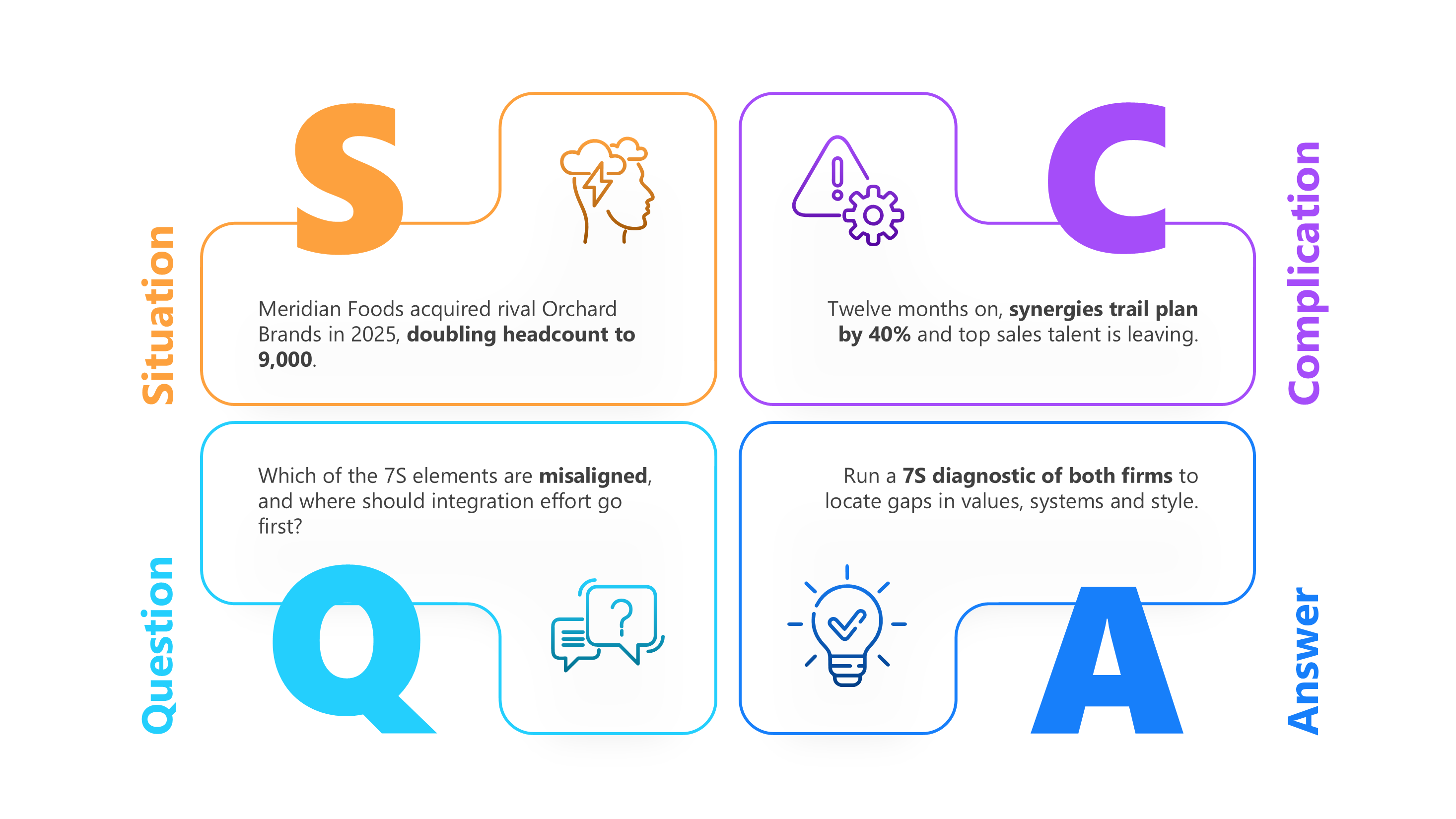
Start with a context slide. Before the 7S diagram appears, the audience needs to understand the purpose of the analysis. Whether the presentation supports a change management initiative, an organizational review, or post-merger integration planning, the framing slide should state what question the 7S analysis is answering. This prevents the model from appearing as a generic exercise rather than a tool applied with specific intent.
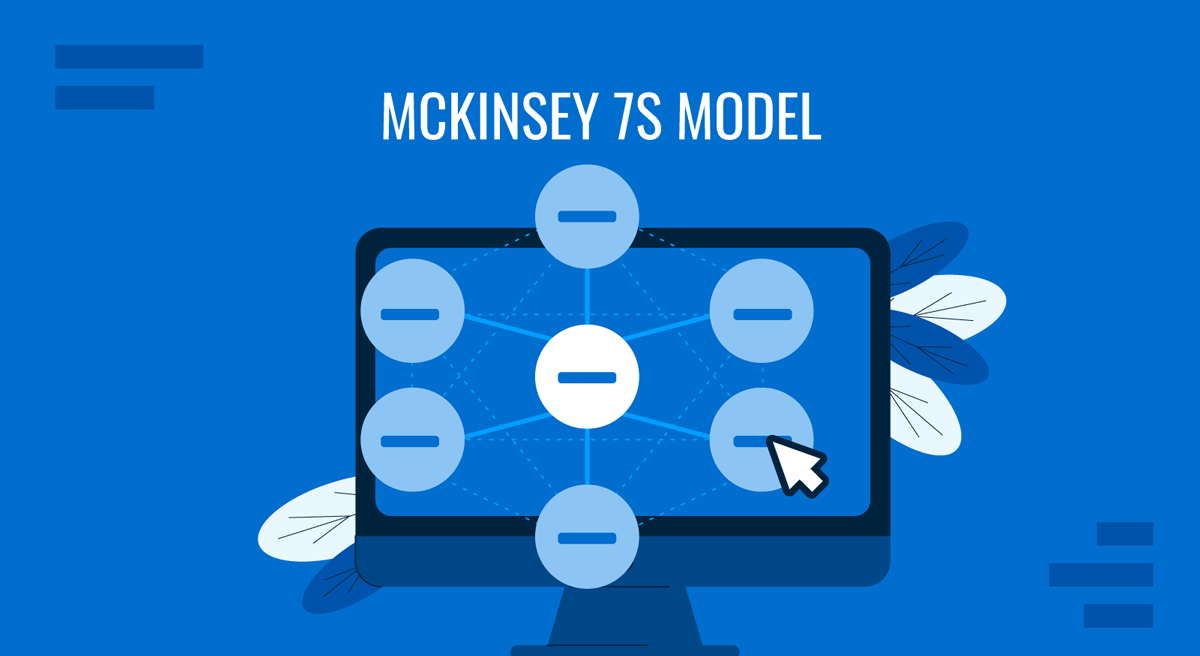
The central diagram slide maps all seven elements in their standard radial arrangement, with Shared Values at the center and the remaining six surrounding it. Each element on this slide should carry a brief label or a single defining statement rather than a paragraph. The goal is orientation: the audience should see the full organizational picture before any element is examined in depth. Supporting slides then develop each element using specific evidence, such as org charts for Structure, process inventories for Systems, or competency assessments for Skills.
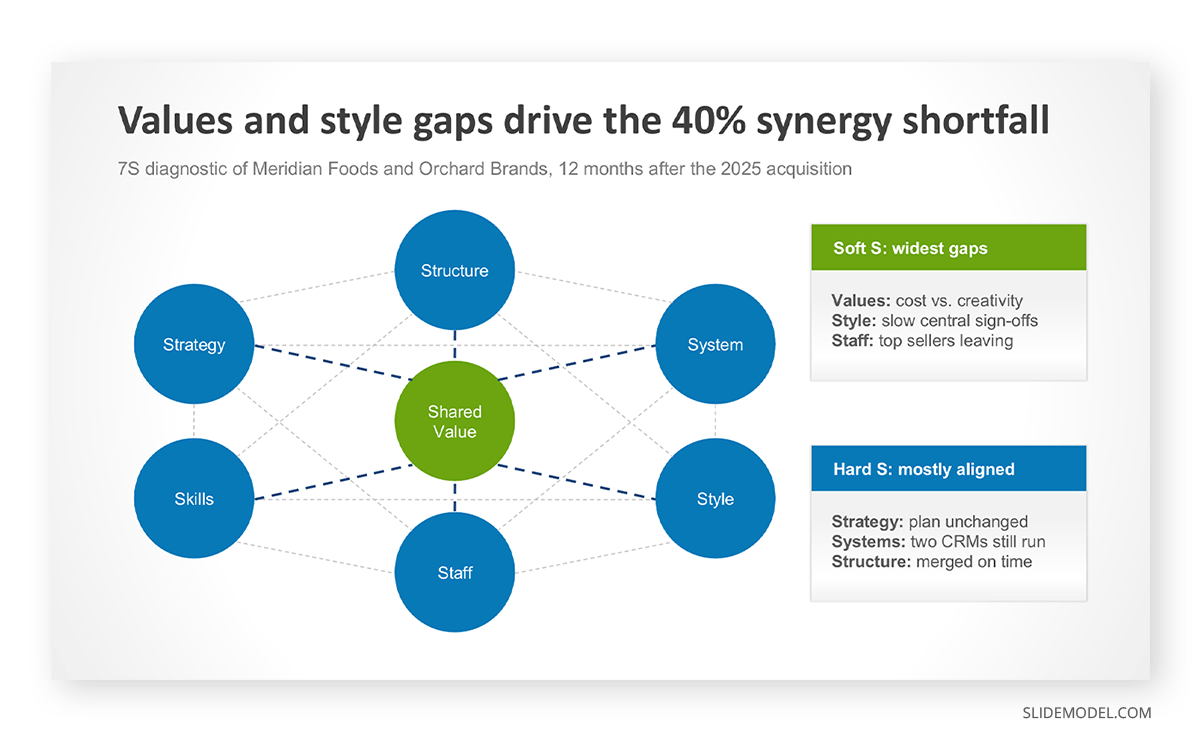
The alignment gap slide is often the most analytically useful in the deck. It places current-state 7S configurations alongside the desired future state, surfacing specific misalignments the presentation will address. Presenters working on transformation programs often use this structure to build the logical foundation for their recommendations within a broader McKinsey presentation structure. The closing slide should connect identified gaps to specific actions with clear ownership.
When to Use the McKinsey 7S Model in Presentations
Change management scenarios are the most frequent context for 7S presentations. When leadership proposes a structural reorganization, a shift in operating model, or a new strategic direction, the 7S analysis surfaces which other elements need to shift alongside it. Presenters can strengthen their arguments by connecting 7S findings to change management models the organization already uses.
Post-merger integration reviews use the 7S framework to map compatibility gaps across all seven dimensions between two organizations. The model helps identify whether combined entities share compatible values, whether systems can be consolidated without friction, and whether structural integration accounts for differences in leadership style. Without a framework that examines all elements together, integration teams risk focusing on visible structural changes while leaving cultural and systems misalignments to surface after the deal closes.
The 7S Model also belongs in strategic planning sessions where leadership needs to assess whether current organizational capabilities support the adopted strategy. If the strategy requires faster decision cycles or new technical skills, those gaps become visible when you examine all seven elements together rather than in isolation.
Related Models to Consider Alongside the 7S Framework
The Balanced Scorecard takes a different orientation, organizing performance measurement across financial, customer, internal process, and learning dimensions. Where the 7S Model is diagnostic, the Balanced Scorecard is evaluative. The two complement each other when a presentation needs to move from organizational assessment to performance accountability. A 7S analysis might reveal inadequate systems; a Balanced Scorecard then tracks whether improvements to those systems deliver the expected results.
Kotter’s 8-Step Model addresses change sequencing rather than organizational mapping. Kotter’s change framework and the 7S Model often appear together in presentations, where the 7S analysis establishes the organizational rationale for change and Kotter provides the execution roadmap. The 7S Model answers what needs to change; Kotter answers how to sequence the effort.
The Denison Organizational Culture Model is a focused alternative to the 7S soft elements, examining culture through involvement, consistency, adaptability, and mission. For presentations where cultural diagnosis is the primary focus, it may provide greater specificity. The BCG Matrix and Porter’s Five Forces address competitive position and market dynamics, making them better suited to strategy-formulation presentations than the organizational coherence questions the 7S Model addresses.
FAQs
What does each S in the McKinsey 7S Model stand for?
The seven elements are Strategy, Structure, Systems, Shared Values, Skills, Style, and Staff. Strategy, Structure, and Systems are the Hard Elements. Shared Values, Skills, Style, and Staff are the Soft Elements.
When should the 7S Model be used in a presentation?
The model is most appropriate when the presentation needs to assess or explain organizational alignment. Common contexts include change management proposals, post-merger integration planning, organizational redesign reviews, and strategic capability assessments.
How is the 7S Model different from a SWOT analysis?
SWOT analysis evaluates an organization’s position relative to its external environment. The 7S Model is internally focused, examining whether the organization’s elements align. The two address different questions and often work well together in a comprehensive strategy presentation.
What is the role of Shared Values in the 7S framework?
Shared Values occupy the center of the original diagram because they are understood as the foundation influencing all other elements. When Shared Values are misaligned with strategy or structure, they often explain persistent behavioral patterns that structural changes alone cannot fix.
How do you identify misalignments using the 7S Model?
Misalignments become visible when you compare the current state of each element with what it would need to look like to support the strategy. A useful check is to ask whether each pair of elements reinforces or contradicts each other. If the strategy requires rapid experimentation but systems support only annual planning cycles, that is a traceable misalignment.
Can the 7S Model be used for team-level analysis?
Yes. The framework scales down effectively to a department or business unit. Team-level 7S analysis is commonly used in transformation programs where business units are assessed individually before an organization-wide integration plan is developed.
How many slides does a 7S presentation typically require?
A focused 7S presentation generally requires between eight and twelve slides: a context slide, an overview diagram, supporting slides for each element, an alignment gap summary, and a recommendations close. Executive-audience versions tend toward the lower end; working sessions with operational teams may go deeper on individual elements.
What is the difference between Hard Elements and Soft Elements?
Hard Elements are more formally documented and easier to analyze using existing organizational records. Soft Elements are more intangible and require qualitative evidence such as surveys, interviews, or behavioral observation. The distinction matters for presentation planning because each group requires different evidence-gathering approaches.
How does the McKinsey 7S Model relate to change management?
The 7S Model is widely used as a diagnostic tool in change management because it identifies which organizational elements need to shift when strategy or structure changes. Change management frameworks typically address how to execute transitions; the 7S Model identifies what needs to change and helps ensure no critical element is overlooked in planning.
Are there limitations to the 7S framework presenters should acknowledge?
The model provides a comprehensive organizational map but does not rank the relative importance of misalignments or suggest a sequence for addressing them. It also does not incorporate external environmental factors, which means it works best alongside frameworks that address competitive dynamics when those are central to the analysis.
Final Words
The McKinsey 7S Model remains one of the most durable tools in organizational analysis because it insists on examining the whole system rather than isolating individual components. In presentations, that holistic perspective is its primary value. Audiences who see all seven elements mapped together, with their relationships made explicit, gain a clearer picture of organizational reality than any single metric or org chart can provide. Presenters who use the framework with discipline, connecting each element to specific evidence, move beyond describing structure to explaining alignment. That is where most of the decisions that matter to strategy actually live.