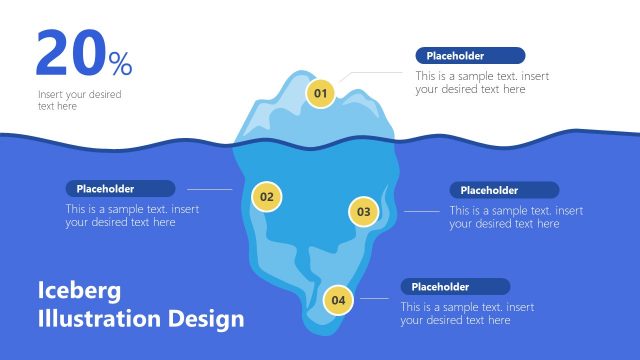
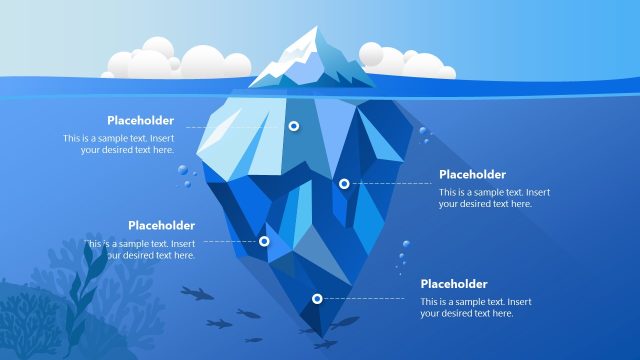
The PowerPoint template of Explicit & Tacit Knowledge Iceberg Infographic presents knowledge management concepts using iceberg metaphor. An iceberg analogy is used to describe various concepts where only small part of a much larger idea is visible. For example, an iceberg of success, culture, psychology, and organizational behavior. The explicit and tacit knowledge could ideally be explained using the similar analogy of iceberg. This presentation uses the vector-based infographic shape of an iceberg to visualize comparison of explicit and tacit knowledge.
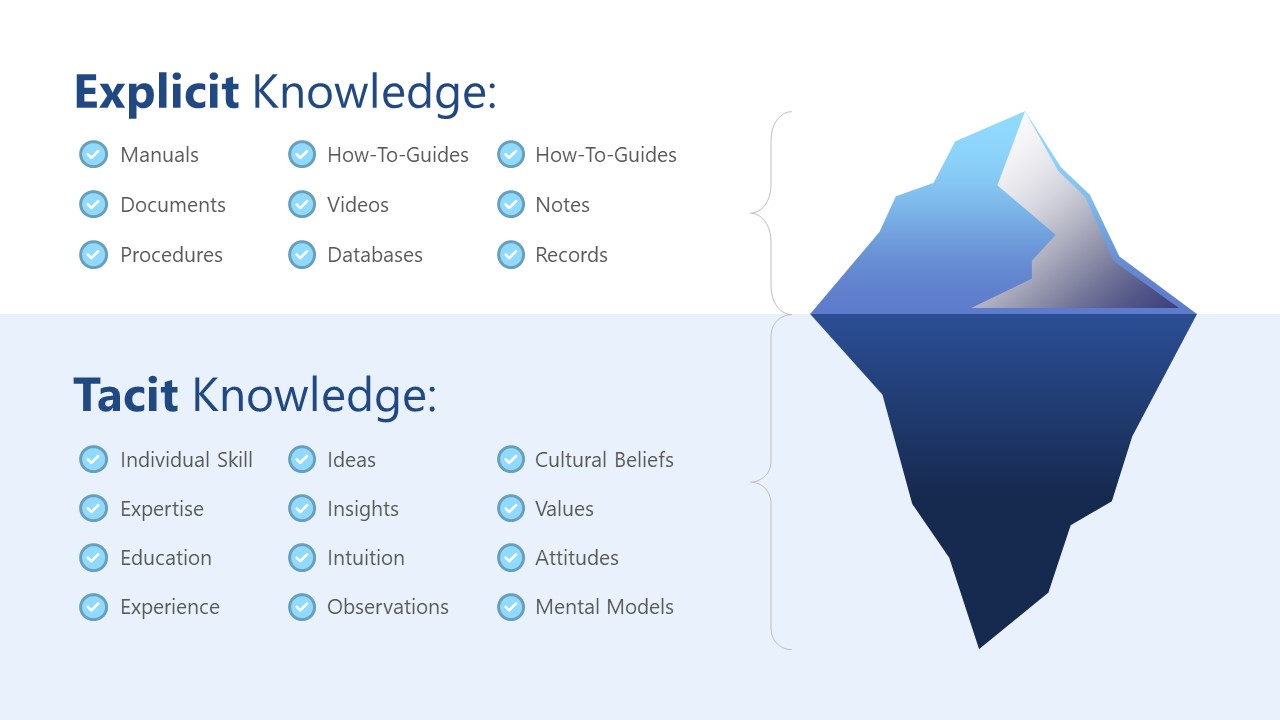
Knowledge management is divided into two major types in terms of knowledge transfer i.e. tacit and explicit. Tacit knowledge is what individuals experience through expertise and job know-how. Such as education, attitude, insights, and intuitions about context-specific issues. Whereas, explicit knowledge is a piece of well-documented information for performing certain actions. These may include user manuals, databases, records, and procedure guidelines. The tacit knowledge is personal to each individual’s capacity and experience but explicit knowledge can easily be shared and employed. In the iceberg model, explicit knowledge is a tip of the iceberg that can be seen. For example, a book or document. On the other hand, tacit knowledge is hidden below the surface and cannot be seen.
The PowerPoint template of Explicit & Tacit Knowledge Iceberg Infographic is useful for organizational knowledge management. It will help distinguish between what can be seen or not in terms of skill learning. This helps develop organization’s knowledge transfer process. The diagram template of explicit & tacit knowledge shows iceberg model and sources of knowledge that fall in each category. You can download this slide for team building and process development presentation. It will encourage viewers to collaborate and share knowledge.
What’s inside this template
Example presentation scenarios
- A knowledge manager can use the iceberg diagram to introduce a knowledge transfer program and show how manuals, records, and databases differ from skills, values, and mental models.
- An HR leader can present the explicit and tacit knowledge lists during onboarding to explain why new employees need both documented procedures and mentor-based learning.
- A learning and development facilitator can use the waterline and bracket structure to guide a workshop discussion about which team capabilities are visible, recorded, or hidden.
- An organizational development consultant can use the checkmark item groups to map culture, attitudes, and experience as hidden factors behind performance or change adoption.
Features
- 100% editable presentation template
- Compatible with Microsoft PowerPoint and Google Slides
- 16:9 aspect ratio slides
- Scalable vector shapes, icons and illustrations
- AI-Ready for Microsoft Copilot and Claude
- Instant access and download
Frequently asked questions
Q: How should a presenter explain the explicit and tacit knowledge split using this slide?
A: Start with the visible top of the iceberg and describe explicit knowledge as content that can be written, stored, searched, or shared. Then move below the waterline to tacit knowledge and connect the listed skills, attitudes, intuition, and mental models to day-to-day work. This order helps the audience see why documentation alone does not capture everything people know.
Q: Who is this infographic best suited for in a business presentation?
A: This infographic fits presenters who need to explain knowledge management, onboarding, training design, or organizational learning. HR leaders, learning teams, consultants, and managers can use it when the key message is that records and procedures are visible assets, while experience, beliefs, and informal know-how require coaching, observation, and collaboration.
Q: Why does the iceberg metaphor work for this knowledge management topic?
A: The iceberg metaphor makes the imbalance between visible and hidden knowledge immediately clear. The smaller top section supports concrete examples such as manuals and documents, while the larger submerged section gives weight to expertise, values, and intuition. The waterline creates a simple visual boundary that helps audiences remember the difference.

Explicit & Tacit Knowledge Iceberg Infographic
1-slide presentation template for knowledge management with an iceberg diagram and explicit-tacit comparison
The Explicit & Tacit Knowledge Iceberg Infographic is a 1-slide presentation template for explaining knowledge management with an iceberg metaphor. It includes an explicit knowledge list above the waterline, a tacit knowledge list below it, bracket markers, and a large editable iceberg diagram for PowerPoint and Google Slides.
- Category
- Diagrams
- Rating

 Loading...
- Aspect ratio
- 16:9
- Item ID
- 20753-01
- Colors
 Microsoft PowerPoint
 Microsoft Copilot
 Claude for PowerPoint
Other formats supported
Subscribe today and get immediate
access to download our PowerPoint templates.