When a crisis lands, organizations do not get the luxury of deliberation. A product recall, a data breach, a leadership scandal, or a sudden operational failure each demand a coherent public response within hours, often within minutes. The gap between a well-prepared organization and an unprepared one shows up immediately, and it shows up most visibly in how they communicate. That is where the crisis communication deck becomes a working asset rather than a slide archive.
This article examines what a crisis communication deck contains, how it connects to a broader crisis communication strategy, and how presenters can design slides that hold up under pressure. It also covers the role of monitoring data, the structure of an effective crisis communication team, and the differences between a pre-built crisis playbook template and the live deck a spokesperson actually delivers.
Whether you are building this resource from scratch or revisiting an existing one after a difficult incident, understanding how these slides function will change the way you approach both preparation and delivery.
What Is a Crisis Communication Deck
A crisis communication deck is a structured presentation designed to coordinate an organization’s response to a significant adverse event. Unlike a standard business presentation built around persuasion or reporting, a crisis communication presentation serves a specific operational function: it organizes who says what, to whom, and when. It is the document that a communications director pulls up at 11 PM when something has gone wrong, and it needs to contain answers before the questions have all been asked.
The distinction between a crisis communication deck and a crisis playbook template is worth clarifying. A playbook is the comprehensive reference document that governs how an organization handles various crisis scenarios, its protocols, pre-approved language blocks, and escalation paths. The crisis communication presentation, by contrast, is the deliverable that gets adapted and presented to specific audiences: the executive team, the board, journalists, employees, or regulators. Both documents belong in every organization’s preparedness toolkit, but they serve different functions at different moments in a crisis timeline.
The slides in a crisis communication deck must be built for speed and clarity. During an active crisis, there is no time to redesign a presentation or hunt for the right framing. The structure should already be in place, with variable fields that get filled in as the facts become clear. A well-designed crisis comms slide deck gives presenters confidence, reduces the chance of inconsistent messaging, and shortens the time from incident detection to organized response.
The Crisis Communication Strategy Behind the Deck
A crisis communication deck is only as strong as the strategy behind it. The slides are the surface layer. Underneath, organizations need a coherent crisis communication strategy that defines their communication philosophy, identifies their core audiences, and establishes the principles that will guide every public statement. Without that foundation, a deck becomes a collection of templates with nothing to anchor them.
One widely referenced framework in the field is the 5 Cs of crisis communication: Clarity, Compassion, Consistency, Credibility, and Control. Each principle translates directly into how slides are written and sequenced. Clarity means avoiding ambiguous language in your key messages slide. Compassion means leading with acknowledgment of impact before shifting to organizational response. Consistency means every audience-facing slide uses the same core message, even when the level of detail varies. Credibility depends on the quality of the evidence and the specifics you include. Control does not mean minimizing information, but it does mean presenting a structured narrative rather than a reactive sequence of updates.
Your deck should reflect these principles in its architecture. The message hierarchy across slides should be deliberate, not incidental. If your communication plan template has already mapped your audiences and channels, those decisions should carry over into the presentation. Each audience variant of the deck, the version for your board differs from the version for external media, should adapt the same core messages to the appropriate level of detail and tone.
A crisis communication strategy also needs to account for who has authority to approve message changes during a live event. Slides that require sign-off at three levels of the organization will delay response. Build a clear escalation map into the deck from the start.
Understanding Crisis Management Phases
Crisis management does not unfold as a single event. Organizations that handle crises well think in phases, and their crisis communication presentation reflects that. The most common model divides a crisis into pre-crisis preparation, active crisis response, and post-crisis recovery. Each phase has distinct communication objectives, and a well-built deck should address all of them.
Pre-Crisis Preparation
This phase is where most of the real work happens. Before any crisis occurs, the organization should have a crisis response plan in place: scenarios mapped, spokespersons identified, holding statements drafted, and monitoring systems active. The slides built during this phase are the ones that save time when speed is critical. Pre-crisis preparation slides typically include scenario matrices, stakeholder contact maps, escalation decision trees, and approved holding language blocks. They should be reviewed regularly, particularly after any significant organizational change.
Pre-crisis preparation also involves training presenters to deliver under pressure. A slide deck that has never been rehearsed in a simulated high-stakes environment will perform differently when the stakes become real. Organizations should run tabletop exercises that use the actual deck, testing whether the material holds up when audience questions are difficult and information is still incomplete.
Active Crisis Response
During an active crisis, the deck shifts from preparation to execution. Slides get pulled from the pre-built library of PowerPoint templates and adapted to the specific event. A rapid response crisis scenario requires slides that communicate what is known, what is being done, and when the next update will arrive. The holding statement, a brief, carefully worded acknowledgment that buys time before the full response is ready, should appear as a slide in this phase. It is not a final answer; it is a commitment to transparency while facts are still being established.
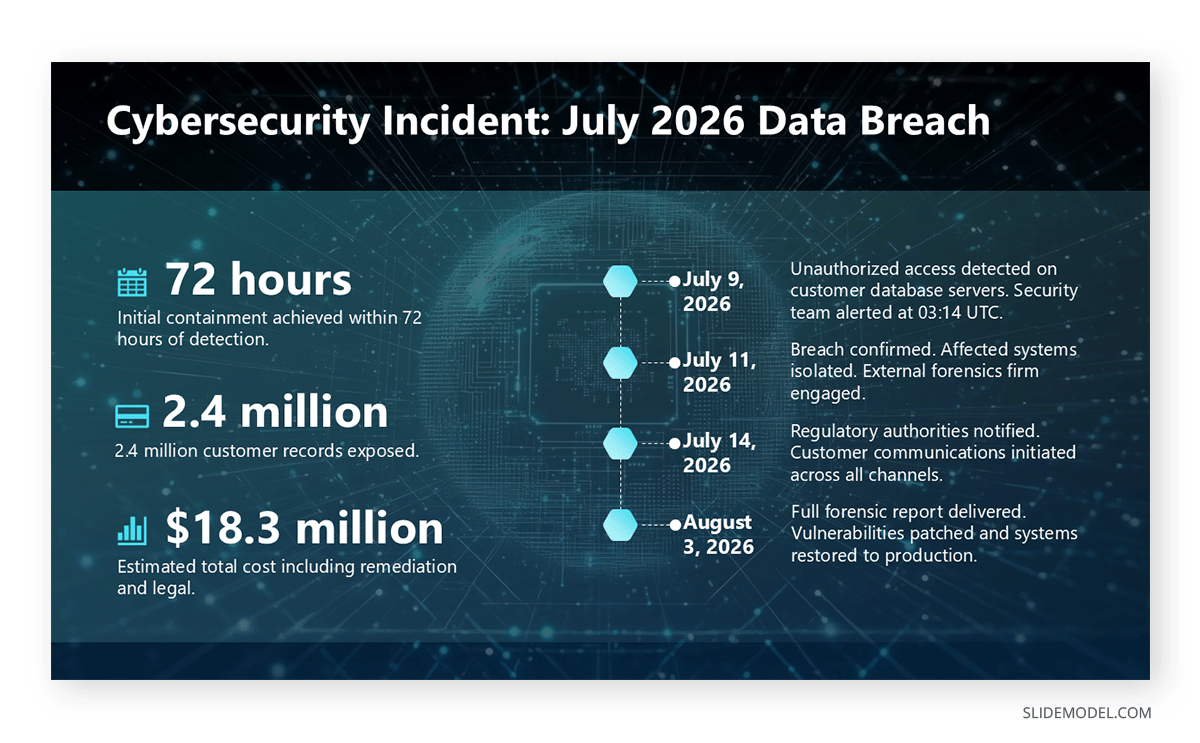
This is also when the gap between organizations with a pre-built crisis playbook template and those without one becomes most apparent. Organizations that have done the preparation can move from detection to public acknowledgment in under two hours. Those building their response from scratch often take far longer, and the delay itself becomes part of the story.
Post-Crisis Evaluation
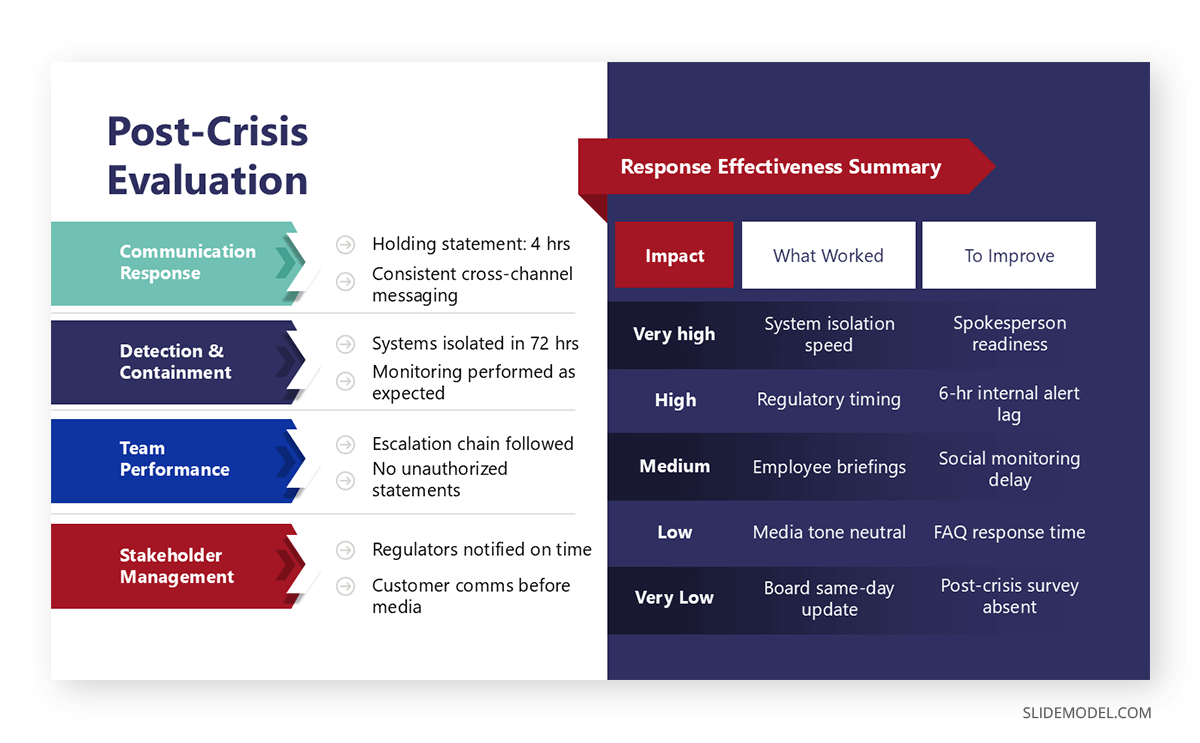
Post-crisis evaluation is the phase most organizations rush or skip. After the immediate pressure lifts, the tendency is to move on. But a structured post-crisis review using data from the response, media coverage, stakeholder feedback, and internal debrief produces the insights that make the next response better. The evaluation slides in a crisis communication deck should capture what worked, what failed, how audiences responded to different message framings, and where the protocols need adjustment. These findings directly inform the next iteration of the crisis playbook template.
Building the Crisis Communication Team
A crisis communication deck does not present itself. Behind every coordinated response is a crisis communication team with divided responsibilities, aligned messaging, and clear lines of authority. The composition of that team, and how clearly its roles are documented in the deck, determines how well the organization responds when multiple stakeholders are demanding attention simultaneously.
The core team typically includes a communications lead responsible for message development and media relations, a legal representative who reviews statements before release, a senior executive who serves as spokesperson for high-visibility scenarios, and an operations or IT lead who provides factual updates during ongoing incidents. Depending on the organization, HR, investor relations, and government affairs may also have standing roles. What matters is not the exact roster but the clarity about who owns each decision. If two people believe they approve the external statement, neither will send it quickly.
Effective stakeholder management during a crisis also requires knowing which external parties need to receive information, and in what order. Regulators, institutional investors, and major clients often need direct communication before or alongside public statements. The deck should include a stakeholder prioritization slide that maps these audiences and the appropriate message variant for each. Crisis communication that reaches a regulator through the news rather than through direct contact creates a secondary problem on top of the original one.
The team structure slide in your crisis communication presentation should also cover alternates. In a major crisis that unfolds over days, your primary spokesperson may be unavailable at a critical moment. The deck should document backups for each key role, with enough context that a substitute can step in with minimal briefing time.
What Goes Into a Crisis Comms Slide Deck
The specific slides in a crisis communication deck will vary by organization and industry, but certain components appear consistently across well-designed decks. Understanding the purpose of each component helps presenters build a deck that works as a coordinated whole rather than a set of loosely related slides.
The Holding Statement Slide
The crisis holding statement is the first message delivered publicly after an incident is confirmed. It acknowledges the situation, expresses appropriate concern, and commits to providing more information. It does not speculate, assign blame, or offer premature explanations. The holding statement slide should be pre-written with variable fields for the incident type and filled in as quickly as the first verified facts are available. It should also note the name and title of the spokesperson who will deliver it, and the next scheduled update time.
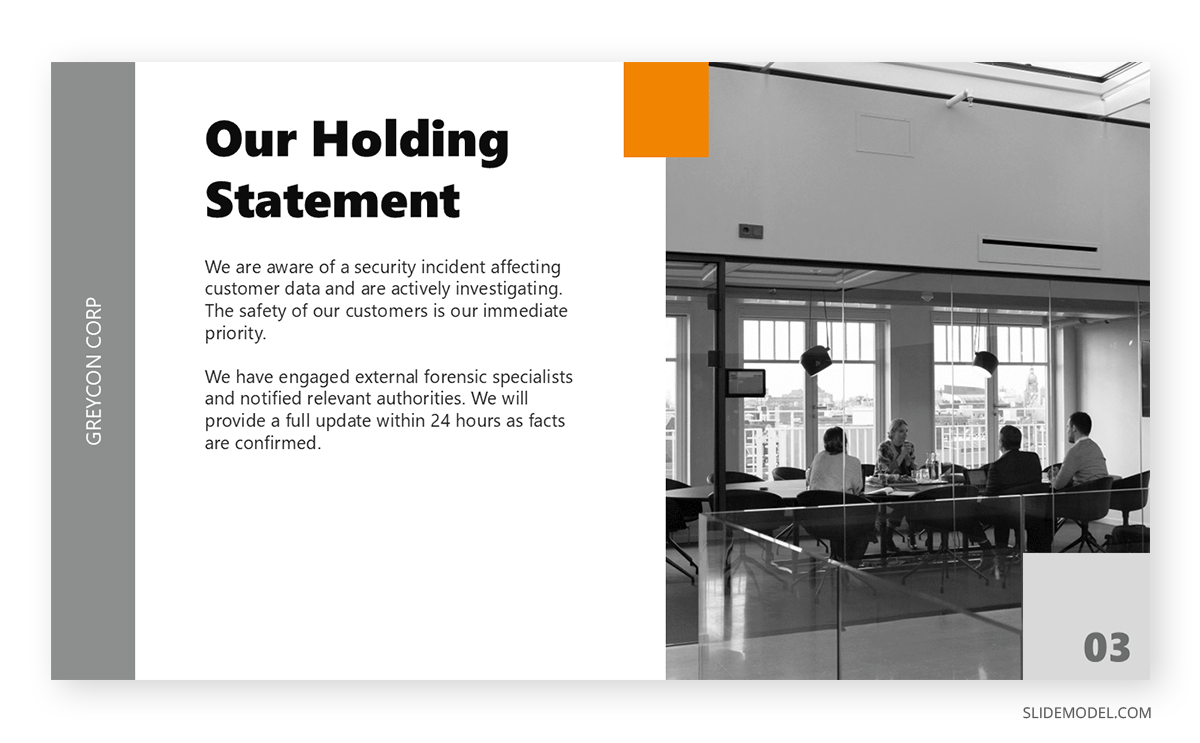
Getting the holding statement right is often what separates an organization that retains public trust from one that loses it in the opening hours. Audiences do not expect an organization to have all the answers immediately. They do expect the organization to acknowledge the situation and demonstrate that it is taking the matter seriously.
The Crisis Messaging Template Slides
Beyond the holding statement, a crisis comms slide deck should contain audience-specific message variants built from a shared core. The crisis messaging template section of the deck presents the central facts, the organizational response, and the next steps in a format that can be adapted for each audience. The employee version of the message will include different details than the media version; the investor version will address financial implications that are irrelevant in a customer communication.
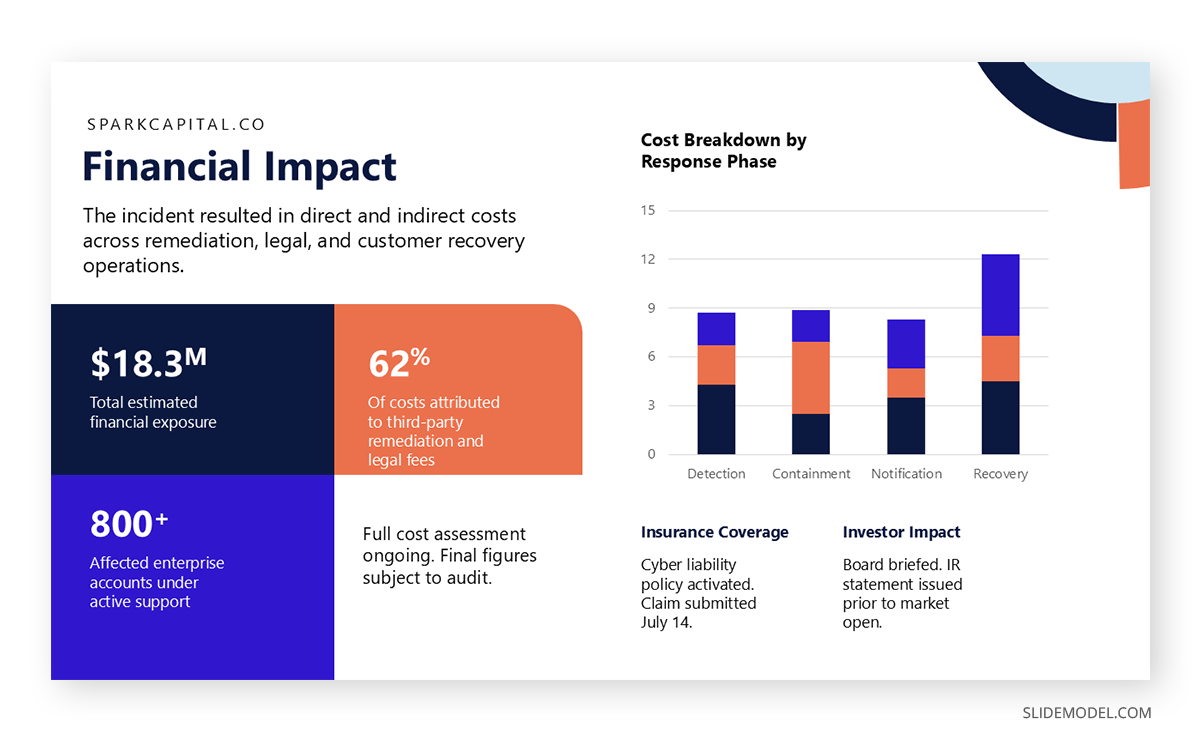
Structuring these variants as separate slides rather than one combined document prevents the mistakes that happen when communicators lift language from the wrong context. It also makes it easier for different members of the crisis communication team to own their respective audience channels without requiring constant coordination. For high-stakes audiences such as the board or regulators, the board presentation format should apply, with clear executive summary slides that lead before the supporting detail appears.
Timeline and Action Log Slides
A crisis communication presentation should document what happened and when. The timeline slide serves two purposes simultaneously. During the response, it helps the team maintain a shared understanding of the sequence of events and the actions already taken. After the crisis, it becomes part of the post-crisis evaluation record. A clean, accurate timeline is also critical if the organization faces any regulatory review or litigation, because it demonstrates that the response was managed and not improvised.
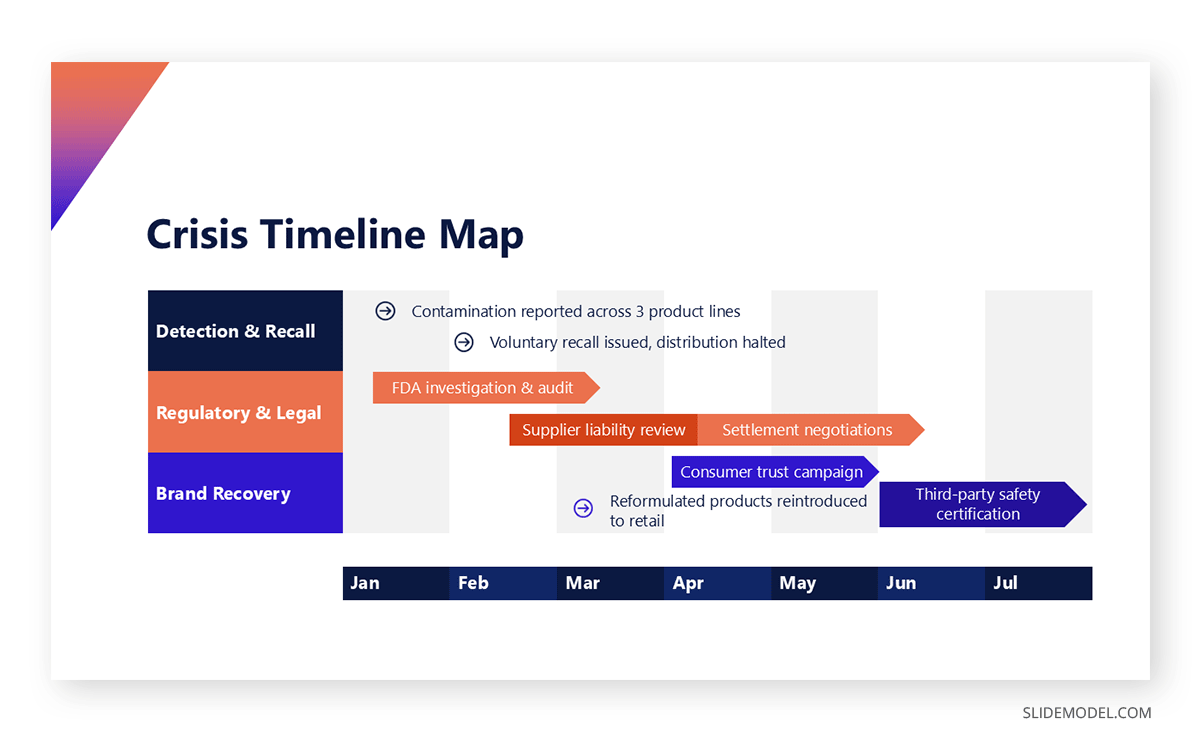
Connected to the timeline is an action log that captures who communicated what, to which channel, at each point in the response. This documentation matters because organizational-level risk management depends on records of how decisions were made and communicated. Gaps in the action log are the kind of thing that surfaces badly in a later audit or legal proceeding.
Monitoring and Intelligence Slides
A crisis does not occur in isolation. While the organization is formulating its internal response, the external narrative is already forming in media coverage, social conversations, and search behavior. Organizations that ignore this real-time intelligence make communication decisions based on incomplete information. The crisis communication deck should include a monitoring section that integrates data from the channels where the crisis is playing out.
Social listening during a crisis captures the volume and sentiment of public conversation in real time. It shows which specific claims are spreading, which audiences are most engaged, and whether the organization’s official messages are being received and accepted or disputed and distorted. Brand monitoring crisis tools, used alongside social listening, provide a broader view that includes news coverage, forum discussions, and review sites where organizational reputation is also being shaped.
Crisis keywords monitoring gives communicators insight into what people are searching for in relation to the incident. If a product name is generating high search volume alongside terms like “recall” or “injury,” that signal needs to be reflected in the public communication, whether through direct FAQ content or a crisis SEO strategy that ensures the organization’s response appears prominently when people search for information. Keyword research during a crisis is not a marketing activity; it is a communication intelligence function. Understanding the brand management implications of search behavior helps communicators prioritize which narratives need direct response versus which ones are better left to dissipate.
The monitoring slides in a crisis communication presentation should be updated frequently during an active crisis and should feed directly into message revision decisions. If a specific piece of misinformation is gaining traction, the deck needs to include a rebuttal message before the next spokesperson appearance. Intelligence without integration into the communication process adds work without improving outcomes.
Crisis Playbook Template vs Live Crisis Deck
Organizations sometimes conflate the crisis playbook template with the live crisis communication deck, and the confusion creates problems at precisely the wrong moment. The playbook is the master reference: a comprehensive document that covers every plausible crisis scenario, defines protocols, lists contacts, and stores pre-approved language blocks. It is a living document, updated regularly, and typically confidential. The live deck is the presentation artifact that gets adapted and delivered to actual audiences during and after an incident. Thinking of storytelling in presentations is useful here: the playbook is your research and notes, while the live deck is the narrative you deliver when the room is full.
The relationship between the two is that the playbook feeds the deck. When an incident occurs, the relevant playbook section provides the raw material: the scenario parameters, the approved holding language, the stakeholder map. The presenter or communications lead then builds or adapts the live deck from that material, customizing it to the specific facts of the incident and the specific audience for each presentation. The deck is always tailored; the playbook is always comprehensive.
Organizations run into difficulty when their playbook has never been translated into a presentation format. A written protocol document, however thorough, does not function as a briefing tool for executives or a script for a spokesperson. The work of converting playbook content into well-structured crisis communication slides should happen during the preparation phase, not during the incident itself. If your organization has a crisis response plan but no corresponding crisis comms slide deck, that gap represents real preparedness risk.
FAQs
What should a crisis holding statement include?
A crisis holding statement should acknowledge the situation factually, express appropriate concern for those affected, confirm that the organization is actively investigating or responding, and commit to a specific time for the next update. It should not contain speculation, unverified facts, or language that implies fault before the facts are established. The goal is to demonstrate that the organization is aware and engaged, not to provide a complete explanation.
How many slides should a crisis communication deck contain?
There is no fixed number, but a functional crisis communication deck typically runs between 20 and 40 slides when it includes all scenario variants and audience-specific message versions. The live presentation for any single audience will be much shorter, often 8 to 12 slides. The deck is a toolkit, and presenters should expect to select and adapt relevant slides for each specific briefing rather than presenting the full document from start to finish.
Who should own the crisis communication deck?
Ownership typically sits with the Head of Communications or the Chief Communications Officer, with legal review on any externally facing language. The deck should have a clear version history so that all team members are working from the same current document. During an active crisis, designate a single person as the “deck manager” responsible for updating slides as new information becomes available and distributing the current version to the team.
How often should a crisis playbook template be reviewed?
At a minimum, the playbook should be reviewed annually and updated after any significant organizational change, such as a merger, a new product launch, or a leadership transition. It should also be updated after any actual crisis, using insights from the post-crisis evaluation. Organizations in heavily regulated industries or those with high public visibility often benefit from semi-annual reviews. A playbook that has not been touched in three years will contain outdated contacts, obsolete language, and scenarios that no longer reflect the organization’s current risk profile.
What is the difference between crisis communication and crisis management?
Crisis management encompasses the full organizational response to a crisis: operational decisions, resource deployment, legal strategy, and executive decision-making. Crisis communication is the function within crisis management that governs how information is shared with stakeholders, the media, and the public. The two are closely connected. Communication decisions need to align with operational facts, and operational decisions often depend on how they will be perceived and communicated externally. A strong crisis communication deck bridges both by providing accurate factual updates alongside the message framing.
How should a crisis communication deck handle situations where the facts are still disputed or incomplete?
Incomplete information is the norm in the early hours of a crisis, not the exception. Slides should distinguish clearly between confirmed facts, actively investigated claims, and information the organization cannot yet verify. Using a consistent visual indicator across slides, such as a status label on each key statement, prevents spokespersons from inadvertently presenting unverified details as established fact. The goal is honest transparency about what is and is not known, not the appearance of certainty.
What role does visual design play in a crisis communication presentation?
Design choices that work in a routine business presentation can undermine a crisis communication deck. High-contrast color schemes, animated transitions, and decorative layouts signal the wrong tone when the subject is serious. Crisis decks should use clean, minimal formatting with a neutral palette, generous white space, and high-legibility type sizes. Every design decision should serve comprehension and speed, not aesthetics. A slide that takes ten seconds to parse costs the presenter credibility in a room that is already under pressure.
How do organizations adapt a crisis communication deck for global or multilingual audiences?
A deck built entirely around one language and one cultural context will perform poorly across international markets. Organizations with global operations should maintain localized message variants for their primary regions, accounting for differences in how direct acknowledgment of fault is perceived, what regulatory bodies expect to hear first, and which channels carry the most credibility in each market. Translation is the minimum requirement. Cultural adaptation of tone, framing, and spokesperson selection is what makes international crisis communication actually work.
Should organizations share their crisis communication deck with external PR or legal agencies ahead of a crisis?
Yes, with conditions. External agencies that will be activated during a crisis need enough familiarity with the deck to contribute usefully, rather than spending the first hours getting oriented. The practical approach is to share the structural framework and the holding statement formats during the preparation phase, while keeping scenario-specific detail internal until needed. Any agency with access to the deck should be covered by a confidentiality agreement, and the version they hold should never be more current than the internal master.
How do you measure whether a crisis communication response was effective?
Effectiveness in crisis communication is measurable, though the metrics differ from standard campaign reporting. Organizations should track sentiment shift over time across media and social channels, the accuracy of information attributed to the organization versus corrections required, spokesperson coverage tone, and how quickly the organization’s official narrative became the dominant framing of the incident. Stakeholder surveys conducted shortly after the crisis provide direct feedback from the audiences the communication was designed to reach. These measurements belong in the post-crisis evaluation and should inform both the next playbook revision and future spokesperson training.
Final Words
A crisis communication deck is preparation made visible. When an organization faces an adverse event, the quality of its response depends heavily on whether the communication infrastructure was already in place. The slides matter because of what they represent: a team that has thought through scenarios, aligned on principles, mapped its audiences, and built the tools to respond with coherence rather than improvisation.
Building an effective crisis communication presentation means understanding each phase of crisis management, knowing which audiences need which message variants, and ensuring that monitoring data flows into the communication process in real time. It means having a holding statement ready before you need it, a stakeholder map that has actually been tested, and a post-crisis evaluation process that captures learning rather than burying it.
Organizations that treat the crisis communication deck as a living asset, reviewed regularly, rehearsed under realistic conditions, and updated after every incident, will find that it performs when performance matters most. Those that treat it as a compliance exercise will discover its limitations at the worst possible time.