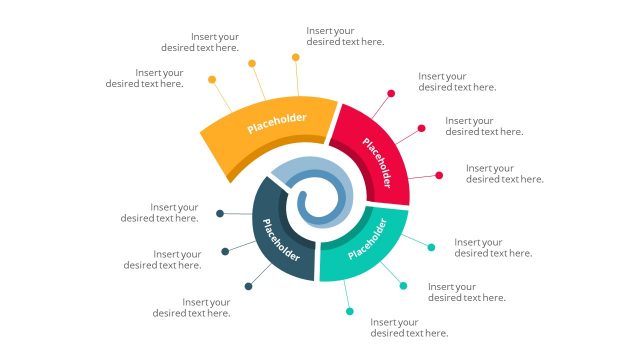
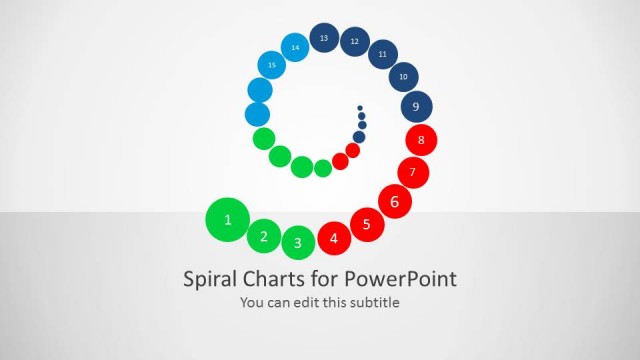
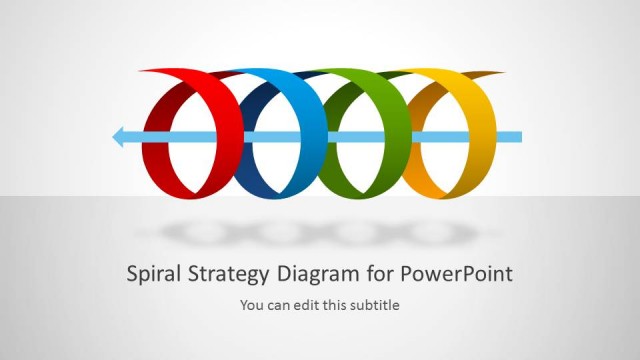
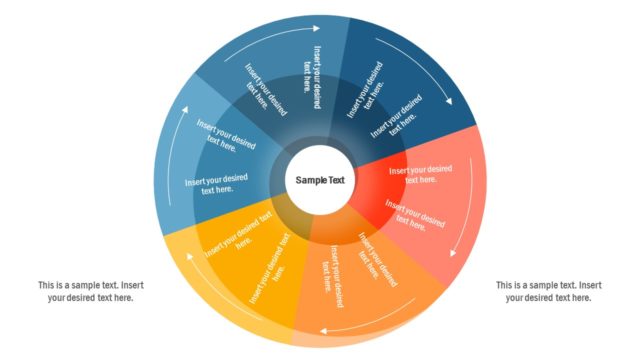
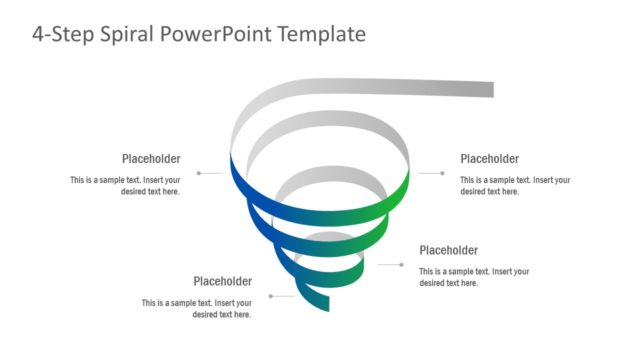
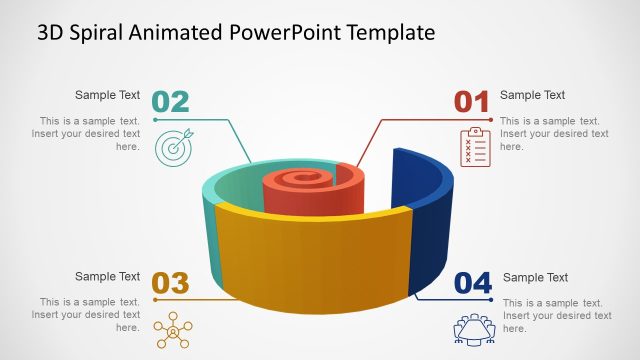
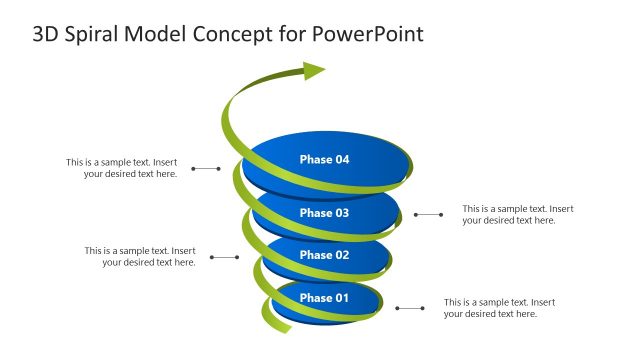
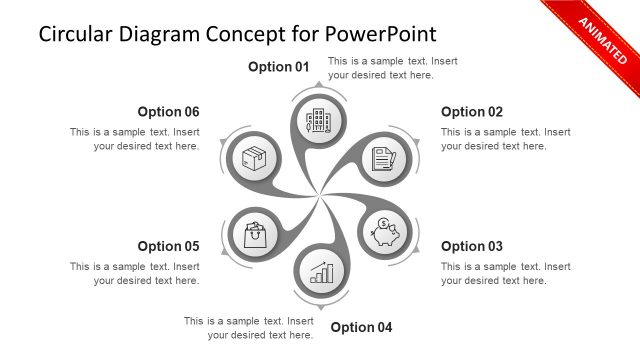
Generate a unique process presentation with the Spiral Diagram for PowerPoint. The presenter can demonstrate the implementation of old and new processes using the PPT template. The spiral diagrams give a dynamic look and feel to the report. Its gradient fill lends a 3D design to the PowerPoint graphics.
The slide designs show an effective process flow diagram. These processes can deal with a system of circular procedures that start a chain of events for the fulfillment of the process itself. Such processes are important in manufacturing companies. The way that certain processing steps lead to another step is demonstrated.
Using the diagrams, the presenter can show the different stages of a cyclical process. Three different types of processes can be presented, distinguished by the differences in color. Another use for the slides is as a visual representation of the phasing out of a certain obsolete process. The decreasing size of the spirals can represent the decline in the use. The transition into a new, better process, is shown as a reverse of the old diagram.
The Office template contains three PowerPoint slides. The first of which contains a blue spiral, shown horizontally at the center of the slide. A line goes through one end of the spiral to the other, to show the linear process flow. Hexagonal PowerPoint shapes, in green and red, are provided. These editable text boxes can be used for inputs and outputs. The second slide contains three vertical spirals in blue, red, and green. The last slide features a green spiral on the left side of the slide. On the right side of the design is a horizontal gray spiral. Text placeholders labeled “obsolete process” and “new process” are located at the center of the slide.
Illustrate transitions and filters using the Spiral Diagram for PowerPoint. The visual appeal of the slide design will facilitate easy grasp of the concepts discussed. The presenter can download other spiral diagrams from the SlideModel Gallery.
What’s inside this template
Example presentation scenarios
- An operations manager can explain how raw inputs move through a production process by using the horizontal spiral and input-output hexagons.
- A consultant can compare three process options for a client by assigning each vertical spiral a distinct workflow, risk level, or implementation approach.
- A project manager can present migration from an outdated method to a replacement workflow using the obsolete process and new process comparison slide.
- A process improvement team can teach employees how repeated circular steps affect outcomes by using the spiral shapes as a visual model for staged movement.
Features
- 100% editable presentation template
- Compatible with Microsoft PowerPoint and Google Slides
- 16:9 aspect ratio slides
- Scalable vector shapes, icons and illustrations
- AI-Ready for Microsoft Copilot and Claude
- Instant access and download
Frequently asked questions
Q: How should a presenter explain a spiral process without making the message feel abstract?
A: Start by naming what enters the process, what changes inside it, and what comes out. Slide 1 is best for that structure because the green input hexagons, central spiral, and red output hexagons create a simple cause-to-result path. Keep each label short so the spiral remains the main explanation.
Q: Who is this template best suited for in a business presentation?
A: This template fits process owners, operations leaders, consultants, and project managers who need to explain movement through stages rather than list tasks. It is especially useful when the topic involves a repeated procedure, a narrowing filter, three process alternatives, or a change from an obsolete method to a new workflow.
Q: Why use a spiral metaphor instead of a straight timeline for this message?
A: A spiral suggests rotation, repetition, compression, or transformation, which makes it stronger than a timeline for cyclical or filtering processes. The decreasing ribbon width can imply narrowing, decline, or refinement. That visual metaphor helps audiences see that each stage affects the next, instead of reading the process as a flat list.


Spiral Diagram for PowerPoint
3-slide spiral process diagram presentation template with input-output flow and obsolete-to-new process visuals
Spiral Diagram for PowerPoint is a 3-slide process diagram template for showing circular, staged, or declining workflows. Visible layouts include an input-process-output spiral, three color-coded vertical spirals, and a new versus obsolete process comparison. It is built for Microsoft PowerPoint and Google Slides.
- Category
- Process Diagrams
- Rating


 Loading...
- Aspect ratio
- 16:9, 4:3
- Item ID
- 1134-01
- Colors
 Microsoft PowerPoint
 Microsoft Copilot
 Claude for PowerPoint
Other formats supported
Subscribe today and get immediate
access to download our PowerPoint templates.