Structure your problem-solving and strategic thinking with our sleekly designed MECE Principle PowerPoint Template. The Mutually Exclusive, Collectively Exhaustive (MECE) framework is a powerful tool that helps you break down complex ideas into simple, manageable, non-overlapping, clean, and all-inclusive categories. This template is handy for business consultants, analysts, educators, and business leaders. They can identify the issues, ensuring that every aspect of the problem is covered and nothing is overlooked. Mutually exclusive means that every component is unique, should belong to one group, and cannot overlap. Collectively Exhaustive implies that all categories cover everything, and nothing remains behind.
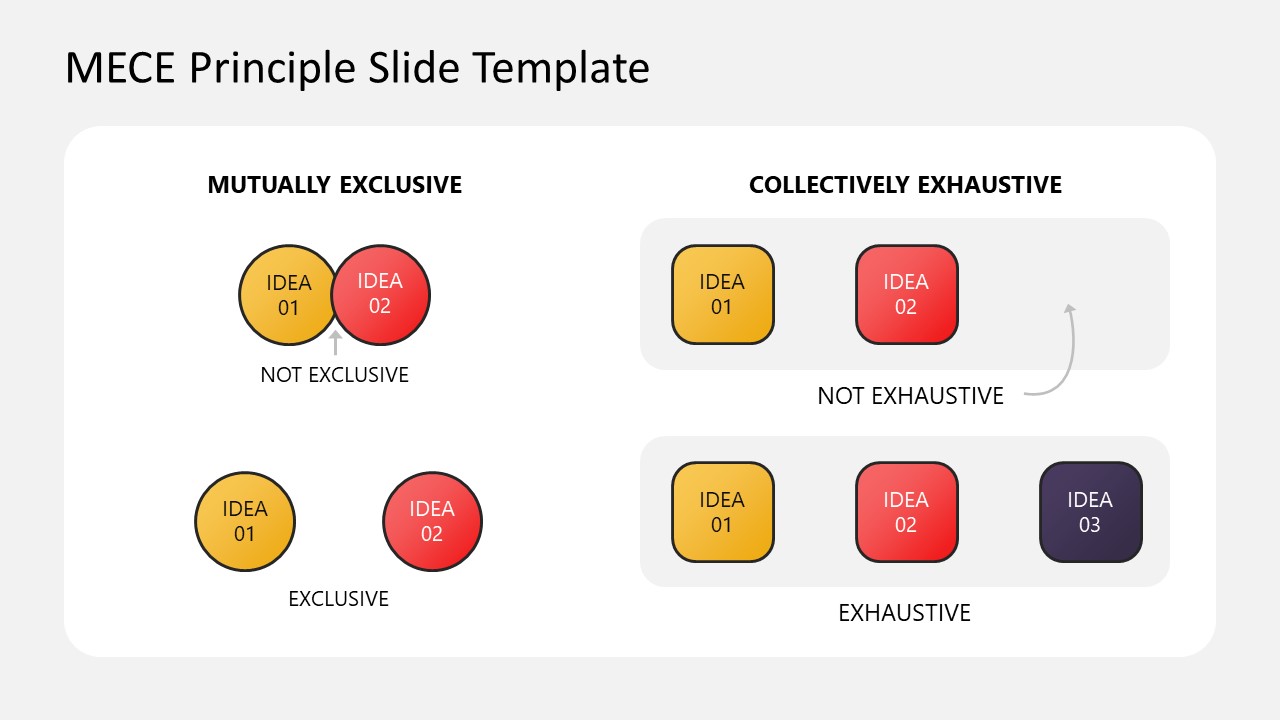
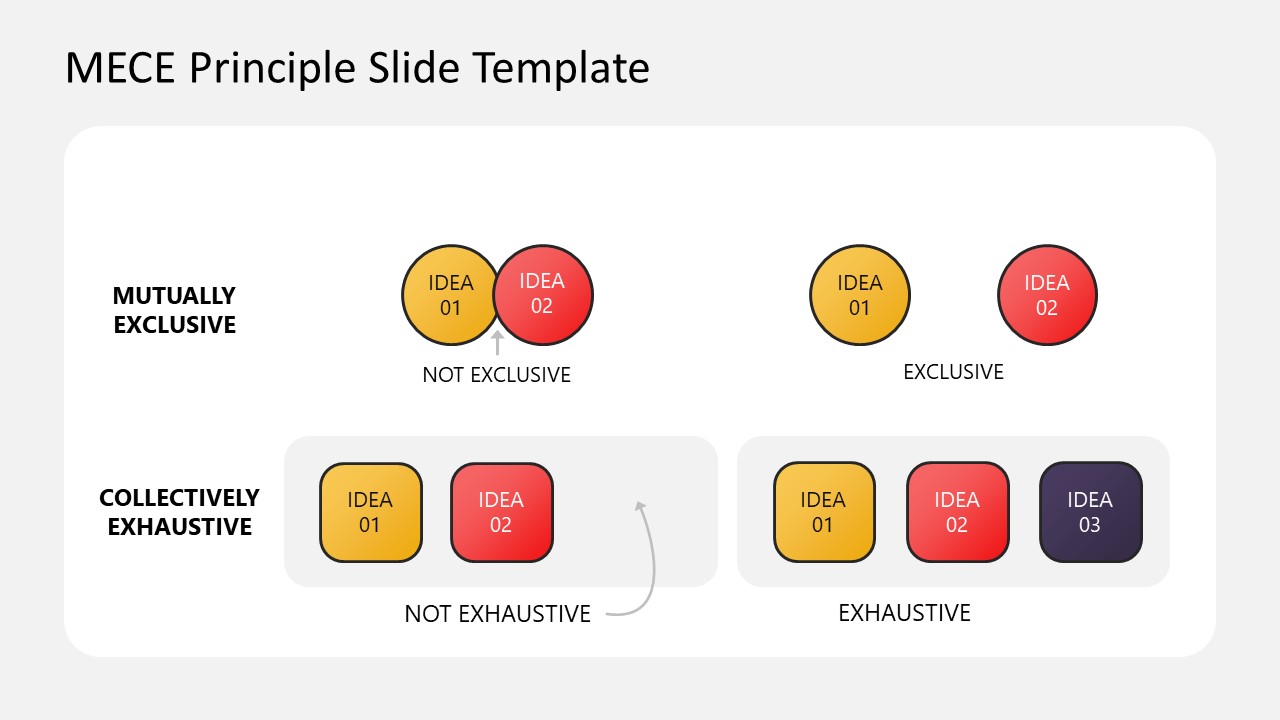
The MECE Principle PowerPoint Template features a clean layout, helping the audience understand how to organize the information effectively. The first slide has two sections. The mutually exclusive section has circular shapes, where if they do not overlap, they are considered mutually exclusive. The template also has color-coded idea blocks to convey the concepts effectively. Professionals working on new business ideas in corporate workshops, conducting RCA (root cause analysis), or developing other strategic plans can use this simple layout to demonstrate their thoughts easily. Professionals can also use this diagram template in their meetings, training sessions, or academic settings to illustrate the importance of the MECE principle for effective decision-making. The second slide has similar components but is arranged in a vertical pattern as compared to the horizontal pattern in the first slide.
Moreover, you can modify the color codes, fonts, and shapes used in the graphical design to accurately fit your needs. Download our MECE principle template and edit it now with Google Slides and Keynote!
What’s inside this template
Example presentation scenarios
- A consultant can use the circle comparison layout to explain why overlapping issue categories create duplicate work during a client problem-solving workshop.
- A strategy analyst can use the exhaustive idea-block grouping to test whether a market segmentation, cost breakdown, or initiative list covers the full scope.
- A trainer can use the vertical MECE diagram to teach new analysts the difference between mutually exclusive categories and collectively exhaustive coverage.
- A business leader can use the horizontal comparison slide to align a management team before building an issue tree or root cause analysis.
Features
- 100% editable presentation template
- Compatible with Microsoft PowerPoint and Google Slides
- 16:9 aspect ratio slides
- Scalable vector shapes, icons and illustrations
- AI-Ready for Microsoft Copilot and Claude
- Instant access and download
Frequently asked questions
Q: How should a presenter explain the MECE idea with this template?
A: Start with the overlapping circles to show the problem: categories that intersect are not mutually exclusive because the same item can belong to more than one group. Then move to the separated circles and the idea blocks to show the desired standard: distinct buckets that also cover the full set of possibilities.
Q: Who is this template best suited for in a business setting?
A: This template is best for consultants, analysts, trainers, and managers who need to teach structured problem solving before deeper analysis begins. It works well when the audience must classify issues, root causes, customer groups, or strategic options before building a recommendation, action plan, or issue tree.
Q: Why do the circle and block metaphors improve the explanation?
A: The circles make overlap visible, so the audience can quickly see why duplicate categories weaken analysis. The shaded containers and idea blocks make completeness visible, showing whether the full space is covered or whether gaps remain. Together, the metaphors separate two MECE tests that audiences often confuse.
MECE Principle PowerPoint Template
2-slide MECE principle presentation template with exclusivity and exhaustiveness diagrams for business problem solving
The MECE Principle PowerPoint Template is a 2-slide diagram template for explaining mutually exclusive and collectively exhaustive thinking. It includes horizontal and vertical comparison layouts, overlapping circle examples, separate circle examples, and idea-block groupings for consultants, analysts, trainers, and business leaders using Microsoft PowerPoint or Google Slides.
- Category
- Models
- Rating

 Loading...
- Aspect ratio
- 16:9
- Item ID
- 23039-01
- Colors
 Microsoft PowerPoint
 Microsoft Copilot
 Claude for PowerPoint
Other formats supported
Subscribe today and get immediate
access to download our PowerPoint templates.