Social proof in presentations is one of the most effective ways to strengthen credibility with a skeptical audience. Whether you are pitching a product, presenting quarterly results, proposing a strategy, or seeking investment, audiences look for signals that others have already validated your claims. Testimonials are part of that equation, but they are only one form of a broader credibility framework that includes case studies, user metrics, brand endorsements, awards, partnerships, media mentions, and adoption data. When structured correctly, social proof transforms a presentation from a set of assertions into evidence-backed communication.
However, social proof is frequently misused. Quotes are used as filler content, logos are displayed without context, and metrics are shown without explanation of their relevance. In these cases, slides become decorative rather than persuasive. Effective social proof for presentations requires intentional framing. It must directly support a specific claim, appear at the right moment in the narrative, and answer an implicit audience question: “Why should we believe you?” Social proof is not about popularity; it is about perceived decision safety.
In this article, we’ll explore the different angles we can take to leverage social proof in presentations to strengthen our narrative.
The Psychology of Social Proof in Presentations
Social proof in presentations operates on well-documented cognitive biases that shape decision-making under uncertainty. When audiences evaluate a proposal, they rarely assess information in isolation. Instead, they look for signals that others have already validated the claim. This behavior reflects principles such as authority bias, conformity, and risk aversion.
As Robert Cialdini outlines in Influence: The Psychology of Persuasion, individuals frequently look to others’ behavior and validation as a shortcut for determining what is credible or correct in uncertain situations. Classic conformity experiments by Solomon Asch illustrate how individuals adjust their judgments in line with perceived group consensus, even in situations involving objective facts. In high-stakes settings, stakeholders often rely on external validation to reduce perceived exposure.
Daniel Kahneman’s framework in Thinking, Fast and Slow helps explain why this pattern persists. Under conditions of complexity or time pressure, people rely more on intuitive, heuristic-driven thinking than on slow, analytical evaluation. In a presentation setting, decision-makers process new information quickly while simultaneously considering financial, strategic, and reputational implications. As a result, they search for credible cues that simplify judgment.
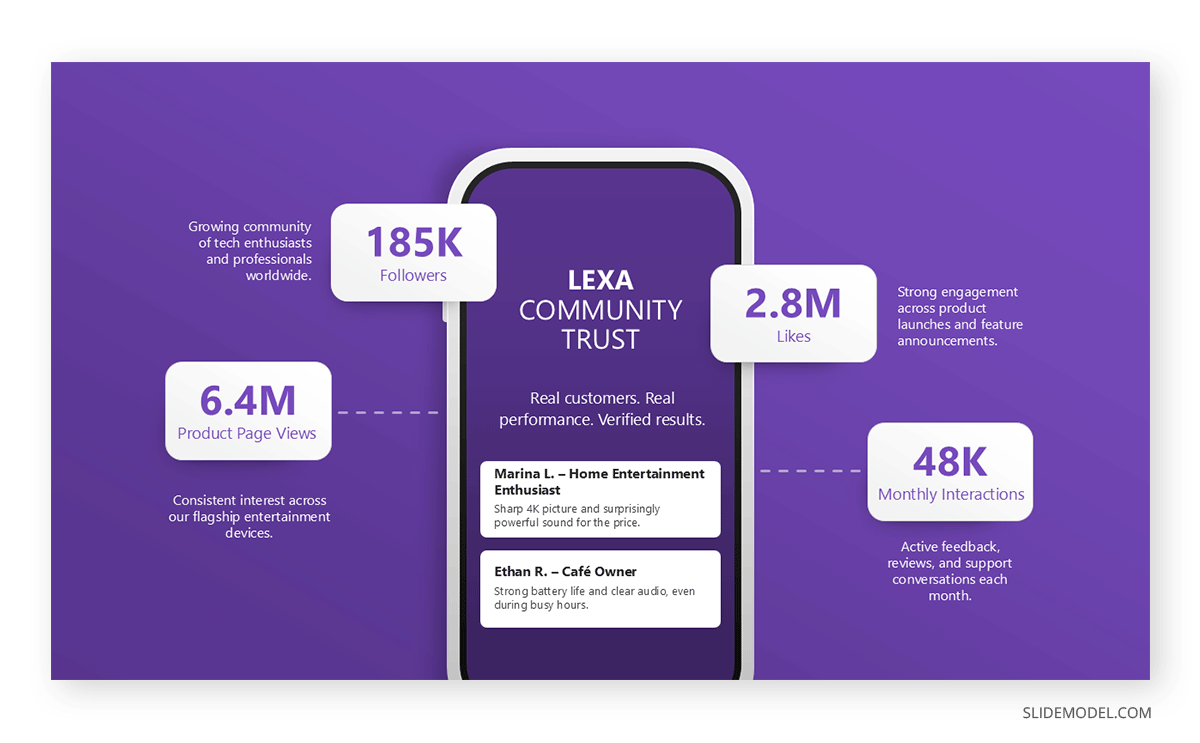
Strategically presenting social proof responds directly to this cognitive reality by demonstrating adoption, endorsements, or measurable success. Metrics, recognizable brands, institutional approvals, and expert validation function as heuristic signals of legitimacy. Rather than forcing the audience to verify every assertion independently, social proof reassures them that the idea has already been tested in comparable contexts. This reduces friction in business decision-making by providing the necessary evidence.
Types of Social Proof in Presentations
Presentation trust signals can take multiple forms, each designed to reduce perceived risk and validate a claim through third-party evidence. The strongest decks rarely rely on only one proof type. Instead, they combine credibility signals that fit the audience’s decision criteria, the complexity of the offer, and the stakes of the decision.
Customer Testimonials
Customer testimonials are first-person validations that translate outcomes into lived experience. They work best when they reinforce a specific claim already made, not when they function as generic praise. A strong testimonial signals relevance through matching context (industry, size, use case) and specificity (what changed, what improved, what was solved). In high-trust environments like enterprise sales, testimonials also reduce implementation anxiety by showing that others with similar constraints have succeeded.
Quantitative Traction and Performance Metrics
Metrics validate results through measurable outcomes. Adoption rates, retention, churn reduction, revenue growth, time saved, and cost reductions demonstrate that the value proposition has been tested in real conditions.
This form of social proof is particularly persuasive in executive, procurement, and investor settings because it signals accountability and makes the proof easier to verify. Presenting these results through structured KPI dashboard slides allows audiences to interpret performance data quickly and objectively.
Case Studies
Case studies provide structured social proof by showing the before-and-after narrative of a comparable organization. They typically outline the problem, decision criteria, implementation, and outcomes. Unlike testimonials, case studies in presentations build credibility through detail and causality, helping the audience understand not only that results occurred, but also why they did.
Client Logos and Brand Associations
Logo slides communicate legitimacy through association. When recognizable organizations appear in a deck, they imply prior vetting and successful collaboration. This proof type is most effective when the logos are relevant to the audience’s world and when the presenter clarifies what the relationship represents (customer, partner, pilot, or integration).
Expert and Authority Endorsements
Authority-based validation includes quotes or support from recognized experts, analysts, academic references, industry bodies, or regulatory entities. This type of social proof is especially valuable when the audience is worried about correctness, compliance, or technical credibility, because it signals independent evaluation beyond customer satisfaction.
Awards, Certifications, and Accreditations
Awards and certifications act as institutional proof. They indicate that an external body has assessed quality, standards, or compliance. This matters in industries where trust is tied to formal verification, such as finance, healthcare, security, or enterprise procurement.
Media Coverage and Third-Party Mentions
Media mentions and reputable press coverage provide credibility through visibility and independent interest. They are most persuasive when the source is recognized by the audience and when the mention is contextualized (what was covered and why it matters). In investor or partnership conversations, this form of proof can signal momentum and legitimacy.
Partnerships and Strategic Alliances
Partnerships demonstrate that established organizations are willing to align with you operationally or reputationally. This reduces perceived risk around integration, scalability, and long-term viability. Partnership proof is strongest when the slide clarifies the nature of the alliance and the practical outcomes it enables.
Adoption and Community Validation
Adoption signals market acceptance. User growth, waitlists, geographic expansion, active community participation, renewals, or repeat usage indicate that validation is not isolated. This type of presentation evidence works well for product-led models and platforms, where momentum and network effects influence confidence.
Benchmarking and Comparative Performance
Benchmarking strengthens proof by adding context. Showing performance against a baseline, an industry benchmark, or an alternative solution helps the audience interpret what “good” means. Comparative proof is especially useful when decision-makers are evaluating multiple options and want clear differentiation.
Across these categories, social proof in presentations generally falls into five functional types. Narrative proof relies on lived experience, such as customer testimonials or case studies, to demonstrate how results unfolded in real situations. Statistical proof uses quantifiable outcomes (adoption rates, growth metrics, retention figures) to validate performance objectively.
Institutional proof derives credibility from external authorities, including certifications, analyst recognition, regulatory approvals, or industry awards. Associative proof builds trust through alignment with recognized brands, partners, or media outlets. Finally, comparative proof strengthens persuasion by positioning results against benchmarks, competitors, or prior baselines. Understanding these distinctions helps presenters select evidence not by format, but by the type of skepticism they need to address.
When to Use Each Type of Social Proof
Selecting the right form of social proof in presentations depends less on preference and more on context. The situation the presenter faces should determine which credibility signals to introduce and when.
When You Need to Establish Immediate Credibility
At the beginning of a presentation, especially in sales or investor settings, the audience may not yet trust the presenter. In these situations, high-level credibility signals are effective. Recognizable client logos, strategic partnerships, industry certifications, or media mentions work well early because they communicate legitimacy quickly. The goal is not depth, but reassurance that the organization has been validated before.
When the Audience Questions Performance Claims
If you are presenting measurable benefits such as cost reduction, growth acceleration, or operational efficiency, quantitative metrics and case studies are more appropriate than generic validation. Traction data, performance dashboards, and before-and-after comparisons directly support performance-based claims. This is especially relevant in executive or procurement discussions where decision-makers require concrete evidence.
When Implementation Risk Is a Concern
In scenarios where the audience is worried about integration complexity, change management, or operational disruption, detailed case studies and context-rich testimonials are effective. They demonstrate how comparable organizations navigated implementation and achieved results. Proof slides in presentations should emphasize process, collaboration, and outcomes over branding.
When Emotional Reassurance Is Needed
High-value or strategic decisions often trigger anxiety beyond financial considerations. In these cases, narrative-driven social proof becomes valuable. Customer testimonials, video endorsements, or practitioner quotes can humanize the experience and provide relatability. This approach works well in enterprise sales, consulting engagements, and transformational initiatives.
When Authority or Compliance Is Under Scrutiny
If the presentation involves regulated industries, technical standards, or complex methodologies, authority-based social proof should take priority. Certifications, analyst recognition, expert endorsements, and regulatory approvals reduce doubt about correctness and compliance. In these settings, institutional validation may carry more weight than peer feedback.
When Differentiation Is Critical
In competitive evaluations, comparative data and benchmarking become essential. Instead of simply showing success, presenters should contextualize results against industry averages or alternatives. This type of social proof clarifies relative advantage and helps the audience justify their choice.
When Market Acceptance Must Be Demonstrated
For early-stage ventures or new products, the primary challenge is often proving momentum. Adoption metrics, user growth curves, renewal rates, and community engagement statistics signal demand and viability. In investor pitches or partnership discussions, demonstrating sustained uptake reduces concerns about traction.
When Internal Alignment Is Required
In internal presentations, social proof may come from pilot results, cross-department adoption, or benchmarking against internal KPIs. Here, the goal is not external validation but demonstrating that the proposed approach has already delivered results within the organization.
The Role of Customer Testimonials as Social Proof in Presentations
Customer testimonial slides fulfill a fundamental psychological function: they reduce uncertainty. Think about every single occasion you made a purchase, how you browsed for reviews and testimonials about your desired item, and how that balanced the final purchase decision. The same thing can be extrapolated to presentations: a buyer risks money, a stakeholder risks reputation, and an executive risks alignment with the wrong strategy. Testimonials act as shortcuts to trust, signaling that others have already taken that risk and survived, or benefited from it.
This is where the concept of social proof becomes essential. In presentations, especially sales presentations, audiences rarely evaluate claims in isolation. They look for signals that validate whether the presenter’s story aligns with real-world outcomes. Client testimonials serve that role by anchoring abstract promises in lived experience. Instead of saying “this works,” the presenter can demonstrate that it has worked for a comparable case.
However, not all testimonials build business presentation credibility. A generic quote praising “great service” offers little reassurance when building investor pitch decks. Social proof becomes effective only when the audience recognizes relevance. They need to see themselves reflected in the testimonial, whether through shared industry, similar scale, familiar challenges, or comparable decision criteria. Without that alignment, testimonials feel ornamental rather than persuasive.
Defining What Makes a Relevant Customer Testimonial
Not every positive comment qualifies as a usable testimonial. A testimonial is pertinent only if it reinforces the specific claim being made at that point in the presentation. Praise alone is insufficient; alignment with the argument is what gives the testimonial weight.
To assess whether a testimonial belongs on a slide, presenters should first clarify the slide’s purpose. Is it meant to support credibility, demonstrate results, reduce perceived risk, or validate adoption? Testimonials should then be selected based on how directly they advance that objective. A quote highlighting customer support may be irrelevant on a slide focused on performance gains, even if it is strongly worded.
Industry context is one of the strongest indicators of relevance. Testimonials from the same industry as the audience carry immediate weight because they imply comparable constraints and expectations, particularly in B2B environments. Cross-industry testimonials can work when the value proposition is universal, such as usability, reliability, or cost efficiency, but they require deliberate framing.
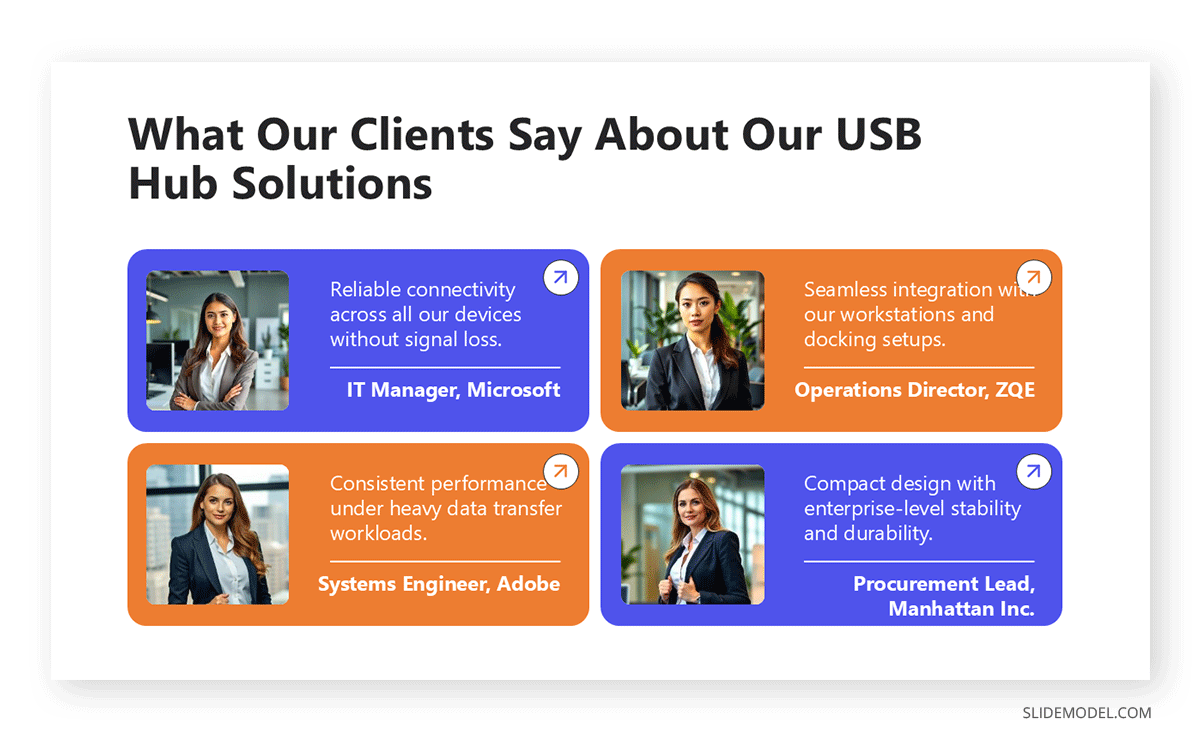
Role proximity also matters. A quote from a CEO carries different implications than one from an end user. Executive testimonials signal strategic alignment and long-term value, while practitioner testimonials emphasize day-to-day usability. A mismatch between the testimonial’s perspective and the audience’s role weakens its impact.
Timeframe is another critical factor. Outdated testimonials can undermine credibility by implying stagnation. Testimonials should reflect current capabilities rather than past versions of a product or service. When older testimonials are used, they require context to clarify continuity.
How to Cull and Curate Social Proof by Industry and Use Case
Curation is where most testimonial strategies break down. Organizations accumulate large volumes of client feedback but lack a system for selecting which to include in a presentation. The result is either overload or arbitrary selection. Effective presenters approach testimonial selection as an editorial decision, not an archival exercise.
Begin by categorizing testimonial data by industry, company size, use case, and outcome type. This structure makes it easier to identify which testimonials align with the presentation’s objective. A startup pitch may require validation around traction and adoption, whereas an enterprise sales deck may emphasize stability, integration, and long-term reliability.
Industry-specific curation is particularly important. Each industry has its own credibility markers. In SaaS presentations, metrics such as time saved, churn reduction, and scalability tend to resonate. In professional services, testimonials often focus on expertise, reliability, and collaboration. In healthcare or finance presentations, compliance and risk mitigation are critical. Presenters should select testimonials that speak the audience’s domain language.
Use case alignment further sharpens selection. Presenting social proof of onboarding success may support an early-stage sales conversation, but it feels misplaced in an upsell discussion centered on advanced functionality. Mapping testimonials to distinct use cases ensures that each slide strengthens the current argument rather than introducing distraction.
Curation also requires restraint. Overly long testimonials dilute impact. Editing for clarity and focus is appropriate when meaning remains intact. The objective is not alteration, but emphasis. A concise testimonial respects the audience’s time while preserving persuasive force.
Structuring Testimonials Within the Presentation Narrative
Testimonials are most effective when integrated into the presentation’s logical flow rather than isolated at the end. A testimonial slide should feel like a natural continuation of the argument, not an interruption. This requires deliberate placement.
One effective structure is the claim-evidence pattern. The presenter introduces a claim, such as improved efficiency or reduced costs, and follows it with a testimonial that confirms the outcome. The testimonial reinforces the explanation rather than replacing it, allowing the audience to interpret it as validation instead of persuasion.
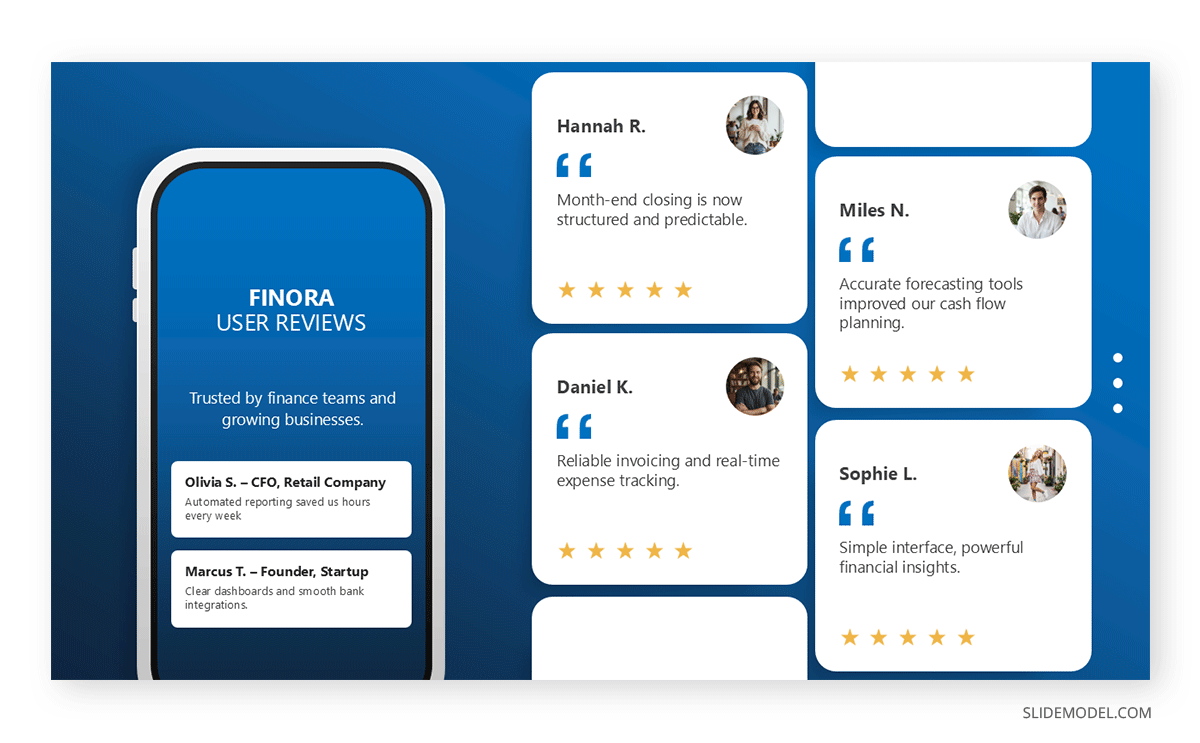
Testimonials can also follow moments of perceived risk. Pricing slides, implementation timelines, or change management proposals often trigger skepticism. Placing testimonials at these points helps address objections by demonstrating that others have successfully managed similar concerns.
Transitions are critical. Testimonials should never appear without context. A brief verbal or textual cue explaining why the testimonial matters guides interpretation. Without framing, audiences may focus on irrelevant aspects or dismiss the quote entirely. A sentence such as “This concern often comes up during onboarding; here’s how one client described their experience” anchors the testimonial’s relevance.
Types of Testimonial Slides and When to Use Each
There is no single customer testimonial format suitable for all situations. Different testimonial slides communicate different types of proof, and effective presentations often combine several.
Exact Data Testimonials
Some testimonial slides focus on numbers and traction. These highlight measurable outcomes such as growth percentages, adoption rates, or cost reductions. They are particularly effective in analytical or executive settings where decision-makers prioritize evidence over sentiment.
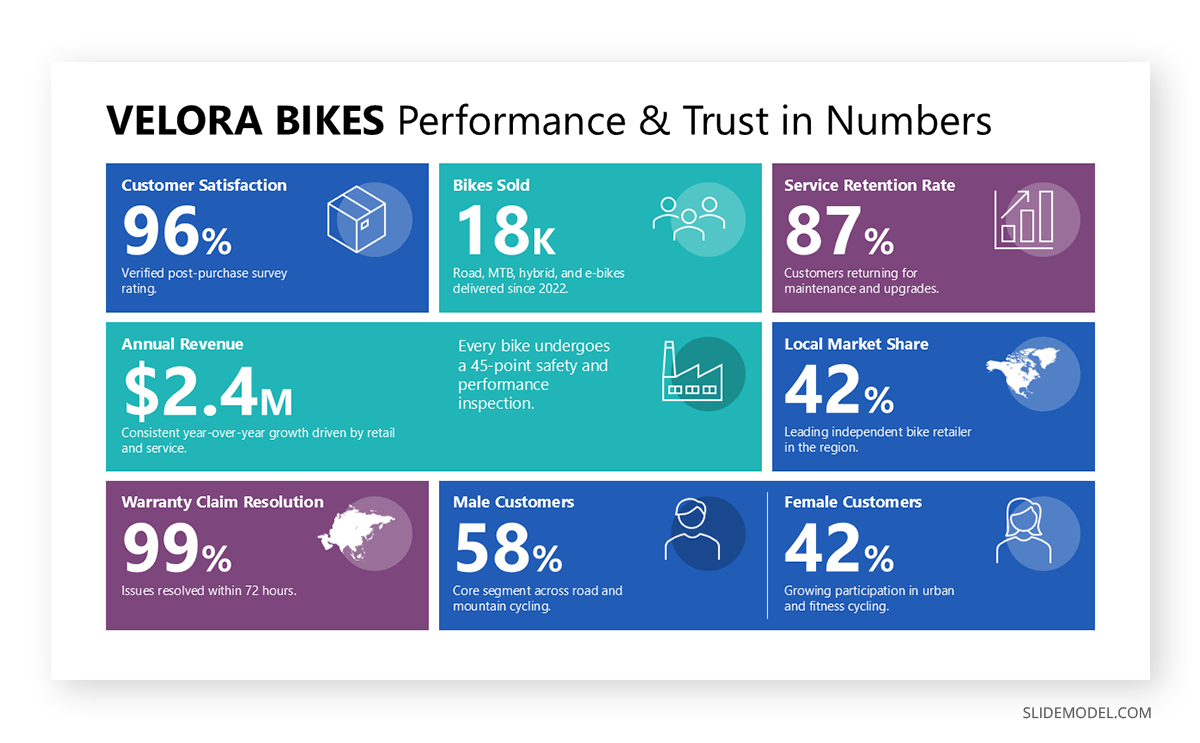
Reviews/Rating Testimonials
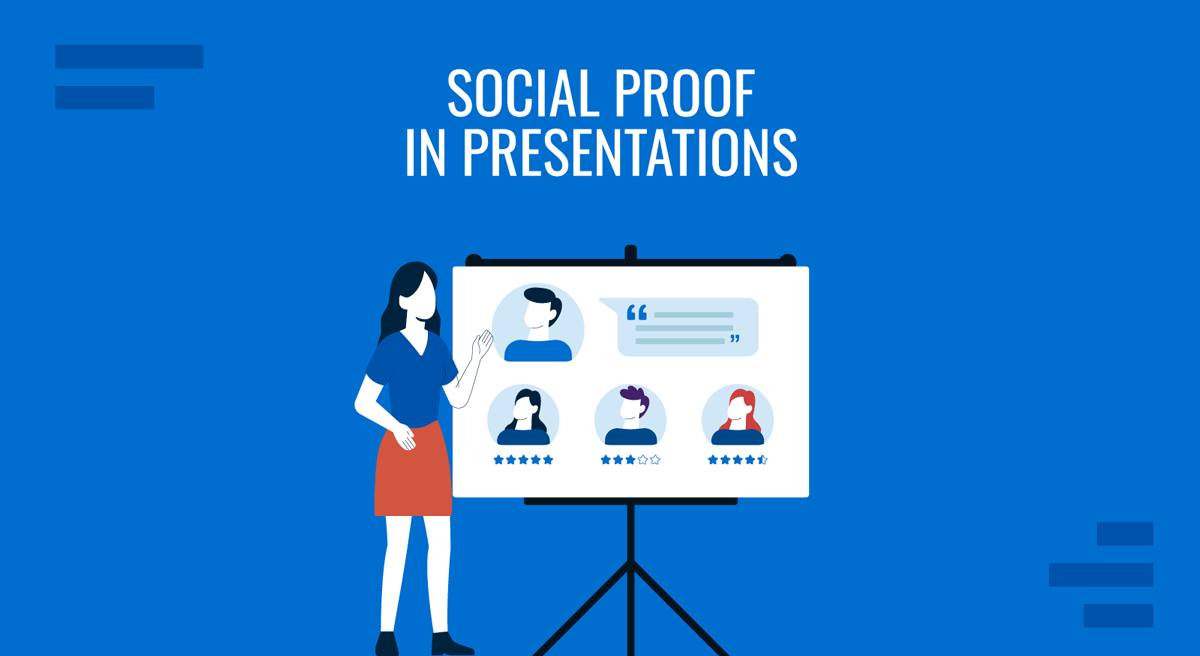
Other slides present reviews and ratings, often using star systems or short excerpts. These work well when the goal is to demonstrate broad satisfaction rather than specific outcomes. Ratings imply scale and consistency, signaling that positive experiences are not isolated. This format is common in product-led or consumer-adjacent presentations.
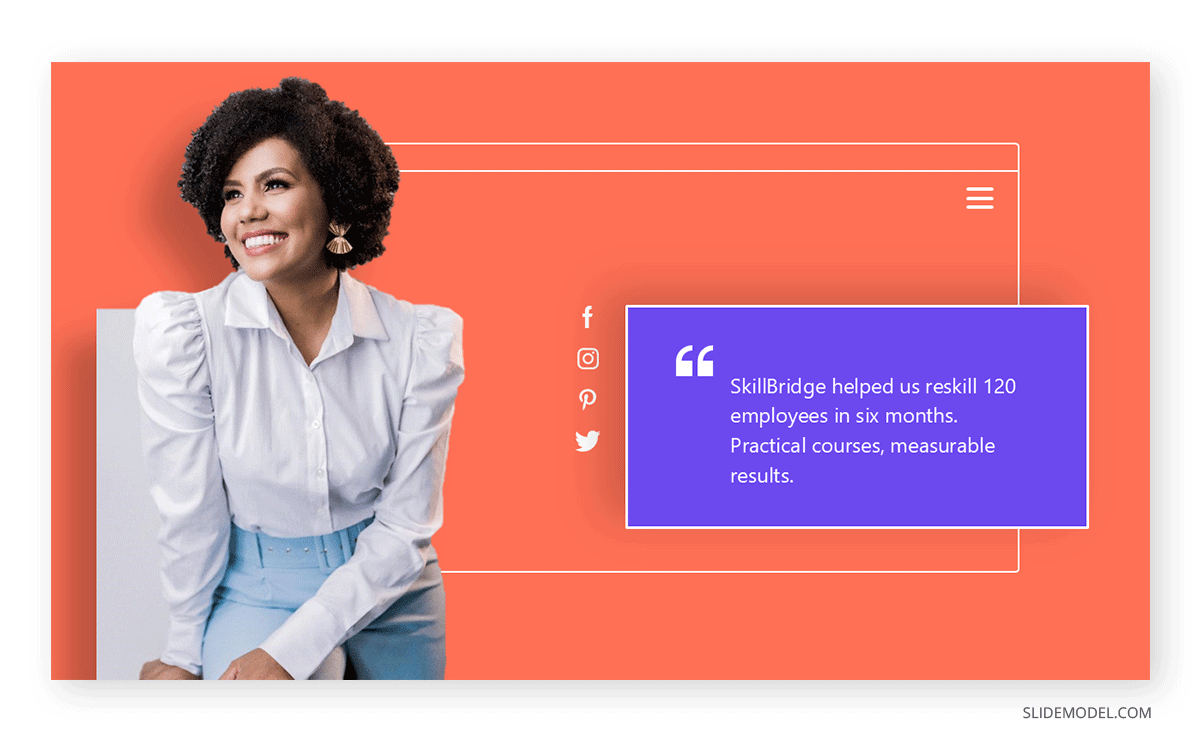
Logo Testimonial Slides
Logo slides are another category. They display recognizable customer brands without quotes. Their power lies in association. When well-known or respected companies appear, they lend credibility through implied endorsement.
Video Testimonial Slides
Finally, customer testimonial videos provide a richer emotional connection. They humanize the message and convey authenticity through tone and body language. However, they require careful timing and technical reliability. Videos should be short, focused, and clearly relevant to the surrounding content.
Recommended lecture: Video Presentation
Designing Clear and Credible Client Testimonial Slides
Design plays a subtle but decisive role in how testimonials are perceived. A poorly designed testimonial slide can undermine trust, even if the content is strong. Conversely, a clean, restrained design reinforces authenticity.
Visual hierarchy is essential. The testimonial itself should be the focal point, not decorative elements. Excessive quotation marks, oversized icons, or busy backgrounds distract from the message. Simplicity signals confidence.
Text length must be controlled. Testimonials should be scannable within seconds. If a quote requires extended reading, it likely belongs in a case study, not a presentation slide. Editing for clarity ensures that the audience grasps the key point immediately.
Contextual information, such as the customer’s name, role, and company, should be visible but secondary. This information grounds the testimonial without overshadowing it. Consistency in how this metadata is displayed across slides reinforces professionalism.
When designing client testimonial slides, alignment with the overall presentation style is critical. Testimonials should not feel like foreign objects. Consistent typography, color palette, and spacing help them blend into the narrative rather than interrupt it.
Handling Negative or Mixed Customer Testimonials Strategically
Negative or mixed testimonials are often avoided, but they can be powerful when handled correctly. Ignoring them entirely can raise suspicion, especially with informed audiences. Acknowledging imperfection demonstrates maturity and transparency.
The key is framing. Negative feedback should never be presented without context or resolution. A testimonial that mentions a challenge becomes valuable when paired with an explanation of how it was addressed. This shifts the narrative from failure to responsiveness.
In some cases, presenting a critical testimonial alongside a positive outcome enhances credibility. It shows that success was earned through iteration, not assumed. This approach is particularly effective in industries where complexity and adaptation are expected.
However, not all negative testimonials belong in presentations. Feedback that is outdated, irrelevant, or based on misuse does not contribute constructively. The decision to include critical feedback slides should always be strategic, not performative.
FAQs
What is social proof for presentations?
Social proof for presentations refers to the use of third-party validation to strengthen credibility and normalize decision-making. It includes metrics, case studies, client logos, media mentions, certifications, partnerships, adoption data, awards, and expert endorsements. Rather than relying solely on the presenter’s claims, a presentation social proof strategy demonstrates that others have already validated the proposed solution or idea.
Why is social proof important in business presentations?
In high-stakes settings such as sales pitches, investor decks, or executive briefings, audiences evaluate risk before opportunity. Social proof reduces uncertainty by showing that others have successfully adopted, funded, implemented, or endorsed the proposal. It shifts the burden of belief from persuasion to evidence.
How is social proof different from marketing claims?
Marketing claims are self-reported statements made by the presenting organization. Social proof relies on external validation. Claims assert value; using social proof in presentations demonstrates that others have confirmed that value.
What is the purpose of using customer testimonials in presentations?
The main purpose of using a customer testimonial in a presentation is to mitigate doubt. Testimonials serve as proof slides in presentations, demonstrating that real customers have validated the claims made. In sales presentations, they help de-risk decisions by demonstrating prior success, while in internal or investor presentations, they reinforce credibility, traction, and adoption.
How do customer testimonials fit into social proof for presentations?
Customer testimonials are one category of social proof. They provide narrative-based validation by sharing firsthand experiences. While metrics and logos demonstrate scale or authority, testimonials offer relatable, human-centered confirmation of results.
How many customer testimonials should a presentation include?
There is no fixed number, but most presentations benefit from three to six well-chosen testimonials. Including too many weakens the impact and increases cognitive load. Each testimonial should serve a clear purpose within the narrative, reinforcing a specific claim rather than repeating generic praise.
When are customer testimonials more effective than other forms of social proof?
Customer testimonials are particularly effective when emotional reassurance, relatability, or experiential validation is required. In high-touch sales environments or complex implementations, a testimonial can clarify how success felt and unfolded, complementing quantitative or institutional proof.
When should social proof appear in a presentation?
Social proof is most effective immediately after claims that may trigger skepticism, such as pricing, implementation complexity, performance promises, or strategic changes. It should reinforce key arguments rather than appear as an isolated section at the end.
What data should be included alongside customer testimonials?
When appropriate, testimonials should be paired with measurable outcomes such as percentages, time savings, growth metrics, or adoption rates. Slides that combine quotes with numbers are particularly effective because they blend emotional validation with factual evidence.
Can early-stage startups use social proof if they lack major clients?
Yes. Early-stage companies can rely on traction metrics, beta user growth, pilot program outcomes, waitlist size, partnerships, industry recognition, or expert endorsements. Social proof does not require enterprise logos; it requires evidence of validation.
What types of testimonial slides work best in sales presentations?
Sales presentations often combine multiple formats: quote-based slides, rating-and-review slides (stars), logo slides, and results-driven testimonials. This variety demonstrates both breadth and depth of validation while maintaining visual and narrative interest.
When should customer testimonial videos be used?
Customer testimonial videos work best when emotional connection matters, such as in high-value sales or brand-focused presentations. They should be short, clearly relevant, and placed where attention is highest. Overuse or poor audio quality can reduce their effectiveness.
Is quantitative data considered social proof?
Yes. Adoption rates, retention metrics, revenue growth, churn reduction, efficiency gains, and user engagement statistics all qualify as social proof when they demonstrate real-world results beyond internal projections.
Is it acceptable to edit customer testimonials for clarity?
Yes, editing for length and clarity is acceptable, provided the original meaning is preserved, and the customer has approved the final version. Ethical editing improves comprehension and ensures the testimonial supports the presentation’s message without distortion.
What is the difference between case studies and social proof?
Case studies are structured narratives that detail a problem, a solution, and a measurable outcome. Social proof is broader and includes case studies as one category. Social proof encompasses any third-party validation that supports credibility.
What are common mistakes when presenting client testimonials?
Common mistakes include using generic quotes, overusing testimonials, failing to provide context, and mismatching testimonials to the audience. Another common error is treating testimonials as decorative elements rather than narrative support.
Does anonymous social proof reduce credibility?
Anonymous proof can reduce impact, particularly in B2B contexts. Identifiable sources, roles, industries, or institutions increase trust. When anonymity is required, additional context helps preserve credibility.
How many social proof slides should a presentation include?
There is no fixed number. The guiding principle is relevance. Each instance of social proof should support a specific claim. Overloading a presentation with proof elements can increase cognitive load and dilute impact.
What role do awards and certifications play in presentations?
Awards and certifications act as institutional validation. They demonstrate that an external authority has evaluated and endorsed the organization or solution, strengthening perceived competence and compliance.
How does social proof reduce perceived risk in presentations?
Social proof demonstrates that others have already taken the proposed action and achieved positive outcomes. This reduces uncertainty by normalizing the decision and signaling that the risk has been tested.
Should testimonials always be included in presentations?
Not always. Testimonials are most valuable when trust, credibility, or proof is required. In purely informational or internal technical presentations, they may be unnecessary. The decision to include testimonials should always be intentional, not automatic.
Can media mentions strengthen presentation credibility?
Yes. Coverage by respected publications or industry analysts functions as authority-based social proof. It suggests that independent observers consider the organization noteworthy or credible.
What mistakes weaken social proof in presentations?
Common mistakes include presenting outdated data, showing logos without context, using inflated or unverifiable metrics, overloading slides with too many proof elements, and failing to connect proof directly to the claim being supported.
Final Words
Social proof in presentations is not an accessory; it is structural support for credibility. Metrics, case studies, testimonials, endorsements, and institutional validation all serve a single purpose: reducing uncertainty at the exact moment it arises. The difference between persuasive and decorative proof lies in alignment.
Each element must reinforce a specific claim, respond to a specific concern, and fit naturally within the narrative. When presenting social proof strategically, you replace assertion with evidence and confidence with validation. The result is not louder persuasion, but clearer justification: evidence that allows audiences to move forward with informed conviction rather than hesitation.