PowerPoint presentations often fail for reasons unrelated to design or data quality. The issue is usually structural. Ideas overlap, key dimensions are missing, and the logic that connects slides is implicit rather than explicit. The MECE principle helps prevent these failures by ensuring clarity in how a topic is decomposed and communicated.
When applied to presentations, MECE becomes a practical standard for organizing slides, sections, and spoken explanations, ensuring that each element has a clear role and that the overall argument is complete. This article focuses on applying MECE to PowerPoint presentations, covering structure, decomposition choices, validation, and iteration in real-world presentation scenarios.
Table of Contents
- Introducing the MECE Principle in Presentations
- Why the MECE Framework Matters in PowerPoint Presentations
- MECE Framework in Consulting and Executive Communication
- Core Components of a MECE Presentation Structure
- Choosing the Right Decomposition Logic for a Given Question in MECE Presentations
- Applying the MECE Framework to Slide Hierarchy and Flow
- Which Diagrams, Graphs and Charts are Compatible with the MECE Framework?
- MECE Validation for Slides and Speech in Presentations
- MECE Failure Recovery and Iteration
- FAQs
- Final Words
Introducing the MECE Principle in Presentations
The MECE principle, short for Mutually Exclusive, Collectively Exhaustive, is a structured thinking standard used to organize information so that categories do not overlap and together cover the full problem space. While often discussed in analytical contexts, its practical value becomes clear when applied to PowerPoint presentations used for business, consulting, and executive decision-making.
In presentation settings, MECE enforces logical discipline across slides and sections. When categories overlap or key dimensions are missing, decks become difficult to follow and hard to trust. This problem is amplified in PowerPoint, where information is fragmented across slides and consumed in real time. MECE makes the underlying logic explicit, allowing the audience to understand how the topic has been broken down and why each component exists.
In consulting-driven presentation standards, slides are expected to represent structured thinking rather than raw content. MECE functions as a baseline quality criterion: each slide and section must answer a clear question, and the overall structure must demonstrate a complete and non-redundant decomposition of the topic.
Why the MECE Framework Matters in PowerPoint Presentations
PowerPoint presentations are not neutral containers. They impose constraints on attention, sequencing, and memory. Audiences process slides in real time, often under cognitive load, and frequently without the opportunity to revisit previous material. In this environment, poorly structured content leads to confusion quickly. The MECE framework addresses this challenge by enforcing order before visuals are even considered.
One of the most common failures in business presentations is conceptual overlap. Teams frequently present lists of initiatives, risks, or drivers that partially repeat each other under different labels. For example, “operational efficiency,” “process optimization,” and “cost reduction” might appear as separate categories, despite addressing the same underlying concept. This violates the “mutually exclusive” principle and leaves the audience uncertain about distinctions. A MECE presentation avoids this by defining categories precisely and ensuring that each item has a single logical home.
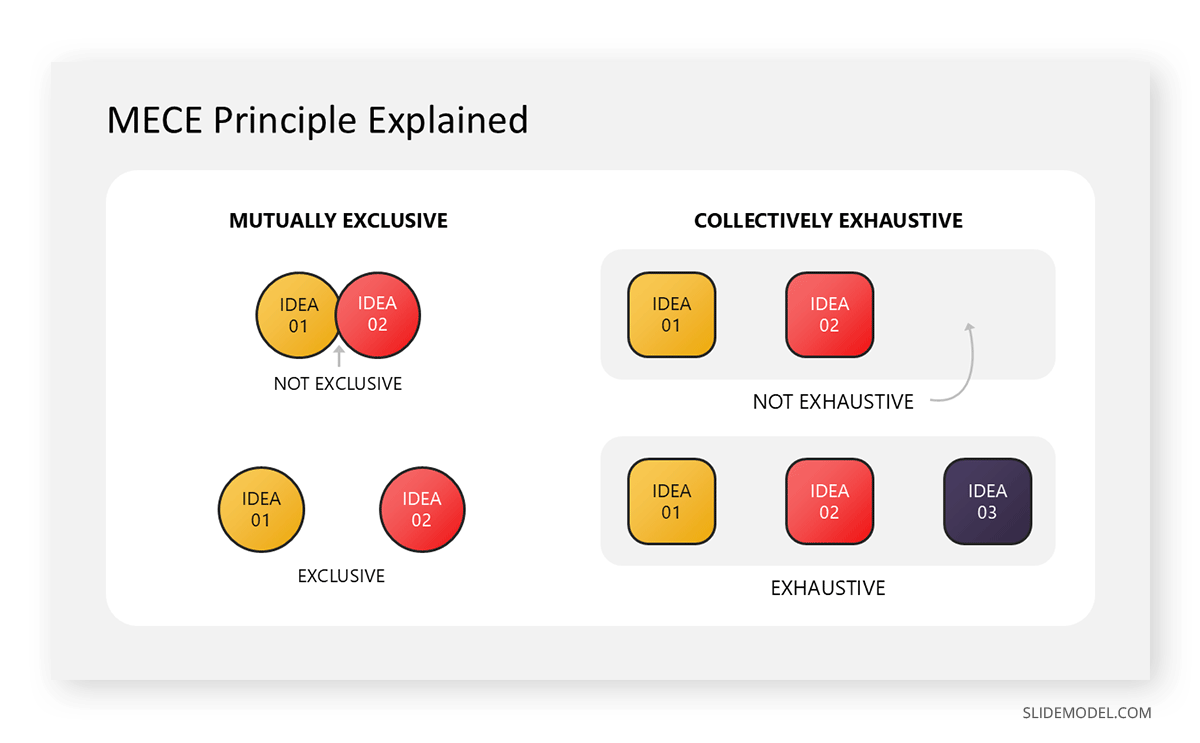
Equally problematic are gaps. Presentations often focus on what is visible or convenient rather than what is complete. For instance, a market analysis slide may address customer demand and competitive landscape but omit regulatory constraints or supply-side limitations. From a MECE perspective, this violates the “collectively exhaustive” requirement. In PowerPoint presentations, such omissions undermine credibility because decision-makers expect that major dimensions have been systematically considered. How can we bypass this? Follow this checklist:
- One idea per slide, one logical owner: Each slide should answer a single question and belong unambiguously to one section of the MECE structure. If a slide can fit in only two sections, the structure or the slide content is flawed.
- Titles must state conclusions, not topics: Slide titles should express the specific insight or answer delivered by the slide. Topic titles encourage overlap; conclusion titles enforce mutual exclusivity and clarify how slides differ from each other.
- Consistent structure within sections: Slides within the same section should follow the same internal logic and layout. When each slide represents a single bucket in the same decomposition, consistency prevents accidental mixing of dimensions.
- Visuals must respect the decomposition logic: Charts, tables, and diagrams should only display data relevant to the slide’s bucket. Avoid visuals that introduce secondary dimensions or comparisons that belong elsewhere in the deck.
- No decorative elements that imply new categories: Icons, colors, labels, or callouts should not suggest additional groupings or meanings outside the defined structure. Visual emphasis must reinforce the MECE logic, not create parallel interpretations.

MECE framework consulting practices emphasize that structure signals thinking quality. Executives rarely have time to interrogate every assumption, so they rely on structural cues to assess rigor. A deck that is visibly MECE communicates that the team has mapped the full problem space and avoided double-counting. This is particularly important in strategy, operations, and financial presentations, where decisions involve trade-offs and prioritization.
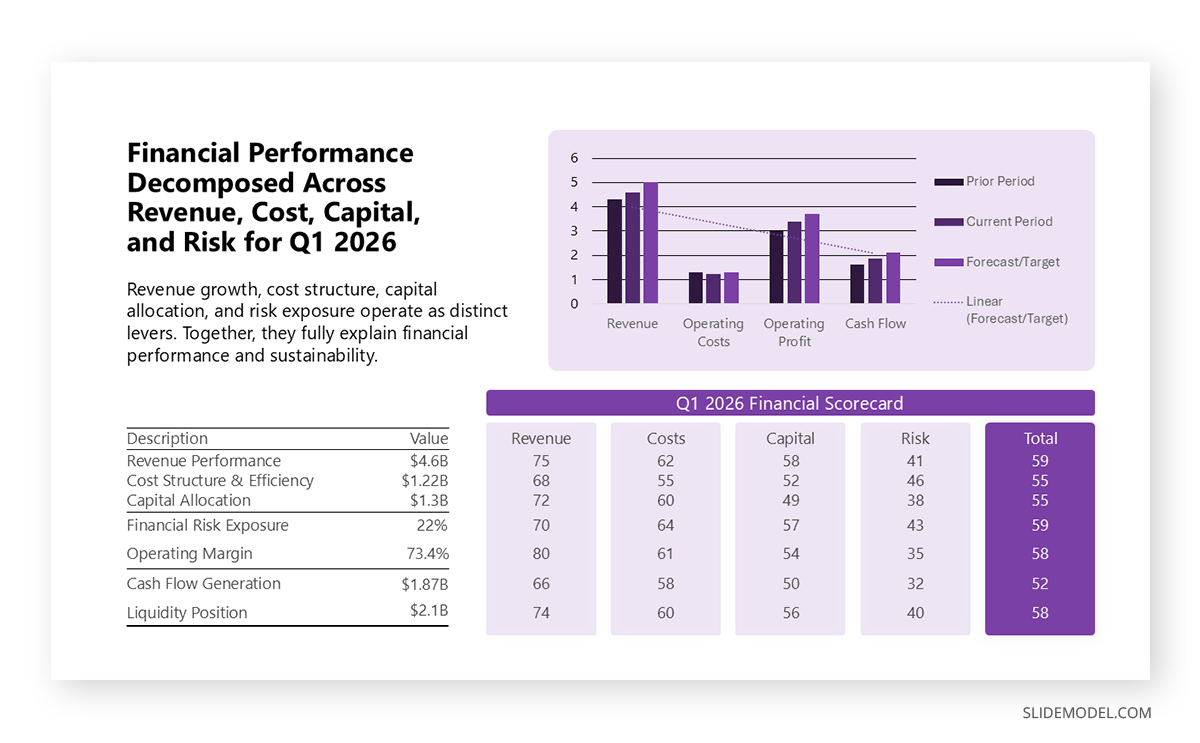
From a practical standpoint, MECE also improves slide efficiency. When categories are clean and exhaustive, fewer slides are needed to explain relationships. The presenter can move from high-level decomposition to detailed analysis without backtracking or clarifying overlaps. This results in tighter decks and clearer executive summaries.
MECE Framework in Consulting and Executive Communication
The connection between MECE and consulting reflects the demands of high-stakes decision environments. In executive presentations, slides often circulate independently of the presenter, making structural clarity essential. The audience must be able to reconstruct the logic without extensive narration.
Consulting presentations often serve as the primary artifact through which analysis is communicated. The deck may outlive the meeting and circulate independently. This makes structural clarity essential. Executives must be able to interpret the logic without extensive narration.
The McKinsey MECE framework tradition emphasizes “top-down” communication. This means starting with the answer and then supporting it through MECE-structured arguments. In PowerPoint terms, this translates into assertive slide titles, clear section logic, and minimal redundancy.
Recommended lecture: McKinsey Presentation Structure
In executive communication, MECE also supports challenge and debate. When arguments are structured cleanly, stakeholders can disagree with specific components without rejecting the entire analysis. This modularity facilitates productive discussion.
Another consulting-specific aspect is synthesis. MECE presentations often culminate in synthesis slides that recombine categories into implications or recommendations. This recombination does not violate MECE because it occurs after analysis, not during decomposition. Understanding this distinction is important to avoid over-rigid application.
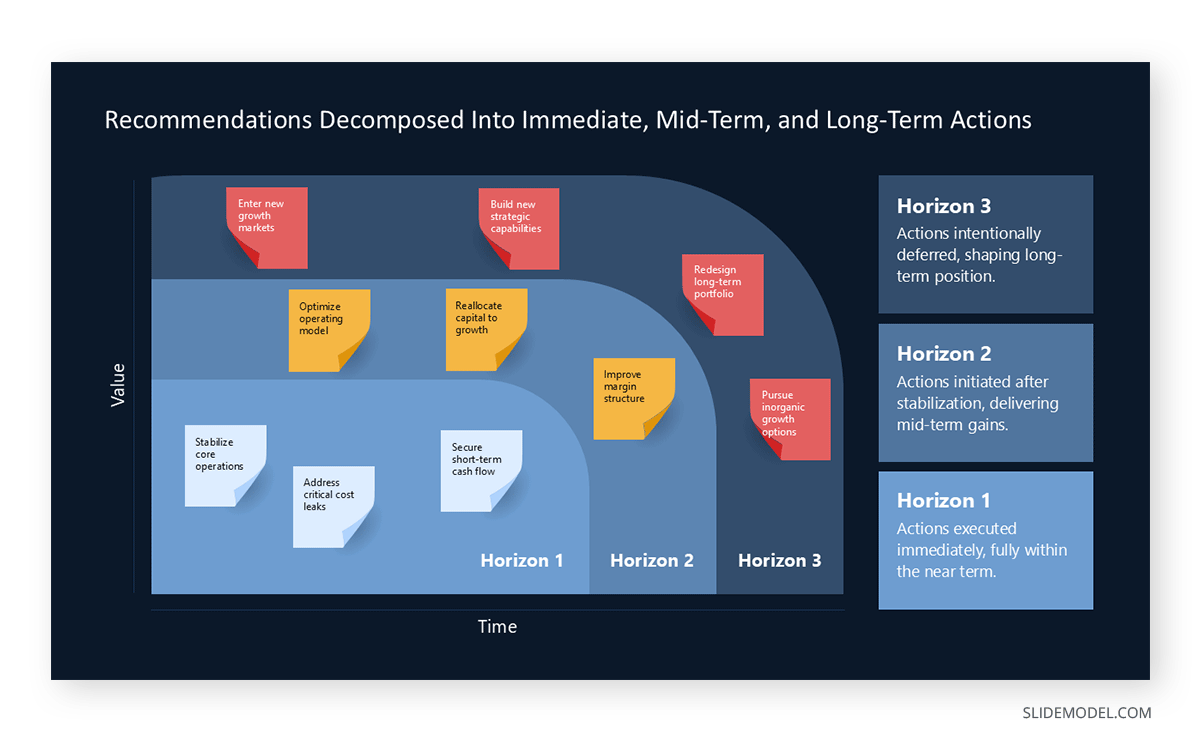
In client-facing contexts, MECE also signals professionalism. While clients may not articulate MECE explicitly, they recognize its effects: clarity, completeness, and coherence. Conversely, presentations lacking MECE structure are often described as “messy” or “unclear,” even if the data is sound.
Core Components of a MECE Presentation Structure
Designing a MECE presentation requires more than labeling slides correctly. It involves deliberate structuring at multiple levels: the overall deck, each section, and individual slides. Each level must respect MECE principles while remaining intelligible to a non-technical audience.
At the deck level, the first task is problem definition. A MECE presentation begins with a clear framing of the question being addressed. This question determines the decomposition logic. For example, if the question is “How can we increase profitability?”, the MECE breakdown might be revenue drivers versus cost drivers. If the question is “What risks threaten project delivery?”, the decomposition could be technical, operational, financial, and regulatory risks. The decomposition logic must be explicit and defensible.
Once the top-level split is defined, each branch must satisfy mutual exclusivity and collective exhaustiveness. This is where many presentations fail. Categories should not be differentiated only by wording; they must represent distinct dimensions. Time-based splits (short-term vs long-term), functional splits (marketing vs operations), or stakeholder-based splits (customers vs suppliers) are often more robust than abstract labels.
At the section level, each major category becomes a section with a clear objective. In MECE framework PowerPoint presentations, section headers often take the form of “answer titles” rather than descriptive titles. This practice, common in McKinsey MECE framework decks, reinforces clarity. Instead of “Market Analysis,” a section title might state “Market growth is constrained by regulatory limits rather than demand.” The section then provides evidence supporting that claim.
Within sections, slides should follow a consistent internal logic. If a section analyzes drivers, each slide should address one driver, using a standardized layout. This consistency reinforces mutual exclusivity and helps the audience map content quickly. Deviations in structure often signal conceptual confusion.
At the slide level, MECE applies to bullet points, visuals, and supporting data. Bullet lists should represent parallel ideas, not mixtures of causes, effects, and actions. PowerPoint charts should align with the category they support and avoid introducing unrelated insights. Even annotations should be scoped carefully to avoid blurring boundaries.
Choosing the Right Decomposition Logic for a Given Question in MECE Presentations
MECE does not prescribe how to decompose a problem; it only defines the quality standard the decomposition must meet. The presenter’s task is to select a logic that matches the decision being supported, not the data that happens to be available.
The starting point is the core question. Decomposition must answer that question directly. If the question is diagnostic (“Why is performance declining?”), Causal or Driver-based logic is usually appropriate. If the question is evaluative (“Should we pursue this option?”), Criteria-based logic works better. If the question is forward-looking (“How do we grow?”), Time-based or value-chain logic often provides clarity.
The second consideration is decision ownership. Decomposition should align with the organization’s decision-making process. Executives often think in terms of financial impact, risk, and feasibility, whereas operational teams think in terms of processes and constraints. A MECE structure that clashes with the audience’s mental model may be logically correct but ineffective.
Third, the logic must be stable. Good MECE decomposition does not change mid-deck. Mixing axes, such as combining functional splits with time horizons, introduces overlap and confusion. If multiple perspectives are required, they should be sequenced rather than merged.
Finally, test the logic by stress-checking extremes. Ask whether every relevant issue fits cleanly into one bucket and whether removing a bucket would leave the answer incomplete. The right decomposition logic makes MECE feel natural instead of forced.
Applying the MECE Framework to Slide Hierarchy and Flow
All presenters know that hierarchy is the answer for any effective PowerPoint presentation. In the MECE framework, PowerPoint presentations, hierarchy is not merely visual; it is conceptual. Each level of the hierarchy answers a different question, and each answer fits cleanly within the overall logic.
At the highest level, the executive summary reflects the full MECE structure in compressed form. A strong executive summary mirrors the deck’s decomposition, often using a small number of mutually exclusive points that together answer the core question. This allows senior audiences to grasp the full logic without reading the entire deck. If the executive summary introduces ideas that do not appear later, or omits ideas that do, the MECE structure has broken down.
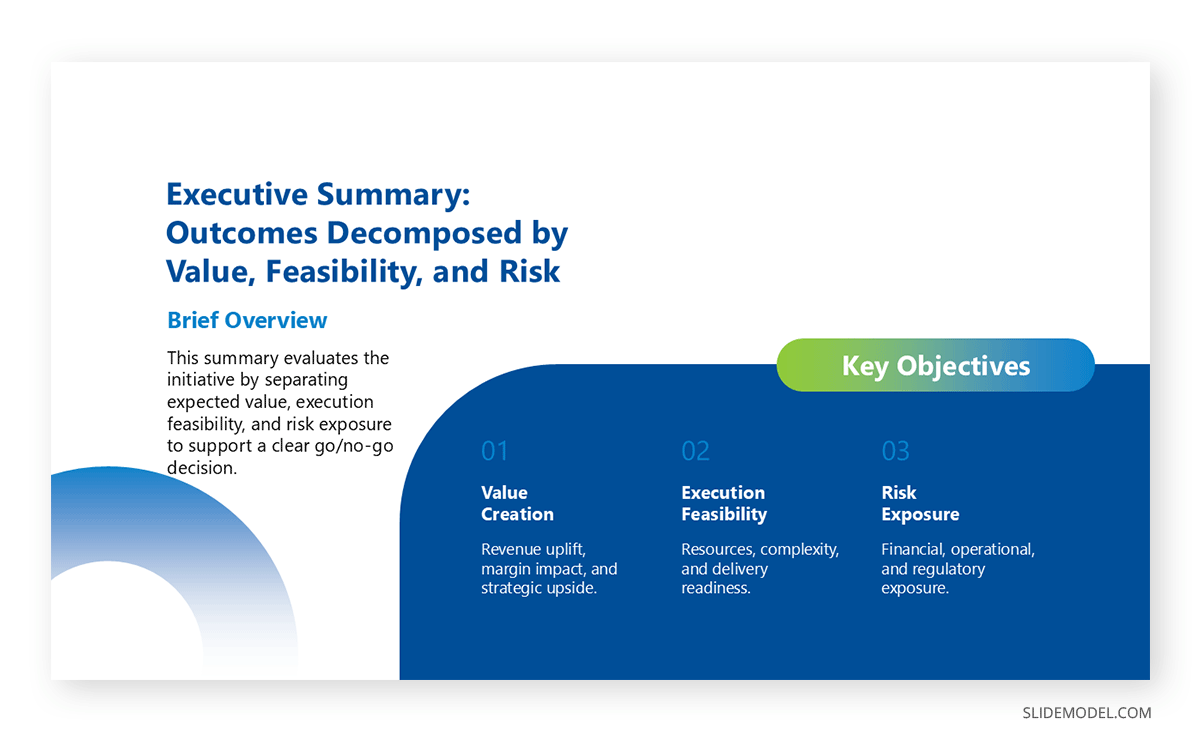
The middle level of hierarchy consists of sections and subsections. Each section should represent one branch of the MECE decomposition. Flow between sections should feel inevitable rather than arbitrary. For example, a presentation analyzing market entry might move from market attractiveness to competitive dynamics to operational feasibility. The sequence follows a logical evaluation path rather than a storytelling preference.
Within sections, slide flow should move from general to specific. A common MECE consulting framework pattern is: define the dimension, present evidence, interpret implications. This pattern helps maintain cognitive alignment. Audiences know what to expect and can focus on content rather than structure.
Transitions are particularly important. In MECE presentations, transitions often restate the logic: “Having examined demand-side factors, we now turn to supply-side constraints.” These explicit signposts reinforce collective exhaustiveness by reminding the audience that all relevant dimensions are being covered.
Visual hierarchy supports conceptual hierarchy but does not replace it. Font size, spacing, and alignment should reflect importance, but only after the logical hierarchy is sound. Overemphasis on visual design without structural clarity results in aesthetically pleasing but intellectually weak presentations.
Recommended lecture: How to Create a Slide Deck
Flow also involves pacing. MECE presentations tend to be information-dense, which makes pacing critical. Slides should not introduce multiple new dimensions at once. Each slide should advance the argument incrementally, respecting the audience’s processing capacity.
Which Diagrams, Graphs and Charts are Compatible with the MECE Framework?
PPT Diagrams, graphs, and charts are compatible with the MECE framework when their structure enforces non-overlapping categories and complete coverage of the analysis scope. Compatibility is not about the visual format itself, but about whether the visual encoding preserves mutual exclusivity and collective exhaustiveness.
Hierarchical diagrams are among the most MECE-compatible visuals. Issue trees, logic trees, and decomposition trees work well because each branch represents a distinct dimension of the problem, and all branches together define the full problem space. These are commonly used at the beginning of a MECE presentation to show how a question is broken down.
Column and bar charts are compatible when categories on the axis are mutually exclusive and exhaustive. For example, revenue split by region, customer segment, or product line works well if each unit of revenue appears in exactly one bar and no relevant segment is omitted. Problems arise when categories partially overlap, such as mixing channels and customer types in the same chart.
Stacked bar charts can be MECE-compliant if each stack represents a complete total and each segment is a distinct component of that total. They are useful for showing composition while preserving exhaustiveness, but they require precise definitions to avoid double-counting.
PowerPoint Tables are highly compatible with MECE when rows or columns represent clean dimensions. A table comparing options across criteria works well if the criteria are independent and jointly cover the decision logic.
Process diagrams and swimlane diagrams can align with MECE when steps are sequential and non-redundant, covering the full process lifecycle without gaps.
By contrast, visuals like Venn diagrams, overlapping bubble charts, or loosely defined mind maps are generally incompatible with MECE, as they explicitly allow overlap and ambiguity. MECE-compatible visuals must make structure explicit, bounded, and logically defensible.
MECE Validation for Slides and Speech in Presentations
MECE validation for slides and speech is the step that converts structured thinking into reliable communication. Even when a presentation appears logically sound on paper, MECE often breaks during slide creation or verbal delivery. Validation ensures that both what is shown and what is said preserve mutual exclusivity and collective exhaustiveness.
At the slide level, MECE validation focuses on the presentation structure. Each slide must have a distinct idea that does not overlap with neighboring slides. Titles should express conclusions that fit cleanly within the section logic. If two slides could be merged without loss of meaning, or if content could reasonably live under another heading, MECE is likely violated.
Speech introduces a second risk layer. Presenters frequently add explanations, examples, or caveats verbally that cut across categories. This creates hidden overlap even if the slides are clean. MECE validation, therefore, requires rehearsing speech against structure, not just content accuracy. What you say should reinforce the decomposition, not blur it.
A practical MECE validation checklist helps enforce discipline:
- Can every slide be mapped to exactly one section bucket?
- Would removing one slide leave a logical gap?
- Do any slides partially answer the same question?
- Are section boundaries explicit and stable?
- Do slide titles reflect conclusions, not topics?
- Are categories defined by one clear logic axis?
- Does the spoken explanation stay within the slide scope?
- Are examples clearly subordinate, not parallel ideas?
- Can the full argument be summarized using section headers alone?
- Would an external reviewer reconstruct the same structure?
MECE validation should occur before design polish. It is a thinking check, not a formatting task.
MECE Failure Recovery and Iteration
MECE failure recovery and iteration address a reality of presentation work: MECE structures rarely survive initial feedback. Scope changes, new data, and stakeholder input often introduce overlap, gaps, or contradictions that break the original decomposition. Recovery is therefore not a sign of weak thinking, but of disciplined iteration.
The first step in recovery is diagnosis. Presenters should identify where MECE has failed by locating duplicated ideas, slides that no longer clearly belong to one bucket, or new insights that sit awkwardly across categories. These are signals that the original decomposition logic is no longer aligned with the question or scope.
The second step is re-centering on the core question. MECE breaks most often because the question has implicitly shifted. Once the updated question is clarified, the presenter can evaluate whether the original logic still applies or whether a new decomposition axis is required. In some cases, entire sections must be redefined rather than patched.
Iteration should favor structural refactoring over incremental fixes. Moving slides between sections, merging buckets, or redefining category boundaries is often cleaner than adding exceptions or footnotes. MECE failure is rarely solved by adding more slides.
Finally, presenters must recognize when MECE should be relaxed. Exploratory discussions, scenario thinking, or creative ideation may temporarily tolerate overlap. In these cases, explicitly signaling the shift away from strict MECE preserves credibility.
FAQs
Is MECE a requirement or a best practice?
MECE is not mandatory, but in decision-driven or executive presentations, it functions as a quality threshold. Lack of MECE usually signals unclear thinking.
Can a presentation be partially MECE?
Yes. Some sections may be strictly MECE while others are exploratory. What matters is being explicit about where rigor applies.
Does MECE apply to storytelling presentations?
Yes, but at the structural level. Narrative flow can exist on top of a MECE backbone without weakening logic.
Is MECE compatible with Agile or iterative work?
Yes. MECE governs structure, not sequence. Iteration affects content depth, not logical boundaries.
How detailed should MECE buckets be?
Only as detailed as the decision requires. Over-granularity increases cognitive load without improving clarity.
Can the recommendation slide be MECE?
Yes, if recommendations address distinct levers and together resolve the stated problem.
Should visuals be MECE or the logic behind them?
The logic behind the visuals must be MECE. Visual format is secondary.
How do you explain MECE to a non-consulting audience?
Frame it as “no overlap, no gaps” rather than using the acronym.
Is MECE useful for small presentations (5–10 slides)?
Yes. MECE is often more visible in small decks because the structure is exposed.
What’s the biggest sign a deck is not MECE?
Frequent verbal clarifications like “this also relates to the previous slide.”
Does MECE limit creativity?
It limits ambiguity, not creativity. Insight generation still happens inside each bucket.
Can MECE change during a presentation?
No. MECE should be stable during delivery. Changes should occur between iterations.
Should appendices follow MECE too?
Ideally, yes, especially if they may be reviewed independently.
Can MECE apply to a single slide?
Yes. Bullet points, criteria lists, or options on one slide should still be MECE.
How do you test MECE without peer review?
By attempting to reassign each item to another bucket and checking if it still makes sense.
Is MECE more important than data accuracy?
No. MECE without correct data is still wrong, but correct data without MECE is often unusable.
When should MECE be explicitly stated in a presentation?
When the audience expects rigor (executives, boards, consulting clients). Otherwise, let the structure speak for itself.
Final Words
MECE framework PowerPoint presentations represent a disciplined approach to business communication. By enforcing mutual exclusivity and collective exhaustiveness, they align thinking, structure, and delivery. This alignment is particularly valuable in executive, consulting, and decision-oriented contexts, where clarity and credibility are paramount.
MECE is not a template but a way of reasoning that shapes how presentations are built from the ground up. When applied thoughtfully, it reduces redundancy, prevents omissions, and supports logical flow. When ignored, even visually polished decks can fail to persuade or inform.
For professionals seeking to improve the quality of their presentations, mastering MECE is less about memorizing definitions and more about practicing disciplined decomposition. Over time, this discipline becomes intuitive, shaping how problems are framed and how stories are told.