Hackathons compress weeks of thinking into hours, so the presentation becomes the moment where intention, reasoning, and execution converge. Judges see only a snapshot of the team’s work, and their decisions depend less on the volume of features and more on whether the project communicates clarity, viability, and purpose.
A hackathon winning presentation must demonstrate how a team interpreted the challenge, how the prototype emerged from that interpretation, and how the solution behaves in context. In this environment, communication is an engineering tool. This article explains how to prepare, structure, and deliver a presentation that allows judges to evaluate the hackathon project without struggling to decode its meaning.
What Makes Hackathon Presentations Unique
Hackathon presentations differ from startup pitches, technical defenses, and product demos because they operate within extreme constraints and highly specific evaluation criteria. Judges know that prototypes are incomplete. They expect unfinished elements, technical limitations, and partially implemented ideas. What they evaluate is reasoning: how the team understood the problem, how decisions were prioritized, how functionality supports the core idea, and how the result reflects the competition’s objectives.
This environment produces a paradox. Teams often believe they must show as many features as possible to compensate for imperfections. Yet the more information they present, the harder it becomes for judges to form a coherent impression. Hackathon panels listen to multiple pitches in rapid succession. Their cognitive attention diminishes with each additional team. Presentations must therefore reduce effort, not increase it.
Another unique characteristic is the compressed timeline. Hackathon presentations usually last between three and five minutes. Every second must reinforce meaning. There is no room for background narratives, extended introductions, or deep dives into the team’s personal process. The hackathon format thrives on selectivity, interpretive clarity, and intentional pacing. The winning teams are not always the ones with the most advanced prototypes, but those who demonstrate precise thinking and controlled communication.
6 Steps to Creating a Hackathon Presentation
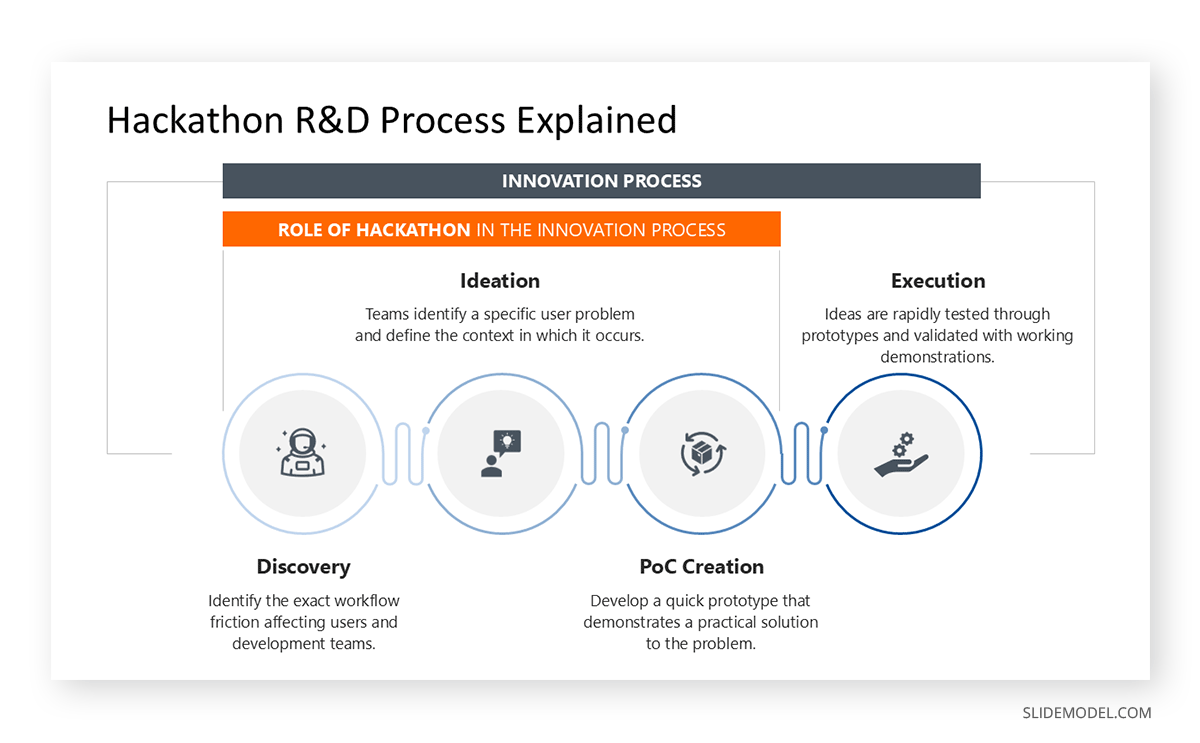
Step 1: Define the Core Insight
Start by identifying the central idea behind your project. Clarify the problem you are addressing and the unique perspective that guided your approach. This insight will anchor the entire presentation.
Step 2: Frame the Problem Clearly
Explain the specific user pain point or system limitation. Keep it precise and proportional to the hackathon scope so judges immediately understand relevance.
Step 3: Present the Solution
State what your solution does before explaining how it works. Focus on purpose and alignment with the problem.
Step 4: Demonstrate the Prototype
Walk through a structured, user-centered demo. Highlight only the features that validate your core idea.
Step 5: Explain Key Decisions
Briefly justify technical and strategic trade-offs made under time constraints.
Step 6: Conclude With Impact
Summarize how your solution creates value and outline realistic next steps or future development potential.
Hackathon Presentation Slide Structure
A strong hackathon presentation template follows a logical progression that allows judges to evaluate clarity, feasibility, and impact without having to reconstruct your thinking. The presentation structure must guide attention from context to execution in a way that feels intentional and controlled.
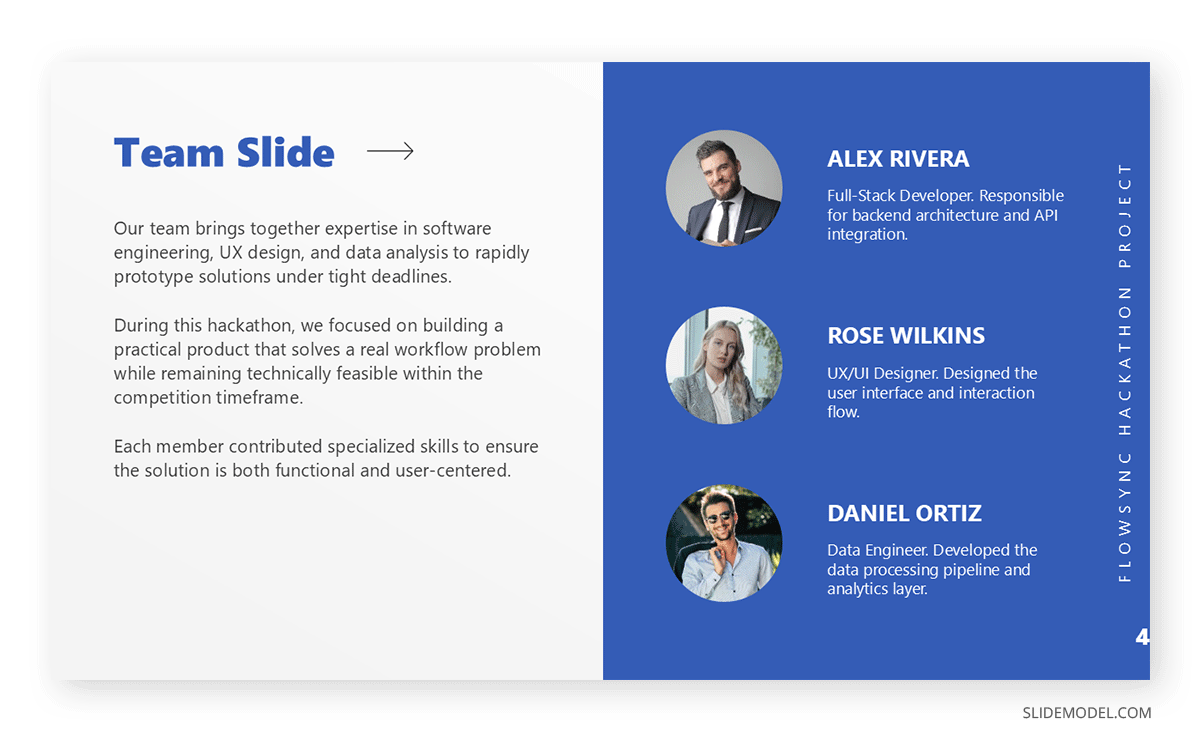
The Title Slide should immediately establish the project name, team identity, and the core theme of the hackathon pitch presentation. Avoid decorative overload. A concise tagline that hints at the problem being solved strengthens first impressions and aligns expectations. Alternatively, you can expand the deck and create a spare Team Slide to introduce your team rather than overly-populating your team slide.
The Problem Slide defines the specific user pain point or system limitation. This is where you answer what judges look for in a hackathon presentation: relevance. When teams wonder how to structure a hackathon pitch, the problem slide becomes the anchor. It should clearly explain who is affected, under what circumstances, and why the issue matters within the scope of the competition.
The Insight Slide narrows the focus. Here, you present the key observation that shaped your prototype. This differentiates your hackathon slide deck from generic solutions and demonstrates analytical reasoning.
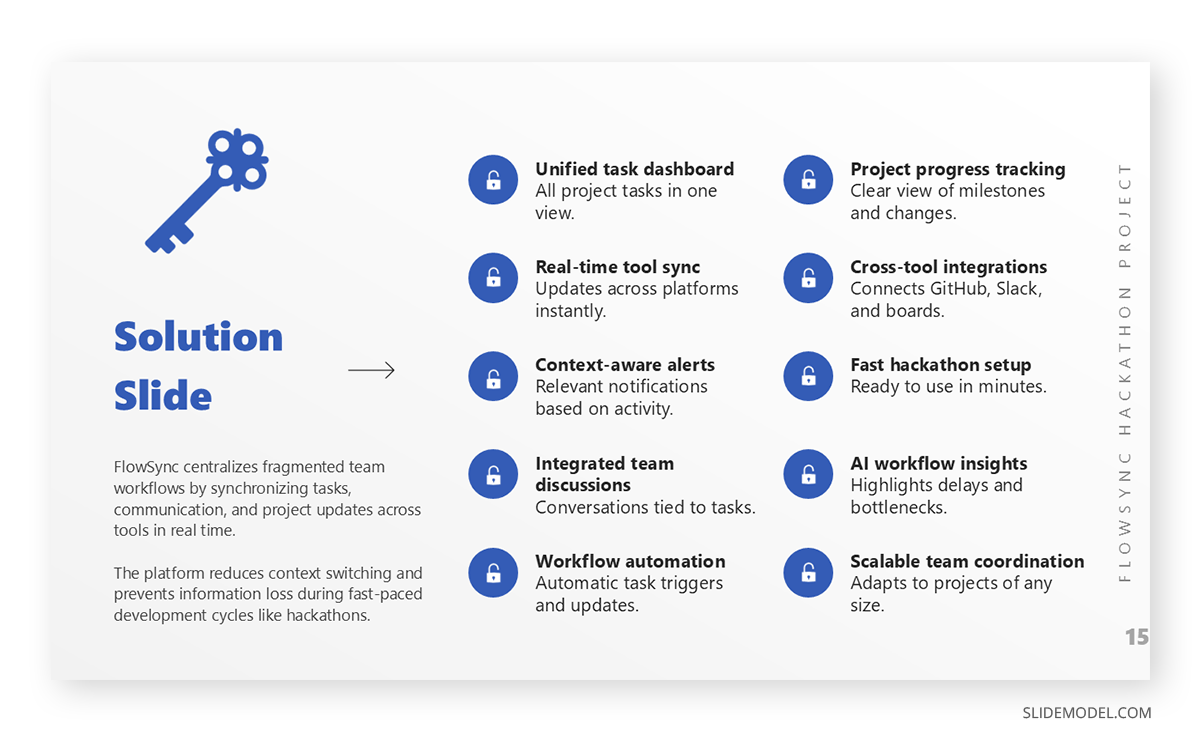
The Solution Slide introduces what your product does, then details how it works. In many hackathon pitch deck templates, this slide clarifies functionality and user flow, setting up the demo.
The Demo Slide (or slides) show the prototype in action through a structured walkthrough. If you are unsure how to present a prototype at a hackathon, keep the flow linear and user-centered.
The Architecture Slide explains technical feasibility at a high level. Judges evaluating a hackathon demo presentation need to understand system logic without excessive detail.
The Impact Slide outlines measurable or realistic outcomes and addresses scalability and potential for continuation.
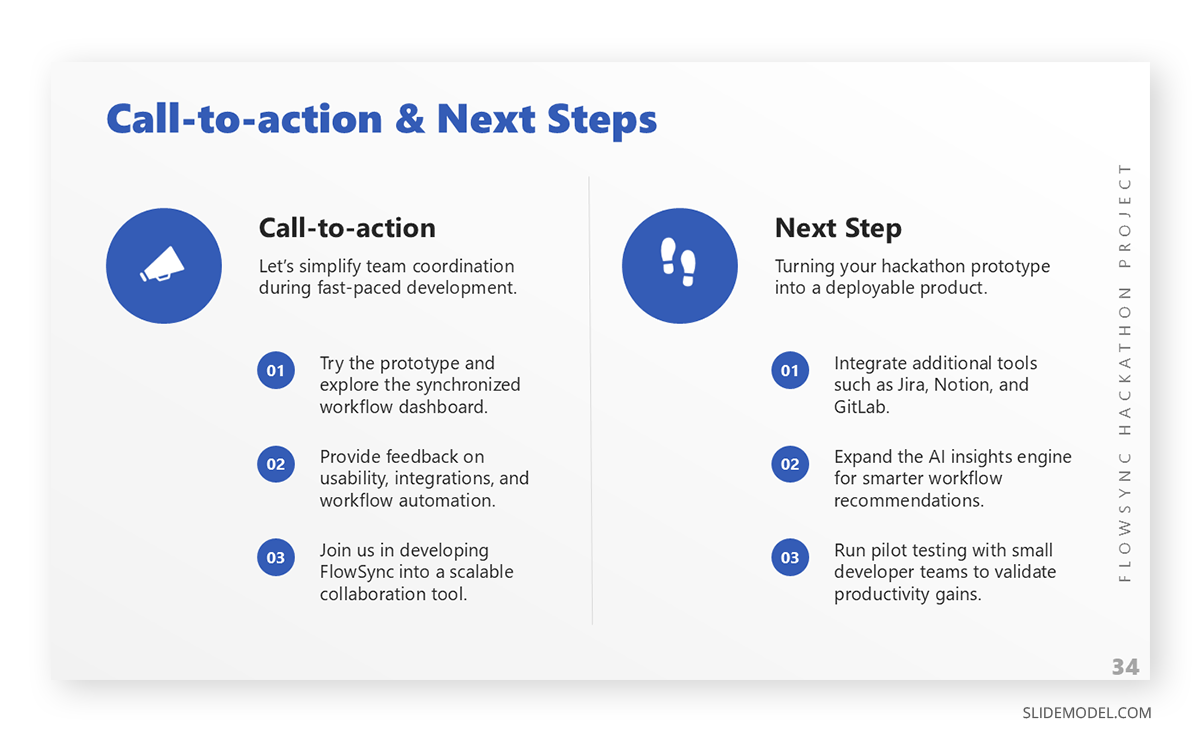
Finally, the Closing Slide reinforces the core message and leaves judges with a clear, memorable takeaway, essential in competitive hackathon judging environments. A strong call-to-action slide helps to connect with your target audience.
Building the Foundation: Identifying the Core Insight
A hackathon project can only be understood if its entire narrative rests on a single, stable insight. The core insight is the conceptual anchor that explains why the problem matters and why the prototype exists in its current form. Without this anchor, judges experience the presentation as fragmented, even if the prototype is technically strong.
To identify the core insight, teams must revisit the prompt or challenge. What underlying friction does the competition highlight? What user behavior, inefficiency, or opportunity defines the landscape? The goal is not to produce a broad statement but a specific interpretation that guides all development decisions.
Once the core insight is defined, it becomes the reference point for every slide, demo segment, and spoken explanation. This prevents the presentation from drifting into feature lists or technical minutiae. Instead, judges perceive coherence: the team saw a defined issue, extracted a meaningful pattern from it, and built a solution that addresses that pattern.
A stable insight is also a defensive mechanism during Q&A sessions. When judges ask why the team chose a particular approach, prioritized a feature, or omitted a component, the core insight provides a direct explanation. It becomes the reasoning framework behind all choices. Teams that lack such a foundation often respond inconsistently, weakening credibility.
Framing the Problem With Precision and Relevance
Hackathon judges make decisions quickly. The problem statement must therefore provide immediate clarity about what user scenario or system limitation motivated the project. This is not an opportunity for lengthy storytelling or statistical deep dives. Instead, the goal is to articulate what is wrong, missing, inefficient, or overlooked, and why addressing it is meaningful.
Effective problem framing relies on specificity. Vague descriptions such as “users struggle with complex workflows” or “the market lacks better tools” do not help judges understand the project’s purpose. A precise articulation of the friction involved, the environment in which it appears, and the consequence of ignoring it grounds the presentation in reality.
The problem statement must also be proportional to the hackathon format. If the issue presented is too expansive, something solvable only with years of development, judges may question the feasibility of the prototype. If the problem is too narrow, the audience may perceive it as having limited impact. The key is to scale the problem to the scope of a hackathon without diminishing its importance.
Articulating the Solution: Purpose Before Features
A hackathon solution must be introduced through purpose, not mechanics. Judges need to understand what the solution does, not every detail about how it operates. The opening statement should define the solution’s function in a single, unambiguous line. This sets the conceptual boundaries of the project and prepares judges for the upcoming demonstration.
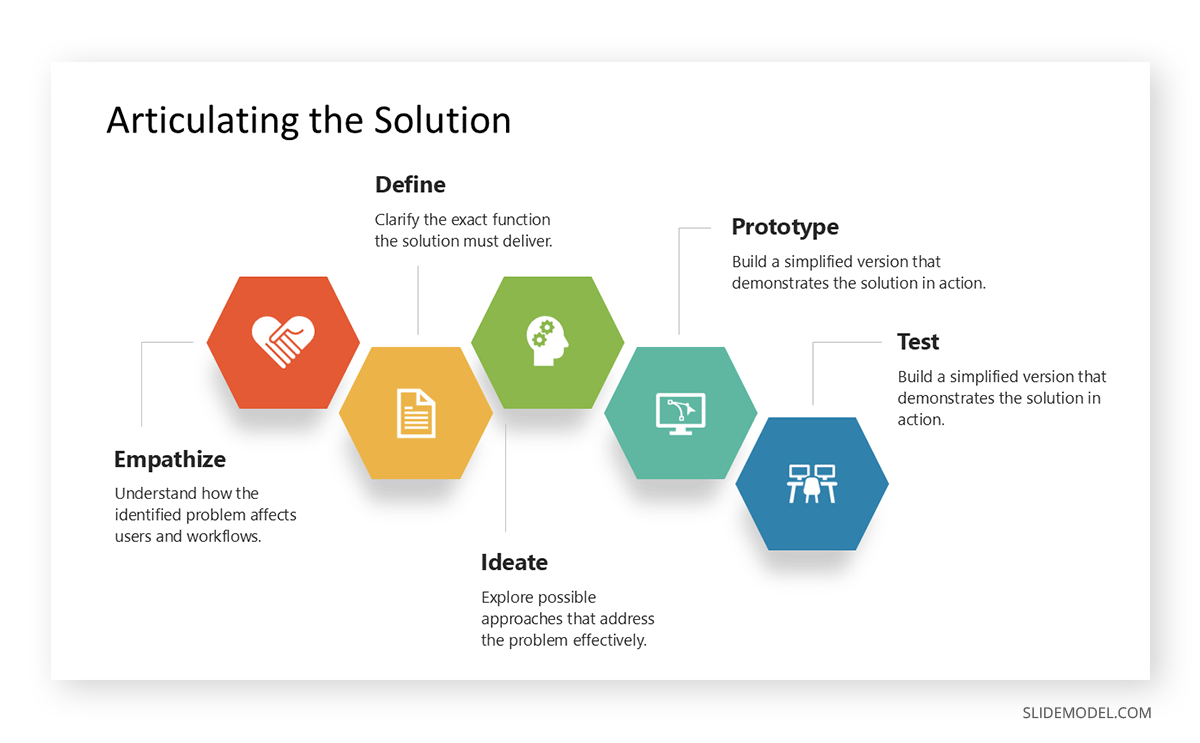
Once the purpose is established, the team can describe the solution’s structure: the main components, the intended user flow, and the central operational behavior. This explanation must remain tightly connected to the problem framing. Every element introduced should have a clear role in addressing the identified friction.
This section should avoid examples of misplaced enthusiasm, such as long lists of features, unnecessary jargon, or overly aspirational claims. Hackathon judges interpret such content as noise rather than value. What strengthens this part of the presentation is coherence: the solution appears as a direct and rational response to the core insight.
Structuring an Effective Prototype Demo for a Hackathon Slide Deck
The demo is the most influential element of a hackathon presentation. Despite this, many teams treat it as an unstructured tour of screens rather than a deliberate demonstration of reasoning. Judges do not need to see everything; they need to see the parts that validate the project’s logic.
A strong demo follows a single, linear, user-centered path. This path illustrates a practical scenario and eliminates unnecessary navigation. The presenter should begin at the entry point, the first interaction, and advance through each step without deviations. The narrative must remain anchored in the purpose and problem definition.
Interpretive commentary is essential. Simply showing the interface leaves judges guessing. The presenter should explain what each step demonstrates and why it matters: a validation rule, a backend process, a decision-support component, a workflow simplification, or a resolution of a user pain point.
Backup material must always be prepared. Live demos are fragile, especially in environments with unstable Wi-Fi or shared hardware. Screenshots or pre-recorded sequences do not count against teams; lack of contingency planning does. Judges appreciate foresight, not risk.
Presenting Technical Architecture Without Losing the Audience
Technical architecture is necessary for many hackathons, but only when presented with discipline. Judges do not evaluate architectural correctness alone; they evaluate whether the technical design aligns with the project’s purpose and constraints. The architecture explanation should therefore begin at the highest conceptual layer and gradually move toward select technical details that matter.
A top-level diagram showing components, interactions, and data flow is sufficient for orientation. Only after this orientation should the presenter highlight key decisions: chosen frameworks, integration choices, storage mechanisms, or unique implementations that meaningfully affected the prototype.
Avoid technical depth unrelated to the problem. Listing every library, dependency, or implementation quirk adds no evaluative value. The presentation must illustrate logic, not exhaustiveness. Judges want evidence that the team understands what it built and why the architecture supports the intended behavior.
Justifying Decisions and Prioritizing Under Pressure
Hackathons involve dozens of decisions made under severe time constraints. The presentation should highlight these decisions not as limitations but as rational prioritization. Judges want to understand how the team determined what to build first, what to postpone, and what to exclude entirely.
This explanation must be concise and factual. For example, a team may emphasize building core functionality before adding enhancements or optimizing performance. They may have chosen a simpler architecture to ensure stability during the demo. They may have prioritized clarity in user flow over feature quantity.
Presenting decision-making as focused reasoning strengthens credibility. Judges recognize that time pressure forces trade-offs. A team that shows awareness of its own constraints appears mature and strategically oriented, which positively affects scoring.
Delivering the Hackathon Presentation: Pacing, Tone, and Composure
The presenter’s delivery determines how judges interpret all previously prepared material. Clear speech, controlled pacing, and command of the narrative significantly influence evaluation. Hackathon presentations must be delivered with precision, avoiding filler language, unnecessary enthusiasm, or excessively fast delivery.
The presenter should internalize the flow: problem > insight > solution > demo > decisions > impact. Internalization allows natural movement between sections without reading from slides. Judges detect when presenters rely heavily on text rather than having self-explanatory hackathon slides, as it reduces credibility.
Voice pacing is essential. Presenters must allow judges time to process information, especially during transitions or demo steps. Strategic pauses, such as The Power Pause, help shift attention and emphasize reasoning. Rapid, uninterrupted speech creates cognitive overload and reduces comprehension.
Physical presence must remain controlled. Gestures should support explanation, not distract from it. When using a screen, the presenter should deliberately direct attention, pointing to components only when necessary. You can learn more about this in our guide on body language for presentations.
If multiple teammates speak, transitions must be rehearsed. Fragmented delivery weakens cohesion and gives the impression of disorganization. A unified delivery strengthens thematic clarity and demonstrates teamwork.
What Do Judges Look for in a Hackathon Presentation?
Judges primarily look for signals that a team can think clearly under constraints. Beyond the visible prototype, they evaluate whether the team demonstrates ownership of its decisions. This includes the ability to explain trade-offs without defensiveness and to justify scope choices without exaggeration. A presentation that shows awareness of limitations often scores higher than one that tries to conceal them under hackathon judging criteria.
Another factor is differentiation. In a competitive environment where multiple teams may approach similar themes, judges look for a distinct angle or interpretation. The presentation must make it evident why this approach stands apart, whether through execution strategy, user focus, or technical implementation.
Communication discipline also matters. Judges assess how efficiently the team uses time, how well speakers coordinate transitions, and whether answers remain consistent during questions. Internal alignment signals preparation and professionalism.
Finally, judges observe composure. A team that remains structured during unexpected issues, manages timing precisely, and maintains clarity under pressure demonstrates readiness beyond the hackathon itself.
How to End a Hackathon Presentation
The closing moments of a hackathon presentation determine what judges remember once the next team begins. A strong ending does not introduce new information; it consolidates the narrative. Restate the solution’s core value in one clear sentence that connects the problem, the insight, and the prototype outcome. This reinforces coherence and shows control over the message.
After reaffirming the value proposition, briefly outline realistic next steps. This indicates that the project has the potential to continue beyond the event without overstating readiness. Mention what would be improved, expanded, or validated with additional time or resources.
End the presentation with a confident, concise call to action tailored to the judging context. This may be an invitation to ask questions or a short statement about the impact the solution aims to create. Avoid filler language or abrupt finishes. A deliberate pause after your final sentence communicates closure and professionalism.
Common Hackathon Presentation Mistakes
Overloading Slides With Technical Detail
One frequent mistake in a hackathon pitch deck is turning slides into documentation. Teams often try to prove competence by filling screens with code snippets, diagrams, or dense text. This shifts attention away from the core message and forces judges to read instead of listen. A presentation should clarify decisions, not replicate a repository. Excessive technical detail reduces clarity and wastes limited presentation time.
Losing Narrative Focus
Another common issue is presenting features without a structured storyline. When teams jump between problem statements, technical explanations, and demo clips without a logical sequence, the evaluation becomes difficult. Even strong prototypes can appear weak if the presentation lacks flow. A hackathon presentation should guide judges step-by-step through the reasoning and execution.
Mismanaging the Demo
Live demonstrations often fail due to poor preparation or unrealistic expectations. Relying entirely on a live internet connection, not rehearsing transitions, or attempting to show every feature creates unnecessary risk. A focused, controlled demo aligned with the core value proposition is far more effective than an ambitious but unstable walkthrough.
Ignoring Time Constraints
Exceeding the allotted time signals poor prioritization. Teams that rush through impact or skip conclusions because they mismanaged earlier slides undermine their credibility. Precision in timing reflects preparation and strategic thinking.
FAQs
How long should a hackathon presentation be?
Most hackathons allocate three to five minutes per team. The exact duration varies by event, but the common expectation is a concise presentation that prioritizes clarity over detail. Teams should structure the narrative so that the problem, solution, demo, and impact each receive focused attention without rushing. If time runs short, the demo and purpose explanation take precedence over supplementary information.
Should every team member speak during the presentation?
It is not required. Some teams benefit from having a single spokesperson to maintain narrative consistency. Others prefer multiple speakers to represent different areas of expertise. What matters is the smoothness of transitions and the absence of fragmented or duplicated explanations. Judges evaluate coherence, not the number of people speaking.
How many slides should a hackathon presentation have?
The number depends on pacing rather than quantity. Most effective presentations use six to ten slides, each designed to communicate one clear idea. Overloading slides with dense text or excessive diagrams weakens comprehension. Slides should reinforce the spoken narrative rather than replace it.
Do judges expect a fully working prototype?
No. Hackathon judges understand that time constraints limit development. They expect a functional demonstration of the core idea, even if partial or simulated. What matters is that the demo shows meaningful behavior, reflects structured reasoning, and aligns with the problem statement. A controlled, simplified prototype often scores higher than an unstable or overly complex one.
What makes a problem statement effective in a hackathon setting?
Specificity and relevance. Judges must understand who experiences the problem, in what context, and why it affects outcomes. Broad or abstract descriptions dilute the presentation’s direction. A clear, grounded problem statement provides orientation and helps judges interpret the solution as a logical response.
Should we include market research or business modeling?
Only when the hackathon’s criteria explicitly require it. Many hackathons focus on technical execution, user experience, or problem-solving rather than commercialization. Market content should appear only when it strengthens the explanation of impact. Unnecessary business modeling wastes time and distracts from core evaluation points.
How technical should architecture explanations be?
Present enough to demonstrate feasibility and deliberate engineering, but avoid overwhelming the audience with granular implementation details. Judges benefit from a high-level diagram, plus a few highlighted decisions that affected performance, stability, or user experience. Architecture must reinforce purpose, not overshadow it.
How do we decide which features to show in the demo?
Choose the features that most clearly illustrate how the solution addresses the problem. Hackathon judges evaluate logic and usefulness, not completeness. Showing fewer features with strong interpretive commentary is more effective than rushing through a long sequence without context. The demo should follow a natural user flow, avoiding unnecessary detours.
Is it acceptable to acknowledge limitations or missing features?
Yes. Transparency increases credibility. Judges know hackathon projects are incomplete. Explaining why certain elements were deprioritized and how they would fit into a future roadmap shows strategic thinking. Avoid apologizing for limitations; focus instead on the reasoning behind decisions.
How much detail should we include about the development process?
Only the aspects that influenced the structure or capabilities of the prototype. Hackathon judges are not interested in the full chronology of the team’s workflow. They want to understand decisions, not narrations of time pressure or coding challenges. Highlight reasoning, not effort.
What do judges evaluate most?
Judges generally evaluate the clarity of the problem definition, the alignment between the problem and the solution, the quality of the demo, technical feasibility, the reasoning behind decisions, and the potential impact. Emotional appeal, presentation theatrics, or high feature count are secondary to coherence and control.
How early should we prepare the presentation during the hackathon?
Earlier than most teams expect. A draft structure should be in place well before development ends. Waiting until the last hour leads to rushed slides and disorganized explanations. When the narrative is prepared in parallel with development, decisions become clearer, and the presentation feels coherent.
How do we avoid running out of time?
Use a strict outline and rehearse with a timer. Each section should have a defined duration. If time becomes tight during the actual presentation, shorten explanations rather than the demo. Judges must see the solution in action; missing the demo is the most damaging outcome.
What is the most common mistake teams make?
Trying to present everything instead of presenting what matters. Excess information dilutes clarity and forces judges to reconstruct your story. Strong hackathon presentations rely on discipline, one idea per hackathon slide, one demonstration path, one interpretive thread guiding the entire narrative.
Final Words
A hackathon presentation is an interpretative tool that allows judges to evaluate the structure behind the team’s work. Strong presentations rely on clarity, not spectacle; coherence, not quantity; reasoning, not improvisation. When teams approach communication as deliberately as they approach development, they transform prototypes into meaningful narratives that judges can understand, compare, and value.
This structured approach not only improves evaluation outcomes but trains teams in disciplined thinking applicable far beyond hackathons.