Create stunning team development presentations with Tuckman’s Team Development Model for PowerPoint with its custom features and functional design.
Tuckman’s Team Development Model portrays four inevitable steps that allow growth to a team. Designed by Bruce Tuckman in 1965, it aims to create solutions to problems that can arise in a group and let the group grow. The framework is a collaboration of personality, psychology and management concepts. The model includes these 4 phases:
- Forming
- Storming
- Norming
- Performing
The Forming stage is where the members of the group meet. Together, they create the team’s objectives and begin to identify and designate the task. Members are very motivated in this part but are a little shy at the same time. Storming is a stage where clashes happen. Usually, if the problems in this phase are not resolved, the team dies with it. The arguments that arise here will make the unit stronger if appropriately addressed. Members that emerged from Storming have developed intimacy and common responsibility towards goals. They are now in the Norming stage. Performing is where the team attains success through hard work and deep knowledge. These stages undergo a cycle or overlap, but they are all necessary for team development.
The PowerPoint template can aid the user in generating a novel presentation. All four slides with 3D PowerPoint shapes are editable. For example, the presenter can identify one challenge that the team might face. These challenges can be sorted and entered into the first slide’s spheres. The second and last slide illustrate that there is growth if the team survives every phase. The 3rd slide, on the other hand, is a venue for a more detailed discussion.
Start up amazing and professional presentations with Tuckman’s Team Development Model for PowerPoint. Another factor that can significantly influence team development is teamwork. Here is the Teamwork Word Cloud Picture for PowerPoint downloadable from the SlideModel gallery. Alternatively, you can download the other variant of Tuckmans stages of group development model created as a presentation template, other model templates for PowerPoint and Google Slides.
What’s inside this template
Example presentation scenarios
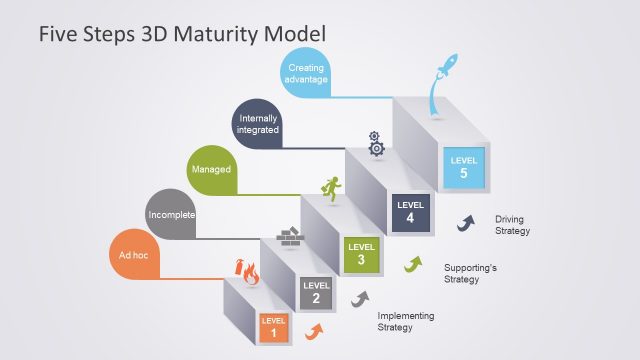
- An HR manager can use the 3D staircase process to introduce the four stages during a team effectiveness workshop and connect each stage to expected group behavior.
- A project manager can use the four-column matrix to compare a new project team's current behaviors against Forming, Storming, Norming, and Performing indicators.
- An agile coach can use the ascending block chart to explain how conflict resolution and working agreements move a squad toward higher performance.
- A leadership trainer can use the waterfall-style stepped diagram to teach managers how to diagnose team maturity before choosing coaching actions.
Features
- 100% editable presentation template
- Compatible with Microsoft PowerPoint and Google Slides
- 16:9 aspect ratio slides
- Scalable vector shapes, icons and illustrations
- AI-Ready for Microsoft Copilot and Claude
- Instant access and download
Frequently asked questions
Q: How should a presenter explain the four stages without making the model feel too theoretical?
A: Start with the 3D staircase slide to frame the progression, then replace each text block with one observable team behavior and one practical facilitator action. For example, keep Forming focused on role clarity, Storming on conflict, Norming on working agreements, and Performing on ownership. This turns the model into a coaching conversation instead of a lecture.
Q: For which presentation situations is this Tuckman model template the best choice?
A: This template fits team workshops, project kickoffs, leadership training, and HR discussions where the audience needs a shared language for group maturity. It works best for presenters guiding managers, new teams, or cross-functional groups through the difference between early uncertainty, conflict, alignment, and high-performance collaboration.
Q: Why do the staircase and rising block layouts help communicate team development?
A: The visual metaphor of steps and rising blocks makes development feel progressive and earned. Tuckman's stages are not shown as isolated labels; they appear as a sequence that requires movement through each phase. That structure helps audiences understand why Storming is not a failure, but a necessary step toward Norming and Performing.


Tuckman’s Team Development Model for PowerPoint
4-slide presentation template for Tuckman's stages with staircase process and team development blocks
Tuckman's Team Development Model for PowerPoint is a 4-slide diagram template for explaining Forming, Storming, Norming, and Performing. It includes a 3D staircase, stepped process, four-column matrix, and ascending block chart. It is built for managers, HR facilitators, and team leads using Microsoft PowerPoint or Google Slides.
- Category
- Models
- Rating


 Loading...
- Aspect ratio
- 16:9
- Item ID
- 6126-01
- Colors
 Microsoft PowerPoint
 Microsoft Copilot
 Claude for PowerPoint
Other formats supported
Subscribe today and get immediate
access to download our PowerPoint templates.