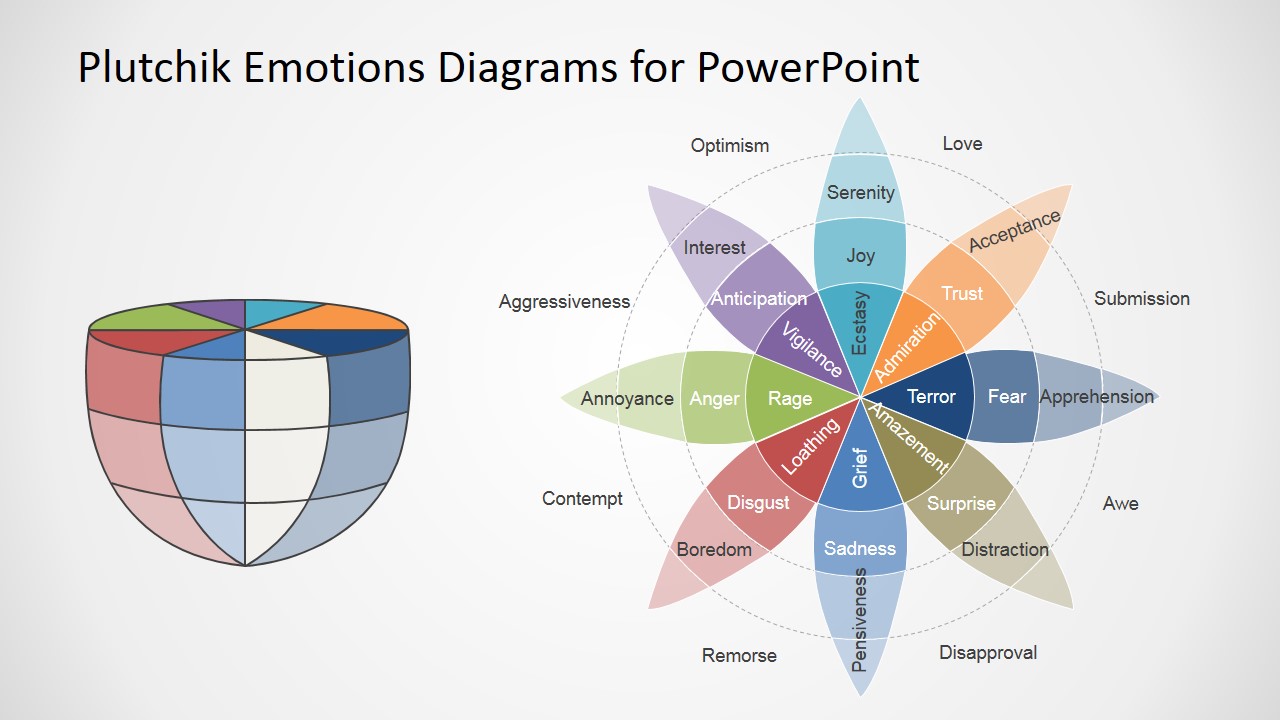
Plutchik Wheel of Emotions Diagram for PowerPoint is a professional PowerPoint Template featuring Robert Plutchik Emotions Theory Diagram.
Traditionally, in the common understanding of emotions, people tend to think as each of them as isolated feelings. To exemplify, several state that being Happy is associated to the feeling of joy or pleasure. Robert Plutchik theory states that emotions are related in a more complex relationship and that the origin of this relationship is part of a long evolutionary history. This means that our emotions have been developing along the evolutionary process and have adapted to increase the fitness of the species, playing an important role for survival. Emotions are not only a state of mind, they also trigger behaviors, for example, a predator will generate fear to an individual (a threat) and its behavior towards that threat will represent a survival reaction.
Robert Plutchik developed ten Axioms for his Emotions Evolutionary Theory:
- Emotions are experienced by all animals (including humans)
- Emotions have been part of the evolutionary process and are present in all animals in different expressions.
- Emotions have evolved during time to increase the survival of species.
- Emotions have identifiable patterns and common elements despite the form of expression and specie.
- There is a set of primary Emotions.
- Emotions are a mixture of the basic emotions.
- Primary Emotions are Hypothetical Constructs.
- Primary emotions are a set opposites.
- Emotions have different degrees of similarity to one another.
- Emotions can vary in its level of intensity.
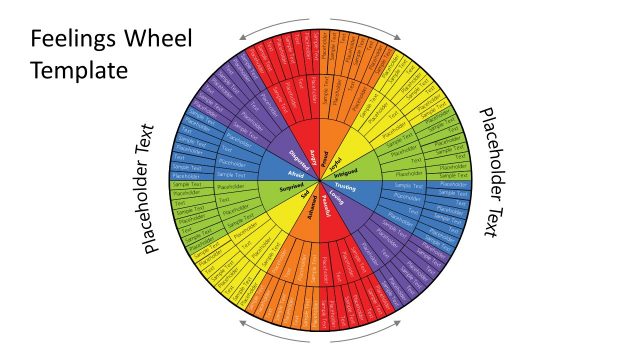
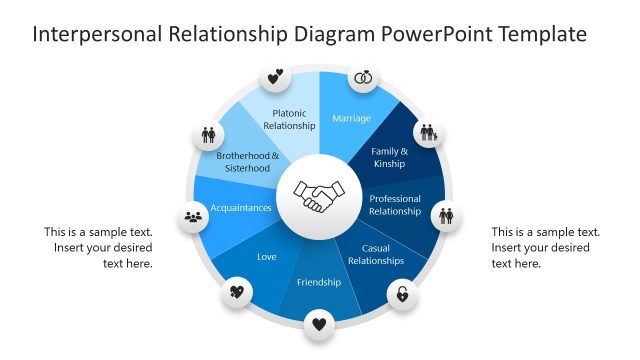
Users can create professional presentations basing their message on Plutchik Emotions wheel, which describe the primary emotions and their derivatives. The diagrams are created with PowerPoint shapes, allowing the user to customize their appearance without losing visual quality. This template is ideal for behavior lectures, psychology courses or Human Resources presentations that describe the reaction of employees to different situations.
What’s inside this template
Example presentation scenarios
- A psychology professor can introduce primary and blended emotions by starting with the labeled Plutchik wheel and then moving to the intensity bowl diagram.
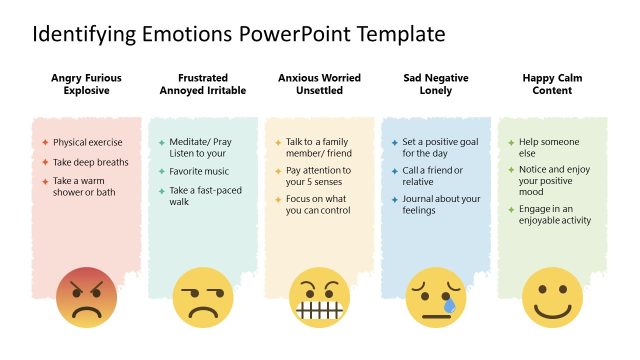
- An HR facilitator can discuss employee reactions during change management by using the emotion icon cycle and editable labels for group reflection.
- A behavioral science presenter can explain emotion intensity by showing the bowl diagram with the vertical Intensity axis and segmented colored layers.
- A training designer can build an emotional vocabulary activity with the facial icon set and the circular wedge diagram with side text placeholders.
Features
- 100% editable presentation template
- Compatible with Microsoft PowerPoint and Google Slides
- 16:9 aspect ratio slides
- Scalable vector shapes, icons and illustrations
- AI-Ready for Microsoft Copilot and Claude
- Instant access and download
Frequently asked questions
Q: How should I present the Plutchik wheel without overwhelming the audience?
A: Begin with the simplified circular emotion wheel before showing the full labeled Plutchik diagram. This lets the audience learn the main emotion families first, then add blended emotions and intensity relationships. Use the icon cycle as a discussion slide so participants connect the theory to recognizable facial expressions.
Q: Who is this template best suited for?
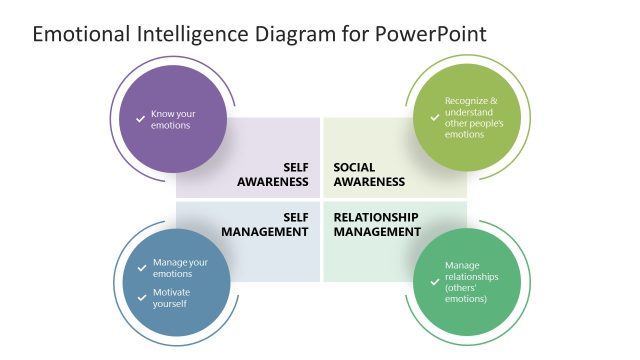
A: This template works best for educators, HR facilitators, coaches, and behavioral science presenters who need to explain how emotions relate to one another. It is especially useful when the session is about emotional literacy, reactions to situations, workplace behavior, psychology concepts, or the difference between primary emotions and intensified states.
Q: Why does the template include both the wheel and the bowl diagram?
A: The wheel shows relationships across emotions, while the bowl suggests depth and intensity. Presenting both metaphors helps audiences understand that emotions are not isolated labels; they can sit near opposites, combine with neighboring states, and vary in strength. The paired view on slide 7 is useful for comparing the two mental models.



Plutchik Wheel of Emotions Diagram for PowerPoint
7-slide presentation template with Plutchik emotion wheel diagrams, intensity model, and emotion icons
Plutchik Wheel of Emotions Diagram for PowerPoint is a 7-slide presentation template for explaining Robert Plutchik's emotion theory. It includes a labeled emotion wheel, a circular emotion diagram, an emotion icon cycle, an intensity bowl diagram, and a vector icon set for psychology educators, HR teams, and trainers in Microsoft PowerPoint and Google Slides.
- Category
- Models
- Rating


 Loading...
- Aspect ratio
- 16:9, 4:3
- Item ID
- 6761-01
- Colors
 Microsoft PowerPoint
 Microsoft Copilot
 Claude for PowerPoint
Other formats supported
Subscribe today and get immediate
access to download our PowerPoint templates.