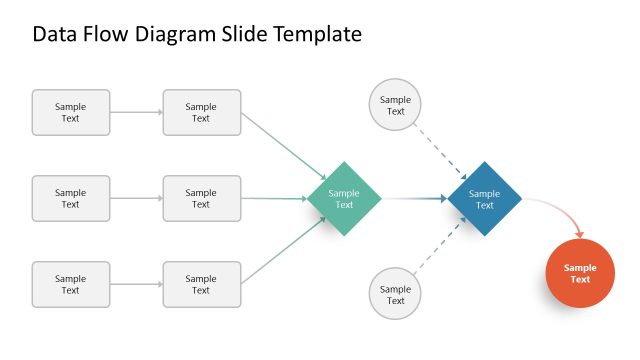
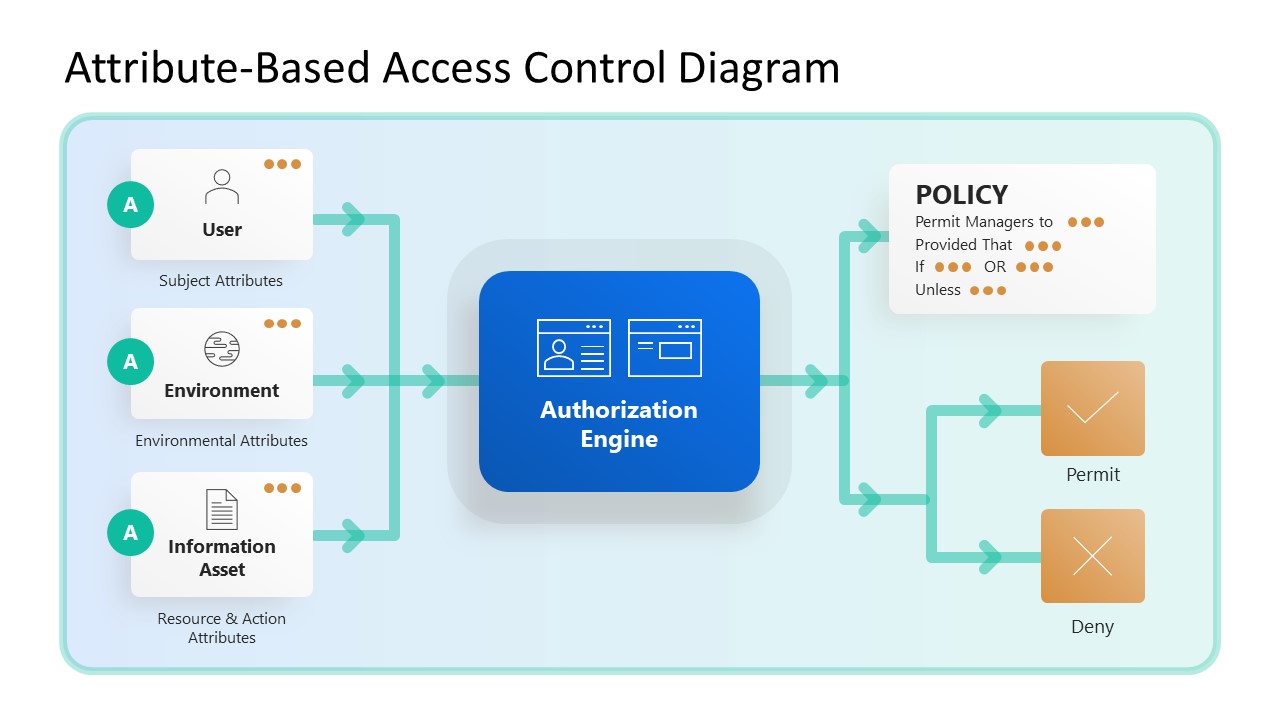
Illustrate complex access control mechanisms in the executive meetings with our comprehensive Attribute-Based Access Control Diagram PowerPoint Template. In the digital realm, access to the online systems, security infrastructure, and other backend databases is fully controlled. This control is selected based on the user’s role when logging in to the site or platform. If it’s an admin person, they have more grants to manage the platform, while for external users, the system provides them with very few permissions and doesn’t let them make any changes to the system. For instance, the admin can create new rules while the user can work on regulations, but cannot define or change them. We have created this flowchart process diagram that contains different shapes and levels. On the left, there are three boxes for three attributes: user (subject attribute), environment (environmental attribute), and information asset (resource and action attribute).
The three attributes are linked with arrows; they all merge and enter into phase two, i.e, authorization engine. At this step, the technological system operates on multiple rules, if-else statements, and data. Then it decides whether to grant the permission or not. The entire process can be easily explained using process diagram stages and corresponding arrows. The Attribute-Based Access Control Diagram PowerPoint Template features a simple layout that is fully customizable, allowing users to modify the PPT icons, shapes, or styles used within the template. Infographic icons with colored backgrounds visually represent all the points in the process diagram. This enhances the audience’s attention and allows IT experts to convey their system ideas effectively.
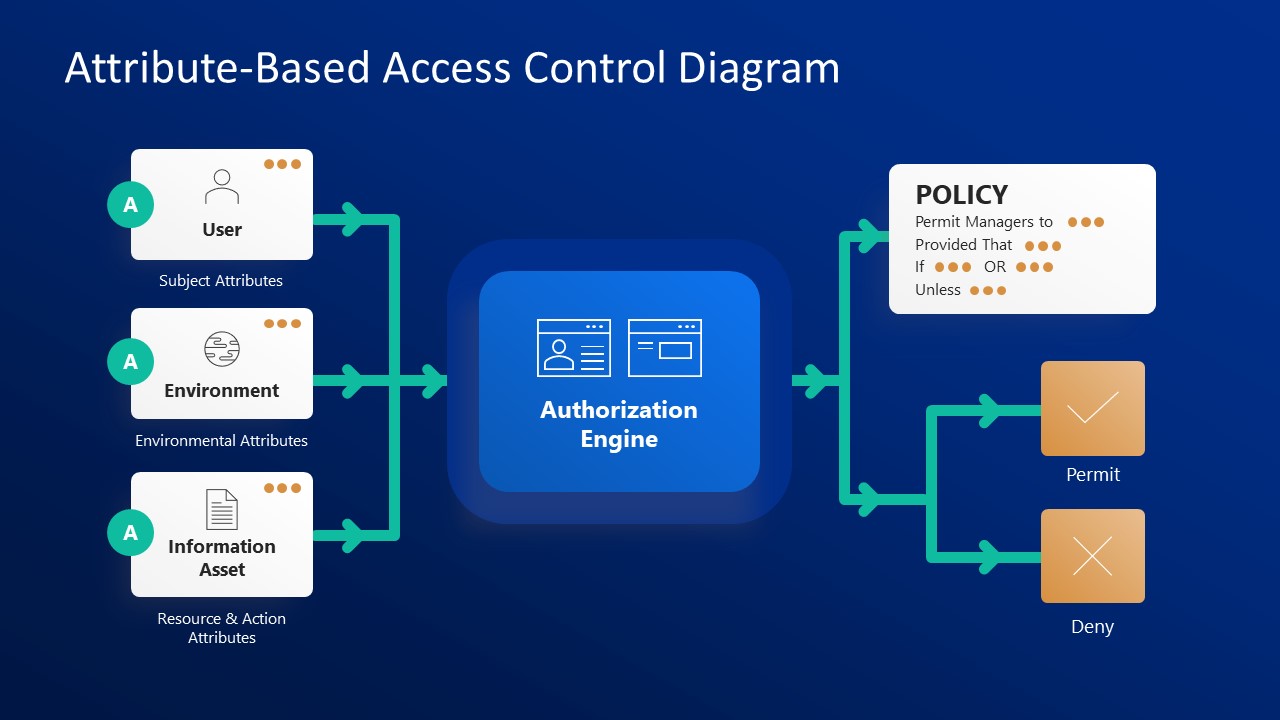
Both slides of the template contain similar diagrams, but they differ in background colors. Download the attribute-based access control diagram PPT template and edit it today!
What’s inside this template
Example presentation scenarios
- A cybersecurity architect can use the authorization engine flow to explain an ABAC decision path to executives before approving a new identity and access management model.
- An IT governance manager can use the policy box and permit-deny outputs to show how business rules translate into access decisions during a compliance review.
- A security consultant can use the three attribute cards to compare subject, environment, and resource-action inputs during a client workshop on zero trust access control.
- A training facilitator can use the light or dark diagram slide to teach technical staff how user context and asset context are evaluated before permission is granted.
Features
- 100% editable presentation template
- Compatible with Microsoft PowerPoint
- 16:9 aspect ratio slides
- Scalable vector shapes, icons and illustrations
- AI-Ready for Microsoft Copilot and Claude
- Instant access and download
Frequently asked questions
Q: How should a presenter explain the ABAC logic clearly with this diagram?
A: Start on the left with the three input cards: User, Environment, and Information Asset. Explain each as evidence the system evaluates, then move to the Authorization Engine as the decision point. Finish with the Policy box and the Permit or Deny outputs so the audience sees ABAC as a rule-based evaluation, not a static role list.
Q: Who is this template best suited for in a security presentation?
A: This template fits IT security architects, IAM leads, governance managers, and consultants who need to explain access decisions to mixed technical and executive audiences. It works best when the message is about the decision process: which attributes are collected, how policies are checked, and why access is approved or rejected.
Q: Why does the left-to-right process layout help explain access control?
A: The diagram uses a pipeline metaphor: inputs enter from the left, the authorization engine evaluates them in the center, and the decision exits on the right. That sequence reduces cognitive load because viewers can follow causality. The separate Permit and Deny boxes make the final security outcome visible without requiring a dense rules table.


Attribute-Based Access Control Diagram PowerPoint Template
2-slide presentation template for ABAC process diagrams, authorization engine flow, and permit-deny decisions
The Attribute-Based Access Control Diagram PowerPoint Template is a 2-slide Microsoft PowerPoint diagram for explaining ABAC logic. It shows subject, environment, and information asset attribute cards flowing into an authorization engine, then a policy check that leads to permit or deny outcomes. It is for IT, cybersecurity, and governance presenters.
- Category
- Process Diagrams
- Rating

 Loading...
- Aspect ratio
- 16:9
- Item ID
- 22396-01
 Microsoft PowerPoint
 Microsoft Copilot
 Claude for PowerPoint
Other formats supported
Subscribe today and get immediate
access to download our PowerPoint templates.