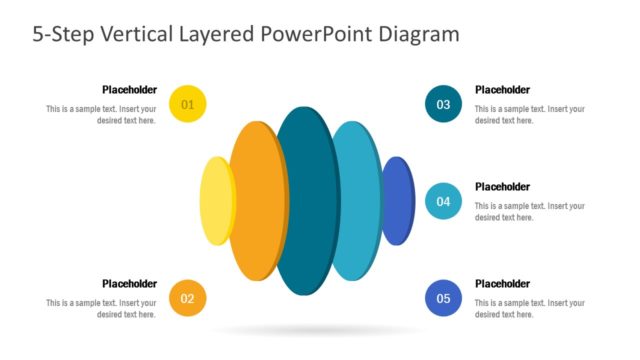
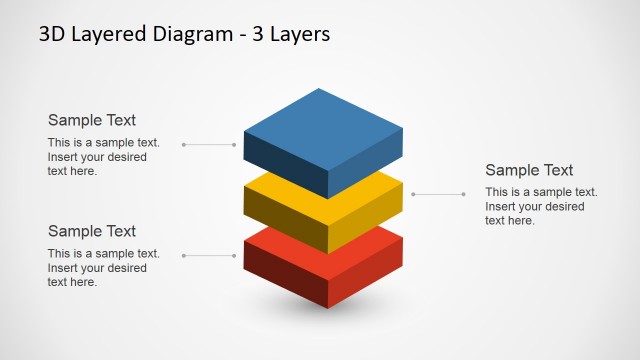
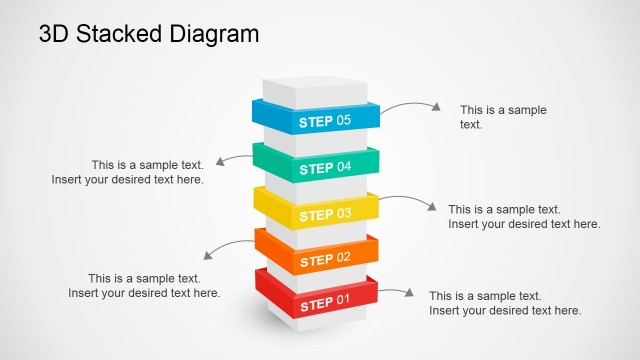
Make a multi-layered diagram template with the 5 Levels 3D Layered Diagram for PowerPoint. It can act as an alternative to other stacked diagrams in PowerPoint. The template uses a solid color scheme in yellow, blue, red, and green. Such a design makes the segments easier to distinguish. The PowerPoint design is created in high definition graphics. Modification will not affect image resolution.
Most business plans involve several complicated steps. This requires the steps to be arranged into segments. It makes the steps easier to understand. It allows the team to study the nature of each segment. Using the diagram, management can give priority to categories more easily.
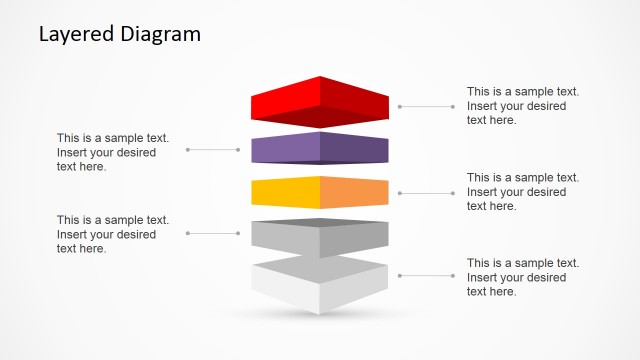
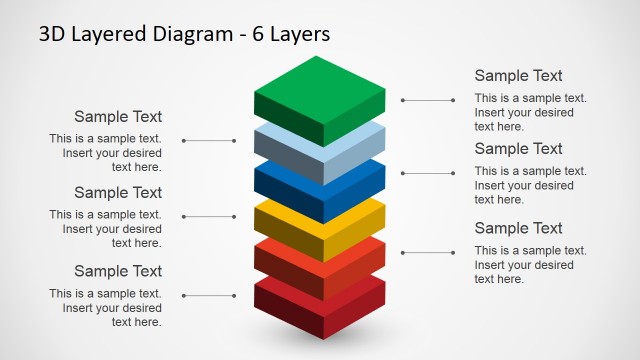
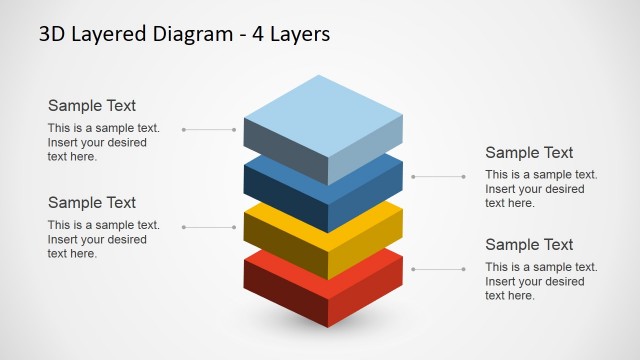
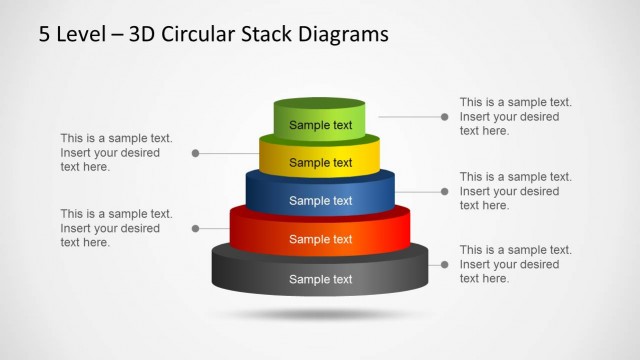
The diagram is composed of five 3D squares. They are stacked vertically in the center of the slides. Each square represents a segment of steps. They can be arranged by priority or by order of execution. The exact sequence of the segments can depend on the needs of the user. In any case, the design simplifies the report into manageable parts.
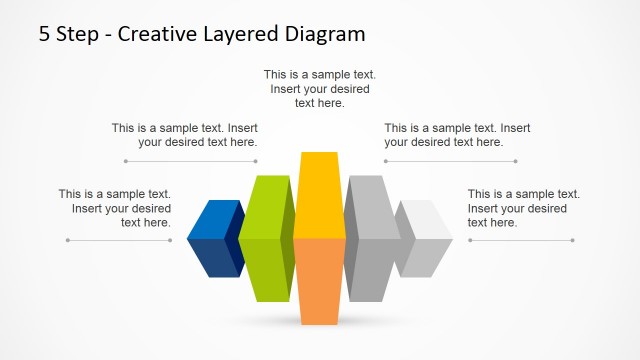
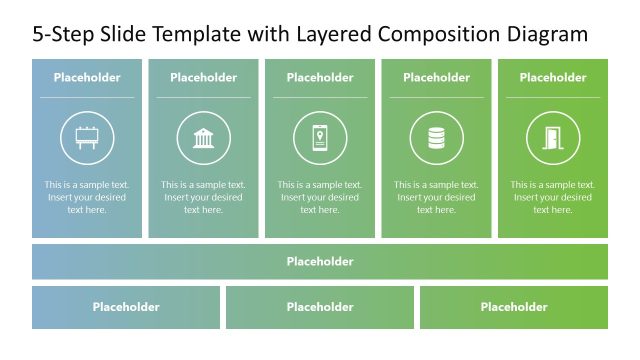
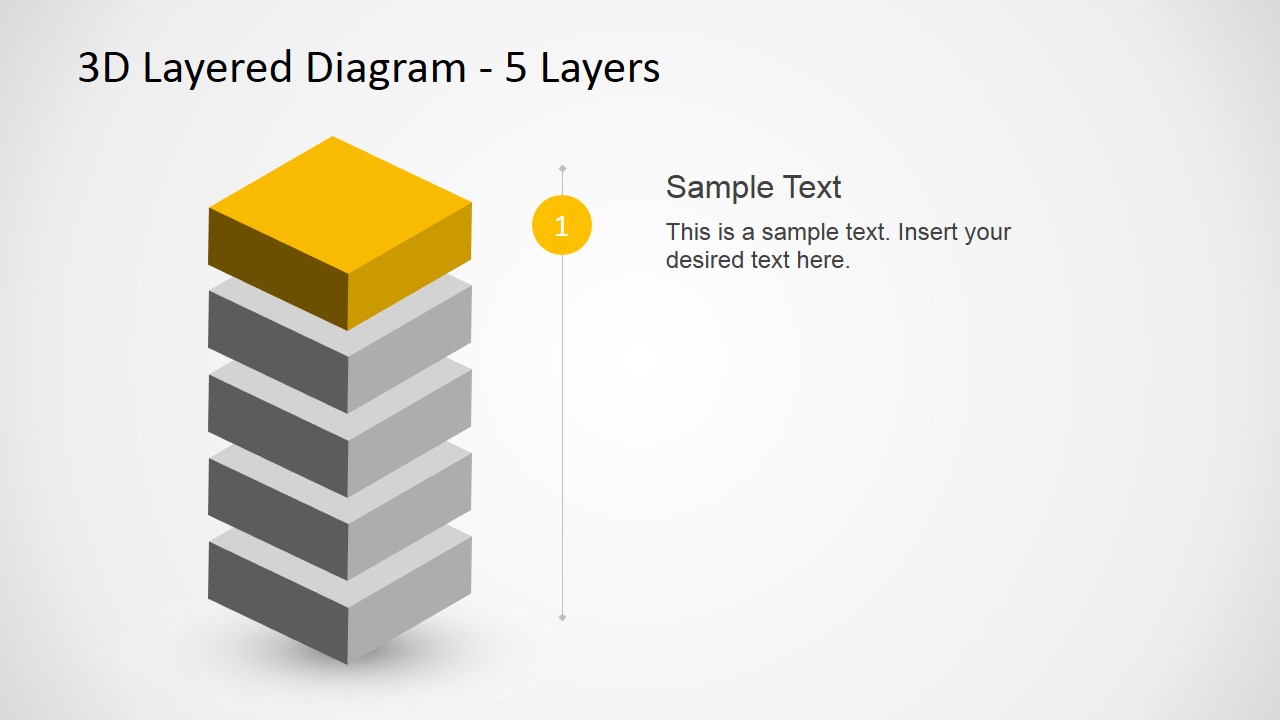
The template has several versions of the layered diagram. The first shows the stack in full color. Thin lines connect the segments to placeholders. These can include descriptions for each segment. The next version replaces the placeholders with color text boxes. The color-coding allows the viewers to identify the text more easily. The third version has text placeholders and PowerPoint icons. The icons include a monitor, money, a shopping cart, a clock, and a delivery truck. The last shows the diagram on the left side of the slide. Each segment is accompanied by a number in a colored circle. Five succeeding slides show the same diagram. In these last slides, however, only one segment is colored at a time.
Use the 5 Levels 3D Layered Diagrams for PowerPoint for the presenter to demonstrate a business strategy.
What’s inside this template
Example presentation scenarios
- A strategy consultant can use the central stacked diagram to explain five parts of a market-entry framework and reserve the single-level focus slides for the most important workstreams.
- An operations manager can present a five-stage workflow by assigning each layer to planning, sourcing, execution, delivery, and measurement, then using the numbered marker layout to walk the audience through the sequence.
- A product lead can use the separate cube tiles to compare five product pillars and use the icon-supported slide to connect each pillar with a business function or customer touchpoint.
- A sales leader can map a service package into five layers and use the color-coded text bars to show what is included at each level without overcrowding the slide.
Features
- 100% editable presentation template
- Compatible with Microsoft PowerPoint and Google Slides
- Scalable vector shapes, icons and illustrations
- AI-Ready for Microsoft Copilot and Claude
- Instant access and download
Frequently asked questions
Q: How should a presenter make a five-layer model clear instead of just decorative?
A: Start with the full stack to name the five layers, then move to the focus slides only when each layer needs explanation. Keep the same layer order and color meaning across the deck. Use the short callout text for labels, not paragraphs, so the audience can understand the hierarchy before hearing the detail.
Q: Who is this template best suited for in a business presentation?
A: It fits presenters who need to explain a five-part structure rather than prove a numeric result. Consultants, managers, and project leads can use it for strategy levels, process components, service tiers, or operational priorities. The single-level highlight slides are especially useful when each category needs a short explanation.
Q: Why use a stacked 3D layer metaphor for this message?
A: The stacked blocks make dependency and priority visible before the presenter speaks. A layer at the top can signal a final outcome, while lower layers can represent foundations, inputs, or earlier stages. The gray focus slides reduce distraction by isolating one layer at a time while preserving the full model.




5 Levels 3D Layered Diagram for PowerPoint
11-slide diagram template for five-level stacks, layered processes, and priority models.
This is an 11-slide diagram template for presenting five ordered levels as stacked 3D blocks. Visible layouts include a central layered diagram with callout lines, color-coded text bars, separate level tiles, icon-supported notes, and single-level focus slides. It is designed for business presenters using Microsoft PowerPoint or Google Slides.


 Loading...
 Microsoft PowerPoint
 Microsoft Copilot
 Claude for PowerPoint
Other formats supported
Subscribe today and get immediate
access to download our PowerPoint templates.