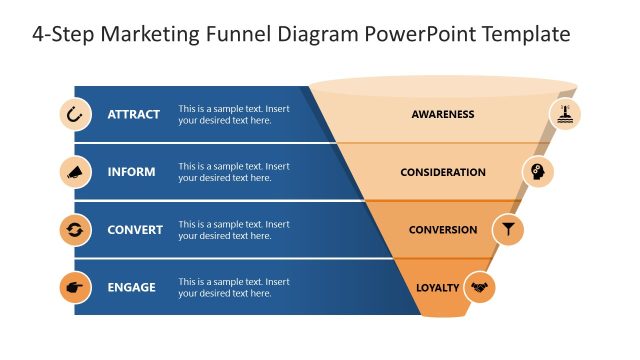
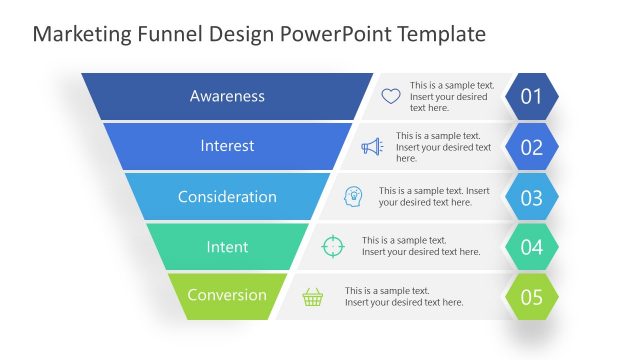
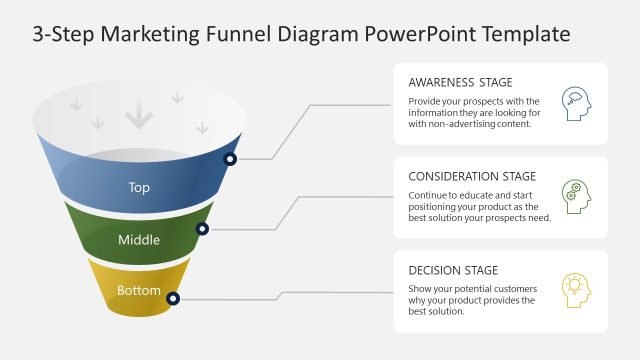
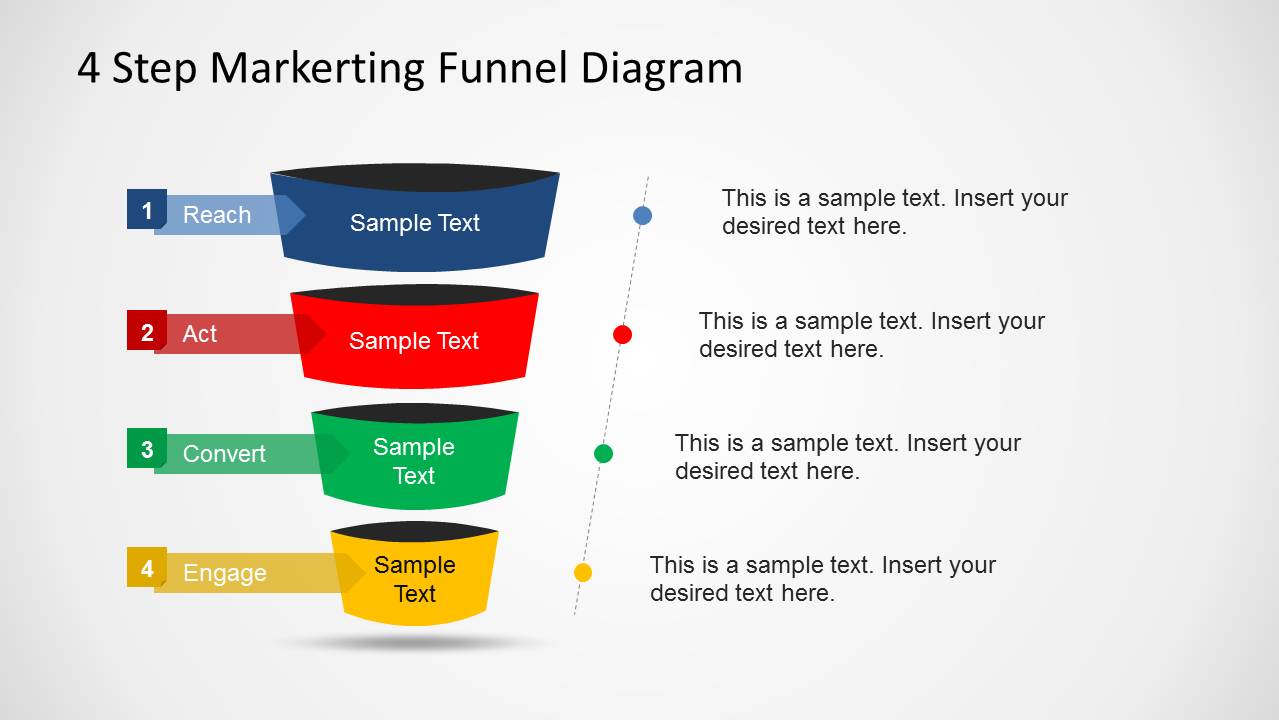
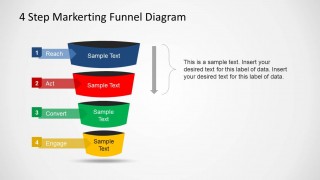
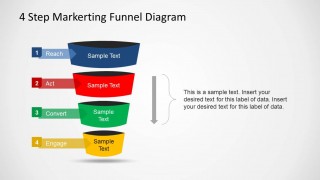
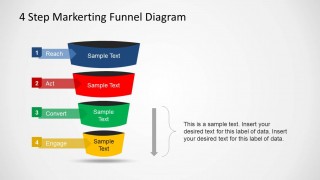
By using the 4 Step Marketing Funnel Diagram for PowerPoint, the presenter can show different steps involved in an effective marketing plan. The steps featured on the slide include reach, act, convert, and engage. These are different steps which ensure an effective marketing campaign for a new product.
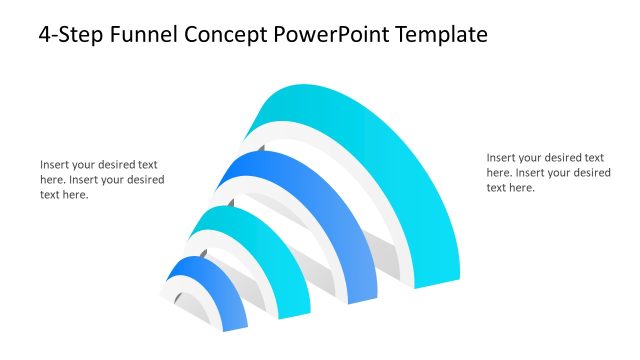
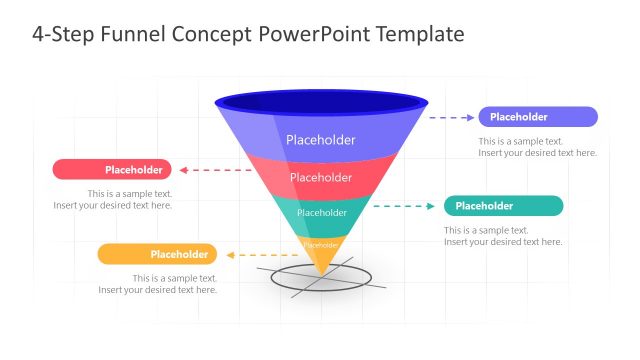
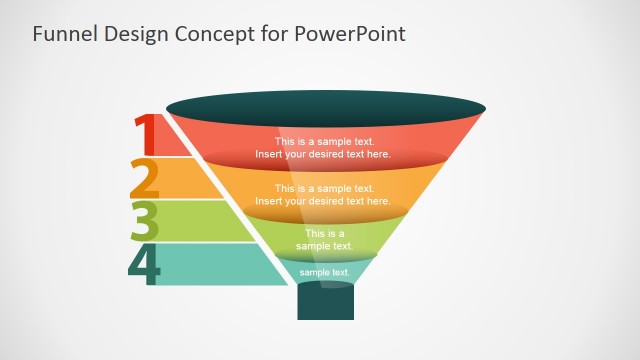
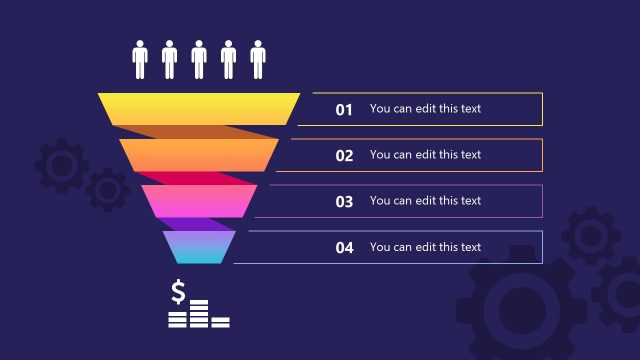
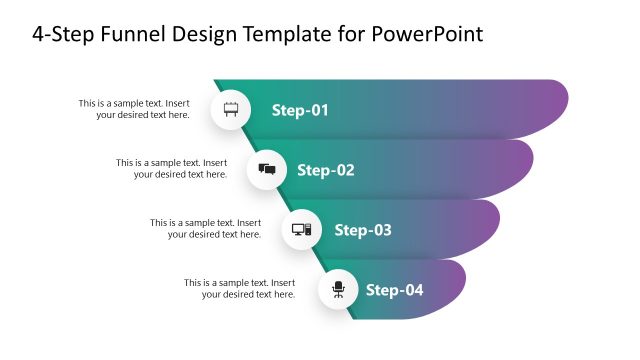
The steps are illustrated as a set of rings of decreasing sizes. The rings are arranged in a decreasing pattern, ultimately creating a funnel diagram. A funnel diagram is usually applied to represent a multi-step selection process. This way of presenting represents the way these steps narrow down the client base, finally filtering them to maintain a loyal, solid selection of customers.
The first step in the funnel diagram is shown as reach. This refers to the initial step of “reaching out” to prospective clients through market research tests. In this stage, the marketing team gathers a wide variety of would-be customers from different target groups.
The next step, shown by the red ring, is to act. This is where the main marketing campaign is implemented. The action refers to the release of advertisements and commercials to the general public. This is related to the next phase, which is to convert. The marketing stages become more aggressive as marketers try to stabilize the client base. By the time the marketing process reaches the last phase, engagement, the clients would have gained trust and loyalty to the product and brand.
The 4 Step Marketing Funnel Diagram for PowerPoint is ideal for showing a proper process of marketing to orient new members of the business team. The presentation can help management understand the process of creating a proper marketing campaign to ensure that they have a clear vision of the marketing goals. The PowerPoint objects are 100% customizable for the presenter’s convenience. The presenter can download other PowerPoint templates from the Gallery.
What’s inside this template
Example presentation scenarios
- A marketing manager can use the stacked funnel to brief leadership on how prospects move from Reach to Engage during a campaign planning meeting.
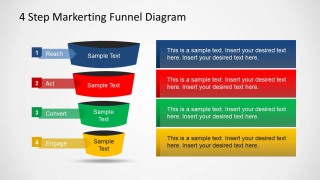
- A sales enablement lead can use the colored description panels to train account teams on the difference between awareness, action, conversion, and customer engagement.
- A consultant can use the bracketed arrow callouts to focus a client discussion on one part of the funnel, such as conversion or post-purchase engagement.
- A product marketer can use the dotted milestone callouts to connect campaign activities with funnel stages during a product launch plan.
Features
- 100% editable presentation template
- Compatible with Microsoft PowerPoint and Google Slides
- 16:9 aspect ratio slides
- Scalable vector shapes, icons and illustrations
- AI-Ready for Microsoft Copilot and Claude
- Instant access and download
Frequently asked questions
Q: How should a presenter explain the funnel without turning it into a generic process slide?
A: Anchor each stage to a business behavior: Reach identifies the audience, Act prompts a response, Convert turns interest into a decision, and Engage supports loyalty. Use Slide 1 or Slide 2 for the full sequence, then use the bracketed callout slides to slow down on the stage where the audience needs the most context.
Q: Who is this funnel template best suited for?
A: This template works best for marketing, sales, and product teams that need a simple explanation of how prospects narrow through a campaign. It is especially useful in strategy briefings, onboarding sessions, and client workshops where the presenter must connect funnel language to practical actions, not detailed analytics.
Q: Why does the stacked ring design help communicate a marketing funnel?
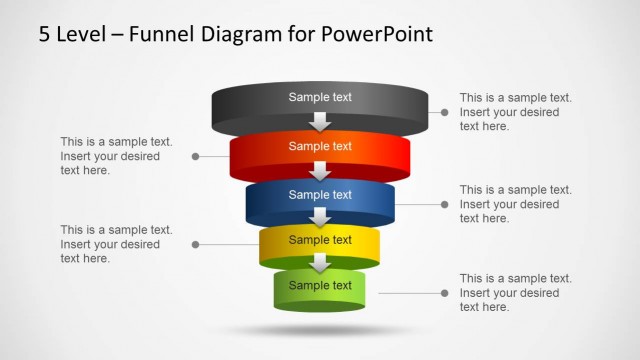
A: The decreasing ring sizes create a clear narrowing metaphor, showing that each stage filters a broader audience into a more qualified group. The consistent blue, red, green, and yellow stages make the sequence easy to follow, while the side callouts separate the visual model from the explanation.


4 Step Marketing Funnel Diagram for PowerPoint
5-slide presentation template with a 4-step marketing funnel and sales funnel callouts
The 4 Step Marketing Funnel Diagram for PowerPoint is a 5-slide diagram template for explaining Reach, Act, Convert, and Engage stages. It includes a stacked funnel, dotted milestone callouts, colored description panels, and bracketed arrow callouts for stage emphasis. It is built for marketing, sales, and campaign planning presentations in PowerPoint and Google Slides.
- Category
- Diagrams
- Rating


 Loading...
- Aspect ratio
- 16:9, 4:3
- Item ID
- 6259-01
- Colors
 Microsoft PowerPoint
 Microsoft Copilot
 Claude for PowerPoint
Other formats supported
Subscribe today and get immediate
access to download our PowerPoint templates.