
A pitch deck explains how a startup turns an idea into a viable business. After presenting the problem, the solution, and the product, investors need to understand how that product will actually reach customers. The Go-to-Market slide addresses that question. It outlines the strategy for entering the market, acquiring the first users, and converting interest into revenue.
This slide connects the product to real distribution channels and customer behavior. It shows that the team has considered where demand exists and how adoption will begin. A clear go to market slide in pitch deck helps investors evaluate whether the company’s growth assumptions are realistic. In this article, we examine how to build and present this slide so the market entry strategy becomes clear and credible.
Why the Go-to-Market Slide Matters in an Investor Pitch
An investor pitch deck tells the story of how a company turns an idea into a functioning business. Early slides often establish the problem, the proposed solution, and the product itself. At some point, the conversation must move from concept to execution. Investors want to understand how the product will actually reach customers and how the company plans to generate traction. That transition happens in the Go-to-Market slide.
The go to market slide in a pitch deck outlines the path from the product to its first meaningful revenue. It describes how a startup intends to reach its initial users, convert them into customers, and scale distribution channels over time. While the product slide demonstrates capability, the go to market slide demonstrates commercial thinking. Investors use it to evaluate whether the founding team understands its market well enough to execute.
Many founders underestimate this slide. They often treat it as a short list of marketing tactics or a vague reference to social media campaigns and partnerships. In practice, the Go-to-Market strategy carries a heavier burden. It must show that the team has thought carefully about customer acquisition, sales mechanics, and early traction strategies. When delivered effectively, it reassures the audience that the company is not only capable of building a product but also of placing it in front of the right people.
The Logic Behind the Go-to-Market Strategy in Pitch Deck
Before describing marketing activities or sales tactics, a Go-to-Market strategy begins with a simple question: who will adopt the product first, and why?
Every market contains many potential customers, but not all of them are equally likely to try a new product. Startups typically begin with a narrow group of early adopters who experience the problem more strongly than the broader market. These users are often actively searching for alternatives or are frustrated with existing solutions.
The go to market slide in a pitch deck should demonstrate the team’s understanding of this dynamic. Instead of presenting a vague plan to reach a large market, the slide focuses on the specific segment most likely to adopt the product in its early stages.
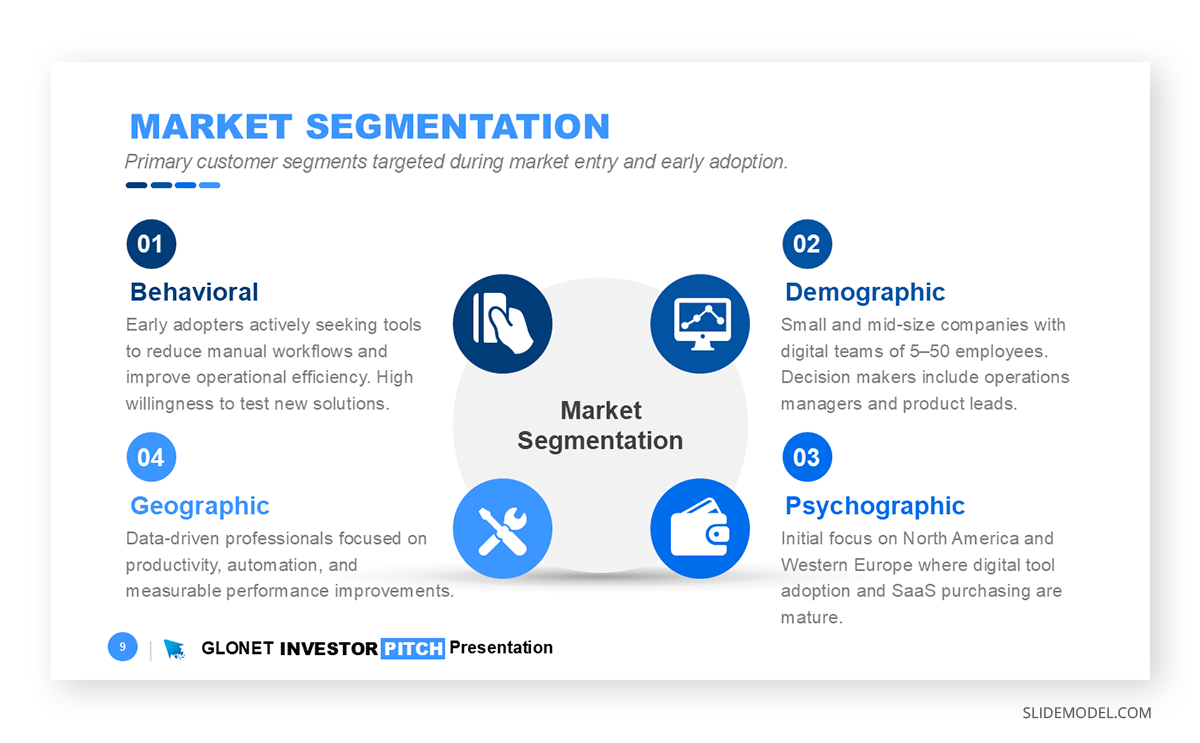
From there, the strategy connects three essential elements. First is the target customer segment. Second is the product’s value proposition for that segment. Third is the method used to reach those customers.
These elements form the foundation of the market entry plan. The slide should make it clear that the company knows who it is targeting, why those customers would care about the product, and how the company intends to place the product in front of them.
Structuring the Go-to-Market Slide
The go to market strategy slide should communicate its message quickly. Investors often review dozens of pitch decks, and they expect to understand the core strategy within seconds of seeing the slide.
For that reason, the information must be structured clearly. Rather than listing unrelated marketing tactics, the slide should show how the company moves from customer discovery to revenue generation.
Most effective versions of this slide organize the information around three components:
- The initial customer segment
- The acquisition channels used to reach that segment
- The conversion mechanism that turns interest into revenue
This structure helps the audience follow the logic of the strategy. Instead of memorizing individual tactics, investors can see how each step contributes to customer acquisition.
The slide itself should remain concise. Detailed marketing plans belong in operational documents, not in a pitch deck. The purpose of the go to market slide is to demonstrate strategic thinking rather than operational detail.
Identifying the First Customer Segment
A common mistake in startup pitches is presenting the entire market as the target audience. While a large market opportunity may exist, successful companies rarely begin by serving everyone at once.
The go to market slide in pitch deck should identify the customer group most likely to adopt the product early. These early adopters often share specific characteristics. They may work in a particular industry, belong to a defined professional role, or experience the problem more intensely than others.
For example, a productivity tool designed for project management might initially focus on small design agencies rather than the entire professional services sector. A cybersecurity product might begin by targeting mid-sized technology companies that lack dedicated security teams.
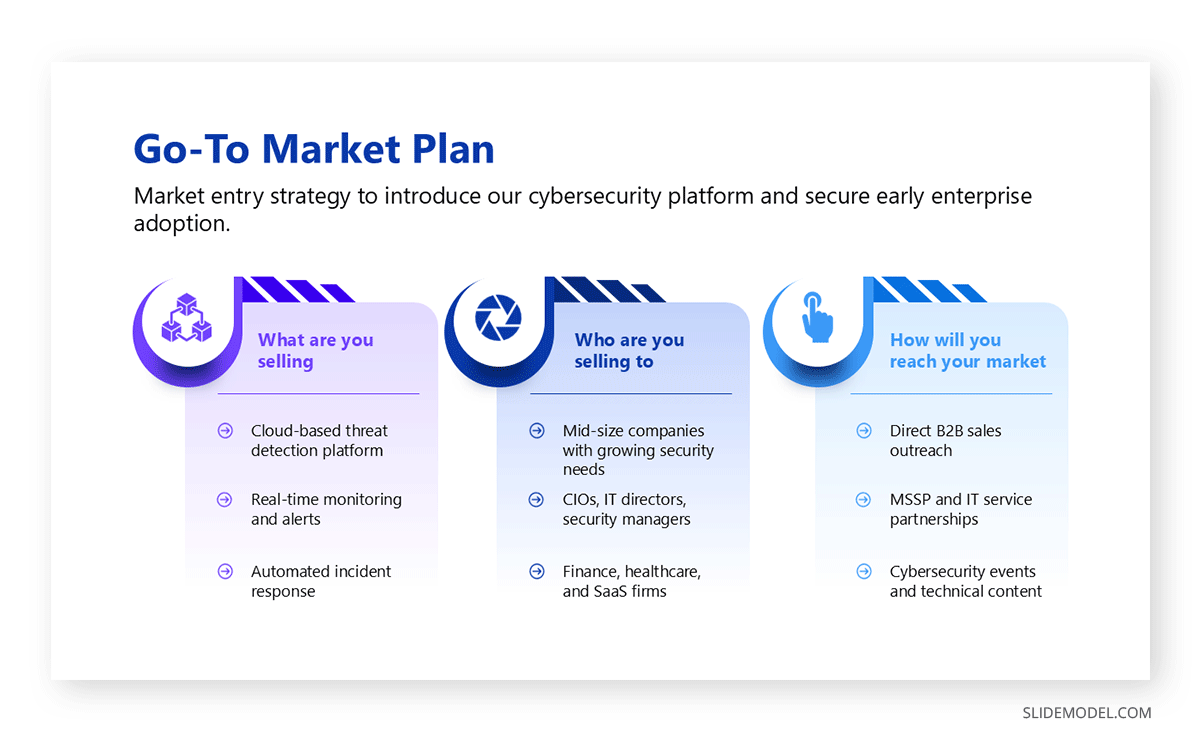
By defining a clear starting point, the company shows that it understands how adoption typically begins. Early traction rarely comes from broad marketing campaigns. It usually emerges within smaller communities where users share similar needs and communicate with each other.
Choosing the Primary Acquisition Channels
Once the target segment is defined, the next question becomes how those potential customers will discover the product.
Different products rely on different distribution channels. Some startups depend on direct sales outreach, particularly when selling business software to organizations. Others rely on digital acquisition channels such as search engines, professional networks, or industry communities.
The go to market slide should identify the channels most relevant to the chosen audience. The goal is not to list every possible marketing tactic but to highlight the channels that realistically connect the product with its early users.
For instance, a developer tool may rely heavily on technical communities, documentation platforms, and open-source repositories. A financial analytics platform might depend on direct outreach to corporate finance teams and participation in industry conferences. A consumer application could grow through app store visibility and referral programs.
Explaining the Conversion Path
Customer acquisition does not end when someone discovers the product. The company must also convert that interest into active use and, eventually, into revenue.
The go to market slide in pitch deck should briefly outline how this transition occurs. Once potential users encounter the product, what steps lead them toward becoming customers?
In some cases, the process is simple. Users discover the product through a marketing channel, visit the website, and begin using it through a free trial or freemium model. If the product solves their problem effectively, they convert to a paid subscription.
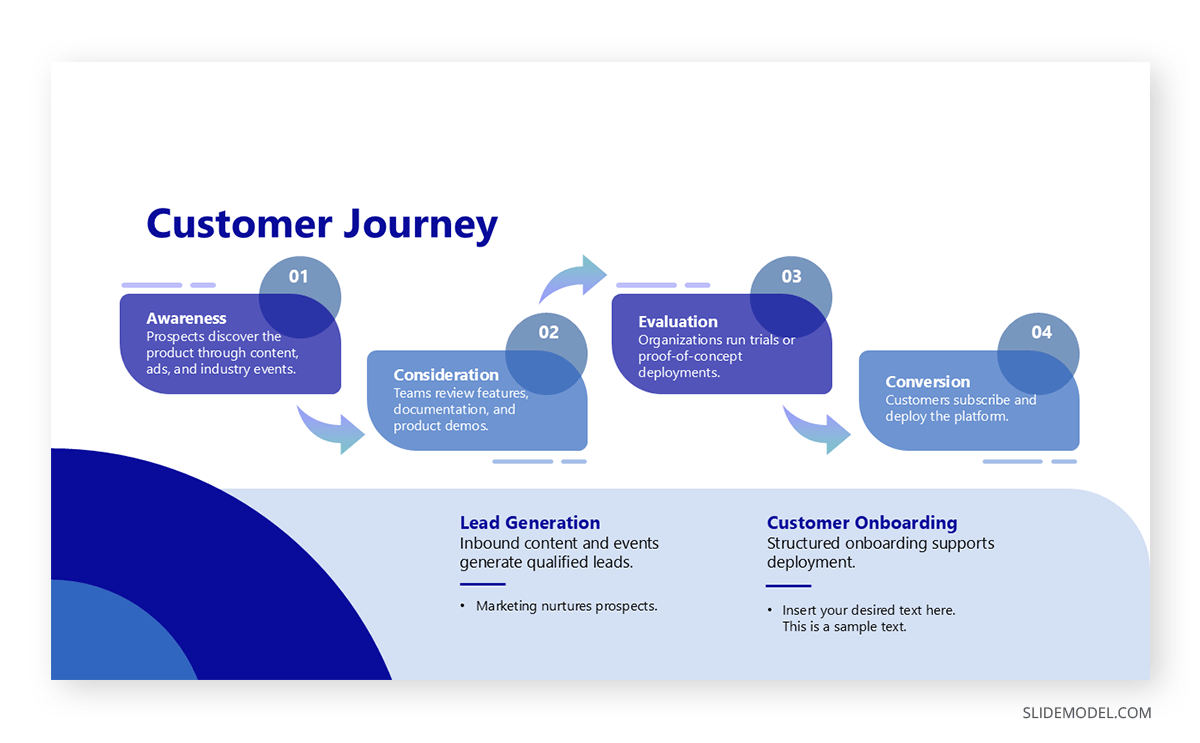
Other products require a more structured sales process. Business software sold to larger organizations may involve product demonstrations, internal evaluations, and negotiations before a purchase decision is made.
The slide does not need to present a full sales funnel. Instead, it should demonstrate that the team understands how discovery leads to adoption and how adoption leads to revenue.
Connecting the Strategy to Growth
While the go to market slide focuses on early adoption, investors are also interested in how the strategy can evolve as the company grows.
A startup may begin with a narrow segment of early adopters, but the long-term goal is usually broader market penetration. The startup go to market slide can briefly explain how early traction creates opportunities to expand.
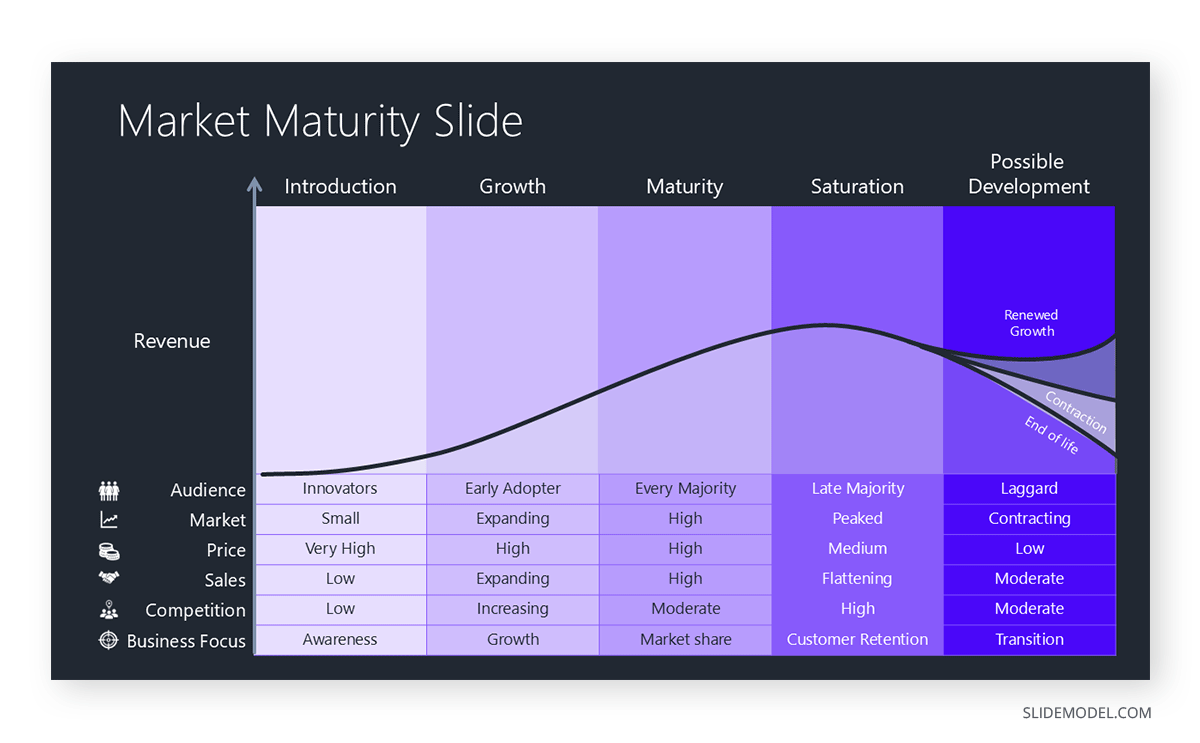
For example, a company that begins by serving small businesses may eventually adapt its product for larger organizations. A tool initially designed for a specific industry may later expand into adjacent sectors that face similar challenges.
This progression shows that the founders are thinking beyond the initial launch phase. It demonstrates that early adoption is not the final objective but the starting point of a larger growth strategy.
Partnerships and Distribution Leverage
Some startups rely heavily on partnerships to accelerate distribution. Instead of reaching customers independently, the company integrates with platforms or organizations that already serve the target audience.
When partnerships play a significant role in the strategy, the go to market slide in pitch deck should clearly highlight them. Investors will want to understand how these relationships help the startup reach customers more efficiently.
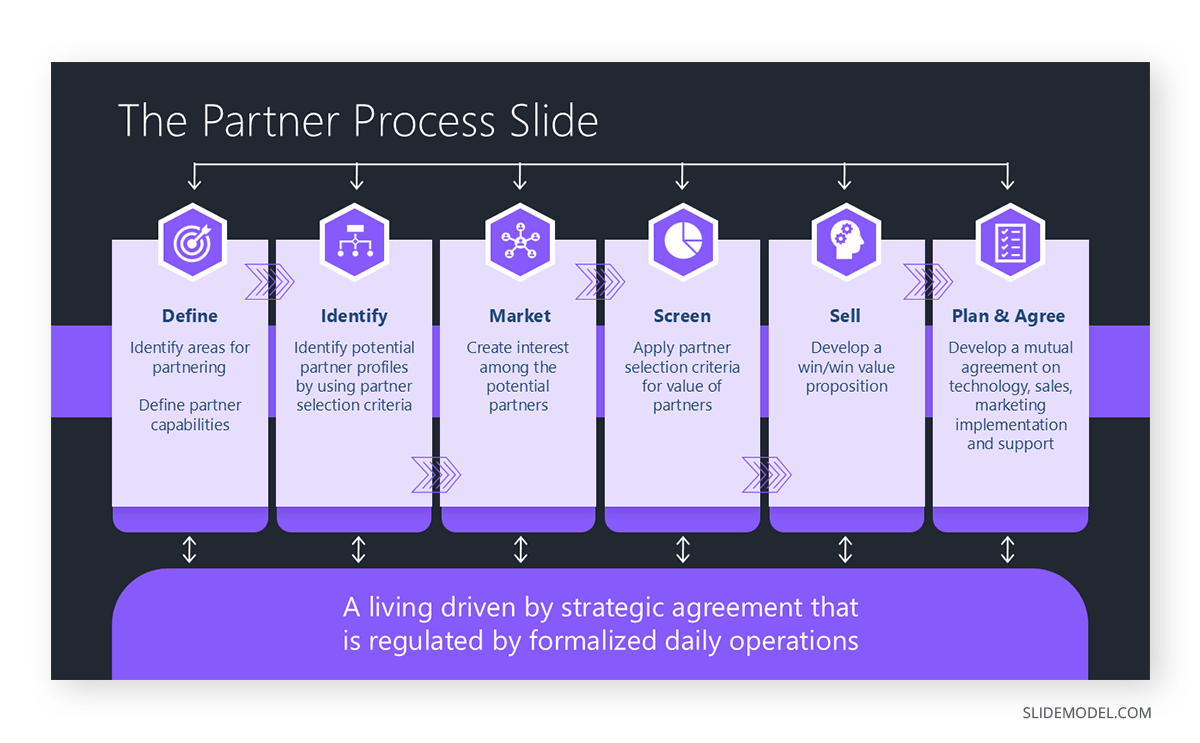
For example, a financial technology product might integrate with accounting software used by small businesses. A logistics platform could partner with e-commerce systems to reach online retailers. A developer tool might gain visibility through integration with widely used programming environments.
These partnerships can shorten the path between product launch and customer acquisition. By entering an existing ecosystem, the company gains access to users who already trust the platform, providing the distribution channel.
Presenting the Go-to-Market Slide During the Pitch
When presenting the slide, founders should guide the audience through the strategy step by step.
The explanation usually begins with the initial customer segment. Once investors understand who the product targets, the presenter can explain how those users will discover the product through specific acquisition channels.
After describing the channels, the presenter briefly outlines the conversion process and sales model. This completes the story of how the company moves from product launch to paying customers.
A clear narrative helps investors connect the strategy with the broader story of the pitch deck. The Go-to-Market strategy slide marks the point at which the product moves from concept to commercial execution.
FAQs
When should the Go-to-Market slide appear in the pitch deck?
The Go-to-Market slide typically appears after the product or solution slide. At that point in the presentation, investors already understand the problem and the product designed to solve it. The natural next step is explaining how the company plans to introduce that product to the market. Placing the slide too early can confuse the audience because the context for the strategy has not yet been established.
How detailed should the Go-to-Market slide be in a pitch deck?
The Go-to-Market slide should communicate the strategy clearly without becoming an operational plan. Investors are not looking for a full marketing roadmap or campaign schedule. Instead, they want to understand the logic behind how the company will reach customers and generate its first revenue. The slide should present the essential elements of the strategy in a way that can be explained in about one minute during the pitch. Supporting details can be discussed verbally or addressed during follow-up questions.
Should the Go-to-Market slide include financial projections?
Financial projections usually belong in the revenue or financials section of the pitch deck. However, the Go-to-Market pitch deck can indirectly support those projections by explaining how customer acquisition will occur. If the strategy relies on scalable channels or efficient distribution methods, that information helps investors understand how revenue growth may become possible. The slide itself should remain focused on strategy rather than numerical forecasts.
Is it necessary to include customer acquisition cost on the Go-to-Market slide?
Customer acquisition cost is an important metric, but it does not always appear directly on fundraising go to market slide. In early-stage startups, this metric may still be uncertain. Instead, founders often discuss acquisition costs verbally when investors ask about the sustainability of the growth strategy. If reliable data already exists, mentioning it briefly can strengthen the presentation, but it should not clutter the slide.
How does the Go-to-Market slide differ from the business model slide?
The business model slide explains how the company generates revenue and how customers pay for the product. The slide go to market focuses on how those customers are reached. In other words, the business model answers how money flows into the company, while the go to market slide explains how the company finds and converts customers. Both slides are closely related but serve different purposes in the pitch deck.
How does the Go-to-Market strategy differ for B2B and B2C startups?
The core logic remains the same, but the execution often differs. Business-to-business startups frequently rely on direct sales processes, industry relationships, and longer decision cycles. Business-to-consumer products often depend more heavily on digital discovery channels, brand recognition, and rapid onboarding experiences. Go to market slides should reflect these differences by aligning acquisition channels with the intended audience’s behavior.
What signals indicate that a Go-to-Market strategy is credible to investors?
Investors often look for several signs that a strategy is realistic. A clearly defined customer segment suggests that the founders understand who will adopt the product first. Logical acquisition channels indicate the ways that the audience discovers new tools or services. Evidence of early interest or validation adds further credibility. When these elements align, the strategy appears grounded in real market behavior rather than speculation.
Final Words
The Go-to-Market slide plays a crucial role in connecting a startup’s product with its path to real customers. While earlier slides explain the problem and introduce the solution, this part of the pitch demonstrates how the company plans to operate in the market. Investors use it to evaluate whether the founders understand how adoption actually happens and whether the proposed strategy reflects realistic customer behavior.
A well-prepared go to market slide does not attempt to cover every marketing activity. Instead, it clarifies who the initial customers are, how those customers will discover the product, and how early interest will convert into revenue. When this explanation is coherent and grounded in a specific market context, the slide strengthens the credibility of the entire pitch.