When you think of a PowerPoint presentation, you probably picture slides with bullet points, graphs, or stock photos. But imagine a presentation where every slide contains just one word, displayed in large, bold text. Surprisingly, this radical approach has proven to be one of the most effective ways to capture an audience’s attention.
This is the Takahashi Method, created by Japanese programmer Masayoshi Takahashi in the early 2000s. First introduced at developer conferences in Japan, his big-text-only presentation style challenged traditional slide design and inspired speakers worldwide to rethink how they communicate ideas.
In this article, we’ll explain the Takahashi Method, explore its advantages and limitations, and share expert insights on when to use it.
What is the Takahashi Method?
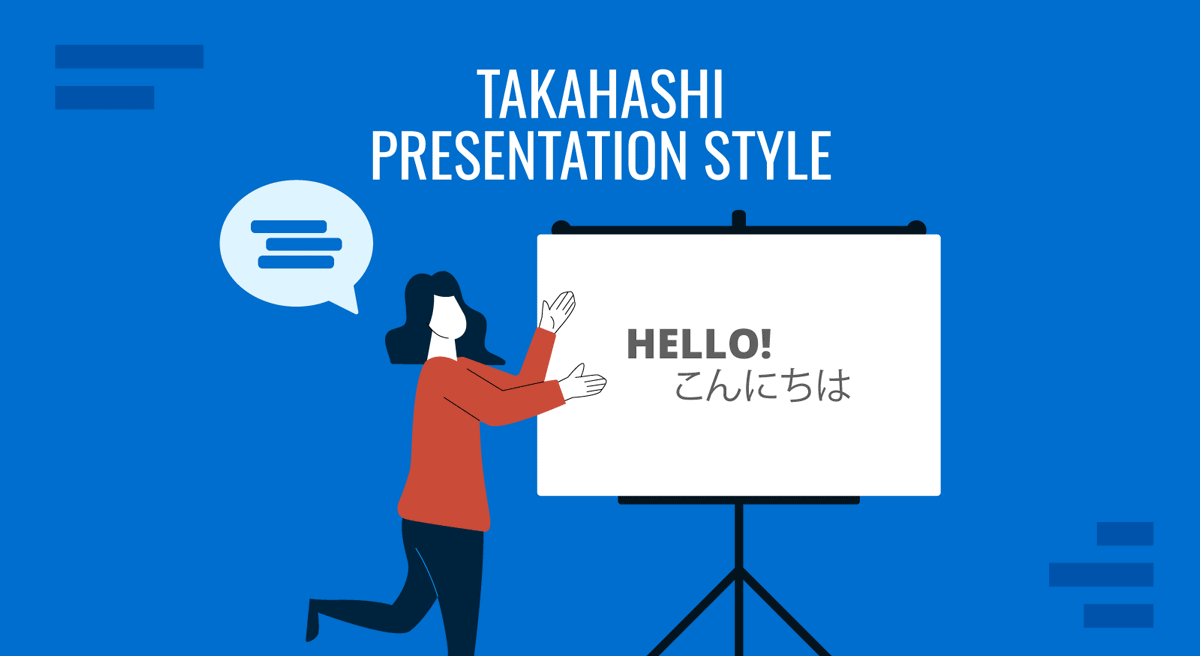
The Takahashi Method is more than a Japanese PowerPoint method; it is a minimalist presentation style where each slide features:
- A single word or short phrase
- Written in large, bold text
- On a plain, uncluttered background
The method was born out of necessity. Masayoshi Takahashi wanted to present technical topics but lacked design resources. Instead, he used simple text slides as prompts for his speech. His audience responded positively, finding the delivery engaging and memorable.
His method emerged as a reaction against slide decks overloaded with bullet points, diagrams, and supporting data that diluted the message. This stripped-down style has since become popular among presenters who value clarity, storytelling, and audience connection over visual decoration.
Instead of using slides as documents, the Takahashi Method treats them as signals. Each slide conveys a single idea, often expressed in a short phrase or even a single word, large enough to dominate the screen and the audience’s attention.
Why It Works: Communication Science Behind the Method
The success of the Takahashi Method is not accidental; it aligns with how people process information.
- Cognitive Load Theory
The human brain can only absorb so much at once. By removing unnecessary visuals, the Takahashi Method reduces cognitive load, making it easier to focus on the message. - Dual Coding Principle
According to research in educational psychology, people learn better when information is processed through both verbal explanation (the speaker) and visual cues (the keyword on the slide). - Engagement Through Curiosity
A single keyword sparks curiosity. The audience is compelled to listen to understand the meaning behind the word. - Retention Through Repetition
Since slides advance quickly, the rhythm reinforces key ideas and improves recall.
When to Use the Takahashi Method
Like any presentation style, the Takahashi Method shines in some contexts more than others.
Best suited for:
- Live talks (conferences, TEDx events, motivational speeches)
- Storytelling presentations, where emotion and clarity matter most
- Education, where complex topics are broken into digestible steps
- Startup pitches, where simple narratives can be more persuasive than heavy data
Less suited for:
- Data-heavy reports where charts and visuals are necessary
- Investor decks requiring detailed numbers
- Handouts that need to be self-explanatory without a speaker
The Takahashi Method relies heavily on sequencing. Since each slide contains minimal information, meaning emerges from the order in which ideas are presented rather than from their internal composition. This makes narrative structure non-negotiable in minimalist text-only slides.
A coherent Takahashi-style presentation typically follows a logical progression similar to written argumentation. It begins with framing: defining the domain, problem, or premise. It then moves through development: introducing causes, mechanisms, or contrasts. Finally, it concludes with implications or actions. Each slide acts as a step in this reasoning chain.
Limitations and Criticism
While effective, the Takahashi Method isn’t perfect.
- Speaker-dependent: The slides won’t carry the presentation; success relies on the presenter’s delivery.
- Not ideal for asynchronous sharing: Without the speaker, the deck lacks context.
- It can feel repetitive if not executed with good pacing and vocal variation.
In other words, it’s powerful when you are the main source of value, but not for “leave-behind” documents. However, the method immediately reveals a weak structure. If ideas are poorly ordered, the presentation feels disjointed because there are no visual crutches to compensate. This is why the Takahashi Method is unforgiving: it rewards clear thinking and punishes improvisation without preparation.
How to Adapt the Takahashi Method Today
Modern presenters don’t need to follow the method rigidly. Instead, they can adapt its principles while leveraging today’s tools.
Use Large, Readable Typography
Fonts like Helvetica, Arial Black, or Montserrat Bold ensure maximum legibility.
Integrate Occasional Visuals
A hybrid approach, mostly keyword slides, with occasional charts, balances minimalism with clarity.
Control the Rhythm
Instead of racing through slides, align transitions with your storytelling beats.
Leverage Professional Templates
SlideModel templates can be adapted for Takahashi-style decks. For example, timeline templates can be converted into single-word sequences (Launch > Growth > Challenge > Vision).
Example: A Startup Pitch Using Takahashi
Instead of showing a dense slide deck, a founder could build a simple keyword-based sequence:
- Problem
- Solution
- Market
- Traction
- Vision
The keywords keep the narrative structure clear while ensuring the audience’s focus stays on the founder’s story.
Expert Tips for Applying the Takahashi Method
Drawing on presentation design best practices:
- Keep contrast high: White text on black, or black text on white, works best.
- Limit slides to one idea: Avoid phrases longer than 2–3 words.
- Practice delivery: Since the slides don’t carry the details, rehearse transitions and timing carefully.
- Think of slides as cues: Each word is a mental trigger for the story you’ll tell.
FAQs
Is the Takahashi Method suitable for business presentations?
Yes, particularly for strategy, vision, and decision-oriented discussions. It is less suited for detailed reporting unless supplemented.
How many slides does a Takahashi presentation typically have?
Often, more than traditional decks, since each slide carries a single idea. Slide count matters less than narrative coherence.
Can images be used with the Takahashi Method?
Yes, but sparingly. Images should reinforce the idea, not compete with it.
Does the method work for virtual presentations?
It can, but pacing and verbal framing become even more important to maintain engagement.
Is the method anti-data?
No. It relocates data from slides to speech or supporting materials, emphasizing interpretation over display.
Conclusion
The Takahashi Method proves that impactful presentations don’t require flashy visuals. Sometimes, all it takes is a single word, delivered with confidence and supported by strong storytelling.
For presenters, it’s a reminder that slides are not the presentation; you are. By adopting Takahashi-inspired techniques, you can simplify your design, engage your audience more deeply, and make your message unforgettable.
If you’re ready to try it yourself, explore SlideModel’s minimalist presentation templates. With bold typography, clean layouts, and full customization, you can create Takahashi-style decks that enhance, not replace, your voice as a presenter.